How Schaduwplan works
Is a sunlight study admissible in an objection or in court?
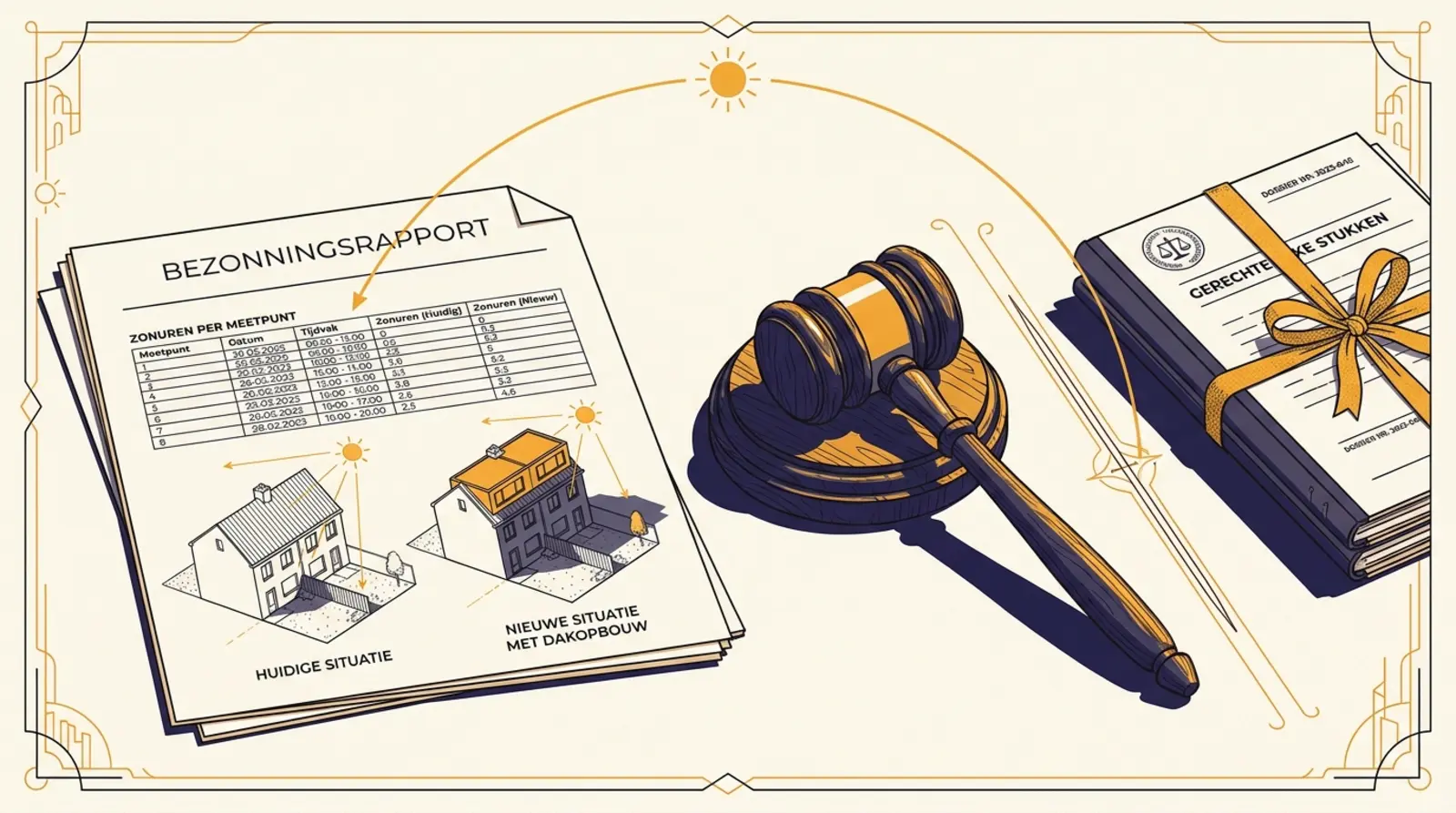
A Schaduwplan sunlight report is indicative and admissible in court. For formal views (zienswijzen), objection procedures and civil neighbour-law cases it is sufficient in almost all situations, because it uses the same 3DBAG, BAG and AHN4 sources that professional firms and the Administrative Jurisdiction Division of the Council of State rely on. For formal administrative appeal proceedings we recommend verification by a sworn expert.
Is a Schaduwplan sunlight report admissible?
Schaduwplan is a web app that turns any Dutch address into a sunlight report within five minutes, based on 3DBAG, BAG and AHN4. The report is indicative and admissible: for formal views (zienswijzen), objection procedures and civil neighbour-law cases it is sufficient as standalone substantiation in almost all cases. For formal administrative appeal proceedings we recommend verification by a sworn expert when the opposing party contests the report on its merits.
That sounds cautious, and it is deliberately so. No sunlight report binds a municipality or a judge. Even the reports of the largest engineering firms (DGMR, Peutz, Nieman) are not formal decisions; they are evidence that the decision-maker weighs in the balancing of interests. So the relevant question is not “is this report legally binding” but “is this report accepted in practice as substantive support”. To that question the answer is: yes, provided the report meets the standard requirements that the Administrative Jurisdiction Division of the Council of State (Raad van State) has laid down in its case law.
What does “admissible” mean for a sunlight report?
In practice people mean three different things by “admissible”, and it pays to pull them apart. Legal weighting is a scale, not a binary status. The higher you sit on the scale, the greater the impact on the final decision, but also the greater the cost and the turnaround time.
| Level | What it means | Example | Typical cost |
|---|---|---|---|
| Emotional argument | Subjective complaint without quantification. Barely counts in the balancing of interests. | “Soon we won’t get any sun on the terrace any more.” | € 0 |
| Indicative evidence | Quantifiable report based on authentic sources, reproducible by a third party. | Schaduwplan sunlight report with test dates, measurement points, a sun-hour table. | € 49 |
| Authoritative report | Report from a firm with a sworn expert who can give a statement under oath. | DGMR report with an expert witness at the hearing. | € 500 to € 5,000 |
| Expert opinion | Independent expert appointed by the court (art. 8:47 Awb). | The Council of State calls in a counter-expert when two reports contradict each other. | € 2,000 to € 10,000 |
Schaduwplan delivers the second category: indicative evidence. For most neighbour-versus-building-plan cases that level is sufficient, because the objection phase has no hearing with witnesses. Only on appeal before the court or the Administrative Jurisdiction Division does the balance shift towards level three. According to the sunlight study guideline of the municipality of Krimpen aan den IJssel (the most detailed official municipal template in the Netherlands), a sunlight report must contain six fixed sections, and Schaduwplan delivers these by default.
Four rulings that show where the bar sits
The case law around sunlight is thin, but the rulings that do exist draw a clear line. Four cases currently determine practice. They show when a report is accepted, when it is contested, and what role data-backed substantiation plays.
Ootmarsum, 3 July 2013 (ECLI:NL:RVS:2013:191). The Council of State annulled a zoning plan because the municipality had not carried out a sunlight study. Under article 3:2 Awb the municipal executive has a duty of care; without a study no proper balancing of interests can take place. The lesson applies in reverse: if you, as the objector, do submit a report, you turn the research gap to your advantage. The municipality must now respond on the merits, rather than deflecting on procedural grounds.
Almelo, 18 January 2023 (ECLI:NL:RVS:2023:172). The Administrative Jurisdiction Division ruled that TNO standards are “not unusual” to apply. The choice between the light and the strict variant remains with the municipality. Even when one or two dwellings do not comply, the plan can stand provided the new situation is not materially worse than the old planning regime. For the objector who brings data, this is favourable: the framework of the standard is not in dispute, only the concrete outcome on your own parcel.
Voorburg, 5 April 2023 (ECLI:NL:RVS:2023:1329). A municipal sunlight study had accidentally left a neighbour’s recently built roof addition out of the 3D model. The Division called a height discrepancy of 3 cm negligible, but did order additional investigation into the missing structure. The lesson: model accuracy to the centimetre is not required, but completeness of all relevant buildings is. Because Schaduwplan automatically loads every building within 150 metres from 3DBAG, this specific risk is eliminated with a single click.
District Court of The Hague, 17 January 2024 (ECLI:NL:RBDHA:2024:1206). The civil-law counter-example: a roof addition had to be demolished despite a valid environmental permit, because the sunlight loss on the neighbours’ property amounted to 75 to 80%. On the basis of article 5:37 Civil Code in conjunction with 6:162 Civil Code, the court ruled that an environmental permit does not protect against civil liability for unlawful nuisance. The same sunlight report that the objector submitted to the municipality remained the core substantiation in the civil proceedings.
For which type of procedure is the report sufficient?
The most frequently asked question: is this enough for my case? The answer depends on the procedure and the resistance of the opposing party. The table below is our honest breakdown, based on real-world cases we have seen in the case law and on what common firms such as Zonnestudie, Handel Bouwadvies and Bezonningsingenieur consider sufficient by default.
| Procedure | Schaduwplan report sufficient? | Supplement recommended? |
|---|---|---|
| Formal view on a draft decision | Yes | No |
| Objection against a granted permit | Yes | No |
| Appeal to the administrative court (district court) | Usually yes | If contested by the municipality or applicant: expert verification |
| Higher appeal to the Council of State | Sometimes | Expert witness at the hearing recommended |
| Civil summary proceedings (art. 5:37 Civil Code) | Yes | Photo dossier and possibly a valuation report |
| Civil proceedings on the merits | Usually yes | Expert witness if contested |
| Municipal officer review process (internal assessment) | Yes | No |
The honest minimum: when you file an objection and the municipality itself does not commission an independent counter-investigation, our report is sufficient. As soon as the municipality or the applicant engages its own firm and the two reports contradict each other, the case shifts to level three or four of the admissibility scale. The administrative court can then, on the basis of article 8:47 Awb, appoint an independent expert.
When you need a firm or an expert witness
Staying honest about the limits. Five situations call for a sworn expert or an independent firm alongside or instead of our report:
- Higher appeal before the Administrative Jurisdiction Division in which the opposing party has brought in its own counter-expertise. Here the hearing and the expert witness weigh more heavily than the report itself.
- Zoning plan procedures where “maximum planning possibilities” must be used as the reference and the building rules have to be interpreted legally. The comparison itself is in the paid report. Schaduwplan consults the omgevingsplan as soon as you enter the address: where the municipality publishes a building plot with its dimensions as data, the permitted envelope arrives prefilled in the viewer and you confirm or correct every value. Where it does not — with older plans the building plot exists only on the plan map — you take the dimensions over yourself, which says nothing about what may be built there. The report then puts the existing, the requested and the permitted situation side by side per measurement point, with the provenance of every value. What Schaduwplan does not do is derive that envelope from the planning rules; that interpretation stays with you and your architect. Permit-free building, in-plan deviation powers and custom rules are not included in the envelope, so it does not show the complete permitted building volume, and the comparison is context alongside the standards test — not a pass/fail verdict of its own.
- Large area developments with many dozens of dwellings, complex aesthetic-quality requirements or specific high-rise requirements. These call for a more extensive report with an urban-planning rationale.
- Damages claims where a valuation and an arithmetic calculation of the loss in value are required. Schaduwplan provides the sunlight data, but not the valuation work.
- Listed monuments and protected townscapes and village sceneswhere cultural-historical considerations play a part. The aesthetic-quality committee may require a heritage specialist to be involved in the study.
In all these cases our report remains useful as a starting point. A firm or expert then need not start from scratch with the 3D modelling and the sunlight calculation; they verify our inputs and build on our quantification. This substantially reduces the cost of the follow-up step, sometimes by 50% or more, because the firm no longer has to do a full intake and rebuild.
Sources (15)
We back every article with public sources. Click to see all the original documents, rulings and datasets.
Sources (15)
We back every article with public sources. Click to see all the original documents, rulings and datasets.
Case law
- Council of State 3 July 2013 — Ootmarsum: zoning plan annulled, no sunlight study— ECLI:NL:RVS:2013:191
- Council of State 18 January 2023 — Almelo: TNO standards not unusual— ECLI:NL:RVS:2023:172
- Council of State 5 April 2023 — Voorburg: missing roof addition leads to additional investigation— ECLI:NL:RVS:2023:1329
- District Court of The Hague 17 January 2024 — roof addition demolished at 75 to 80% sunlight loss— ECLI:NL:RBDHA:2024:1206
- District Court of Limburg 10 May 2022 — nuisance claim rejected, no sunlight report— ECLI:NL:RBLIM:2022:3564
Laws and regulations
- General Administrative Law Act, art. 3:2 (duty of care)— wetten.overheid.nl
- General Administrative Law Act, art. 8:47 (expert appointed by the administrative court)— wetten.overheid.nl
- Civil Code Book 5, art. 5:37 (nuisance to neighbours)— wetten.overheid.nl
- Civil Code Book 6, art. 6:162 (unlawful act / tort)— wetten.overheid.nl
Standards and guidelines
- TNO sunlight standard (light and strict variant)— TNO report 2005-BBE-R0036
- The Hague sunlight standard — RIS 180461— City of The Hague
- Sunlight study guideline, Krimpen aan den IJssel— Municipality of Krimpen aan den IJssel
Data sources
- 3DBAG — 3D models of all Dutch buildings— TU Delft and 3DGI
- BAG — Key Register of Addresses and Buildings— Kadaster
- AHN4 — Actueel Hoogtebestand Nederland— Rijkswaterstaat and the water authorities
Frequently asked questions
- Is a Schaduwplan sunlight report legally binding?
- No sunlight report is legally binding, not even those from firms such as DGMR or Peutz. A report is not a formal decision and binds no one directly. What it is: evidence that a municipality or judge weighs in the balancing of interests. In that sense a Schaduwplan report is just as “admissible” as a report from an independent firm, provided the sources and methodology are well documented.
- Will a municipality accept a report generated in five minutes?
- Yes, when the report contains the same structure and source attribution as those of the firms. By default Schaduwplan delivers a PDF with the assumptions, sunlight diagrams per test date, TNO testing per measurement point, a methodology appendix and attribution to 3DBAG, BAG and AHN4. The speed at which a report is produced is legally irrelevant; the content is what matters.
- How does the opposing party rebut a Schaduwplan report?
- An opposing party (applicant or municipality) can contest three things: the data used (for example claiming that a neighbour’s roof addition elsewhere is missing from the 3DBAG model), the standard applied (light TNO versus The Hague versus the municipality’s own) or the methodology (measurement-point height, test dates, time intervals). Because our appendix states each of these assumptions explicitly, they can be disputed or confirmed one by one, just as with a firm’s report.
- Do I need a sworn expert as an expert witness?
- Only in formal administrative appeal proceedings in which the opposing party contests the report on its merits. Article 8:47 Awb gives the court the power to appoint its own expert. For formal views, objection procedures and civil neighbour-law cases the input of an expert is as a rule not needed. Costs for an expert witness are around € 800 to € 2,500 for a hearing.
- What if my municipality uses its own sunlight standard?
- Schaduwplan selects the standard automatically based on the municipality. Alongside the light and strict TNO standard, the tool applies the own variants of The Hague (RIS 180461), Rotterdam (Sunlight Assessment Framework) and Eindhoven where they apply; for municipalities with a referring guideline (such as Krimpen aan den IJssel) we show the relevant context. About 97% of municipalities have no own standard — there the TNO standard applies as a guideline. Entering a fully self-defined standard with your own test dates and thresholds is not possible.
- Can I share the underlying 3D models with a lawyer or expert?
- Yes, indirectly. The PDF report states every input an expert needs to recheck the calculation: the 3DBAG building ID of each building included, the AHN version used, the test dates, the measurement-point height and the measurement-point coordinates in the Dutch national grid (EPSG:28992). A sworn expert or lawyer can use those to reconstruct and check the sun-hour calculation in their own software. We do not currently offer a direct GLB/OBJ or GeoJSON export.
Test it yourself, before you take the step to a firm
Enter a Dutch address, draw the planned construction from the building drawings and download the report. For € 49 and five minutes you get exactly the substantiation needed for formal views and objection procedures. If the case later escalates, this report serves as the starting point for the expert.
Read more
How Schaduwplan works
Verifying a sunlight report: how to check it is genuine
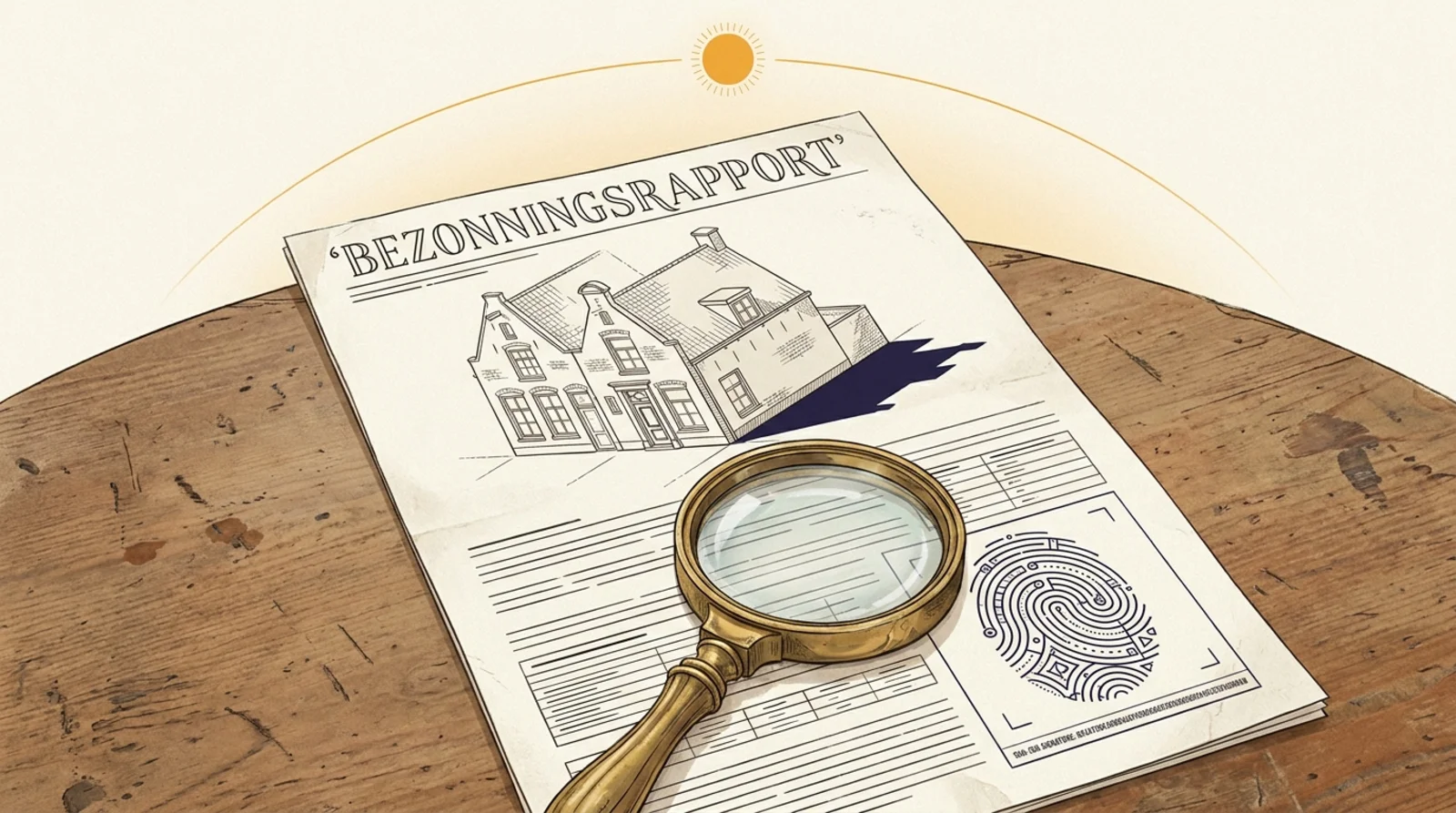
Every Schaduwplan PDF carries a unique SHA-256 hash that we publish at the moment of issue on schaduwplan.nl/verify. A judge, lawyer or neighbour can confirm in under thirty seconds that the file has not been altered since issue, without having to trust us. As far as we know, no other sunlight-study provider in the Netherlands does this.
How Schaduwplan works
Why Schaduwplan has no subscription: € 49, one time
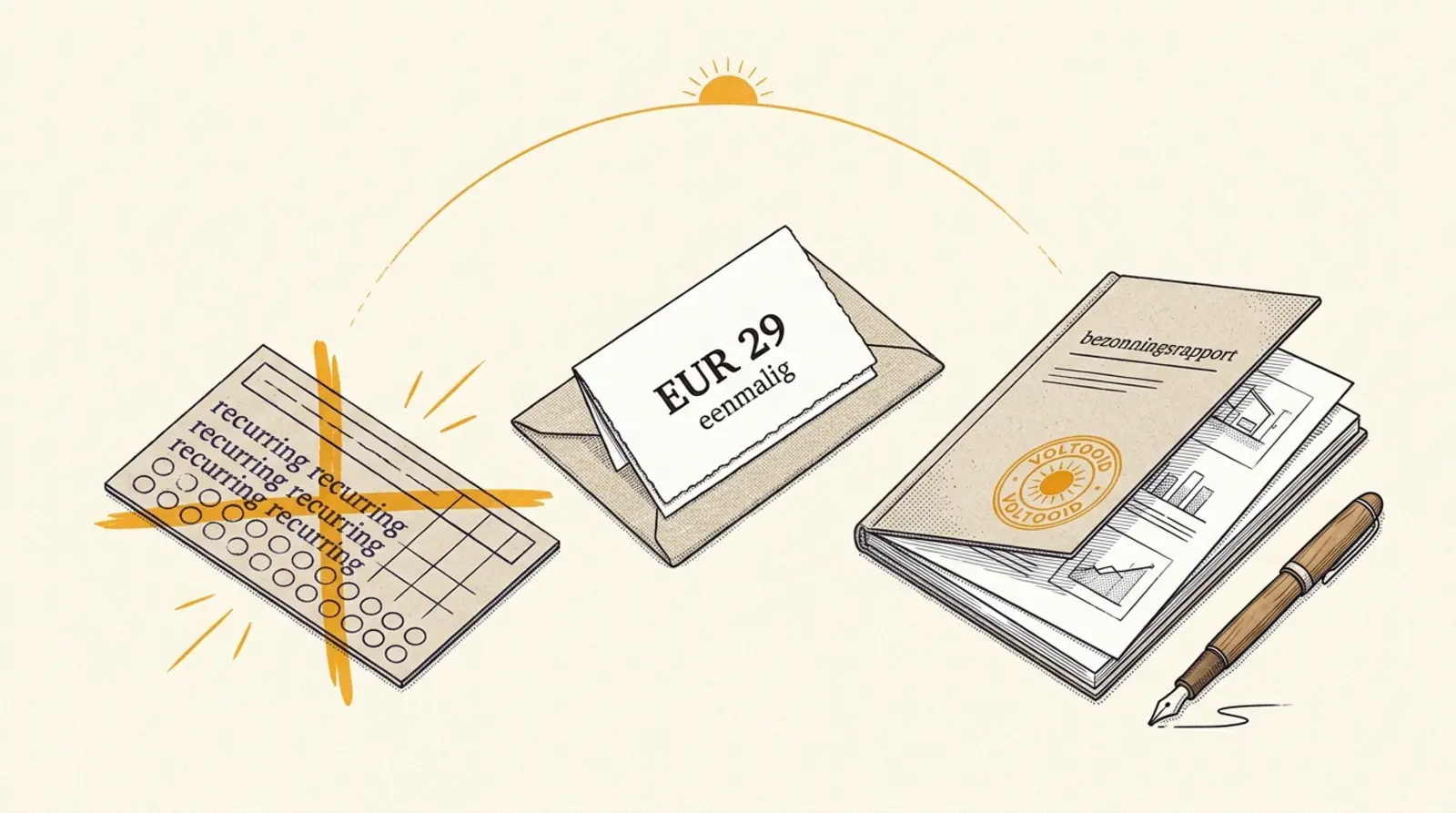
Schaduwplan charges € 49 per report, one time. No subscription, no trial. Most people need one report per permit procedure: once every 5 to 10 years for homeowners. A consumer subscription of € 2.49 per 90 days costs € 50.62 over 5 years, while Schaduwplan stays a single, clear transaction.
How Schaduwplan works
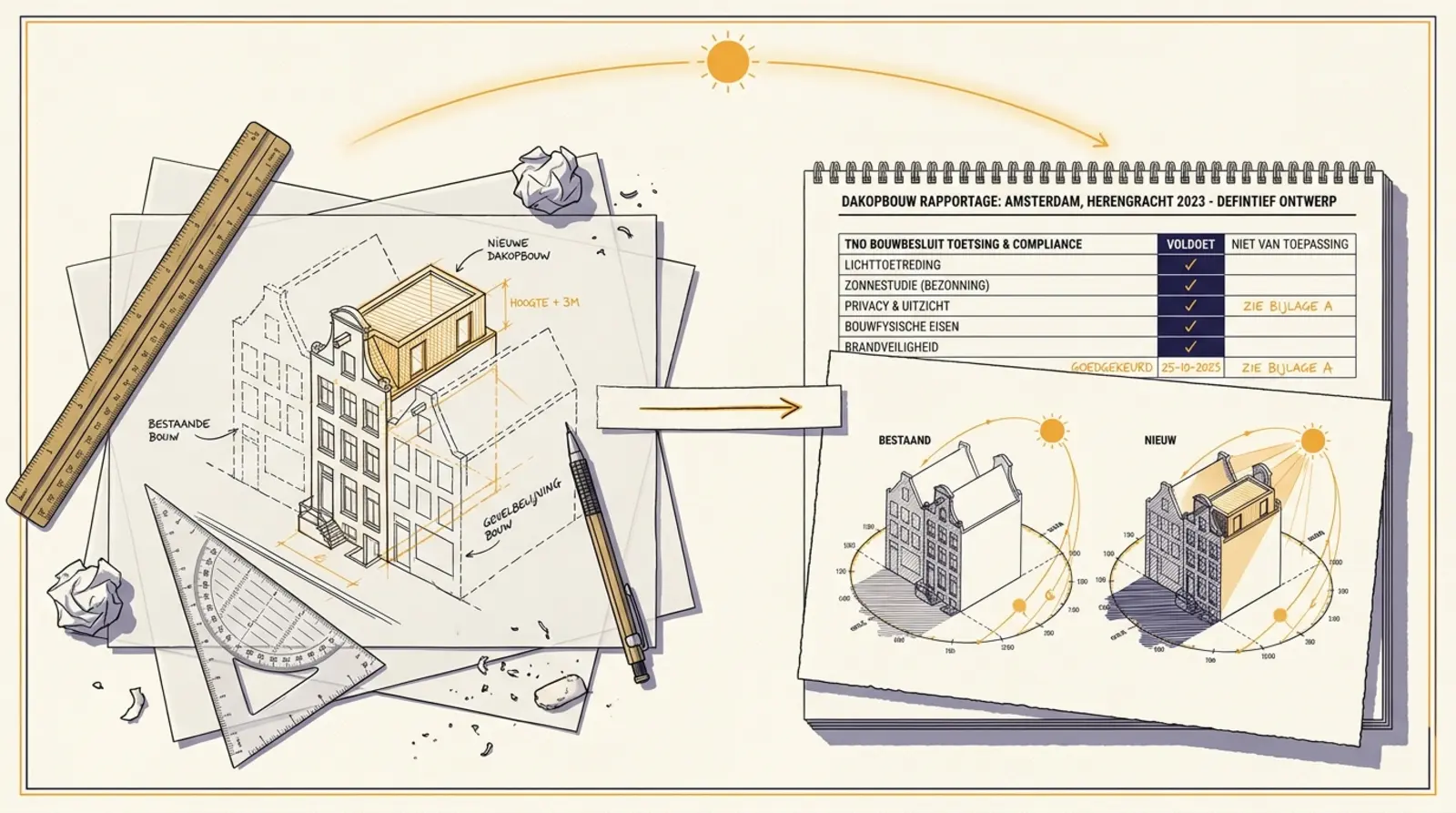
Sunlight study for a permit: SketchUp to auditable PDF
A manual sunlight study in SketchUp or Revit takes 4 to 16 hours of architect time per project. With Schaduwplan you generate an auditable PDF report in 5 minutes from 3DBAG, BAG and AHN4, tested against the light TNO, strict TNO or municipal standards. The time saved per permit application is worth € 300 to € 2,400 in architect fees.