How Schaduwplan works
Sunlight study for a permit: SketchUp to auditable PDF
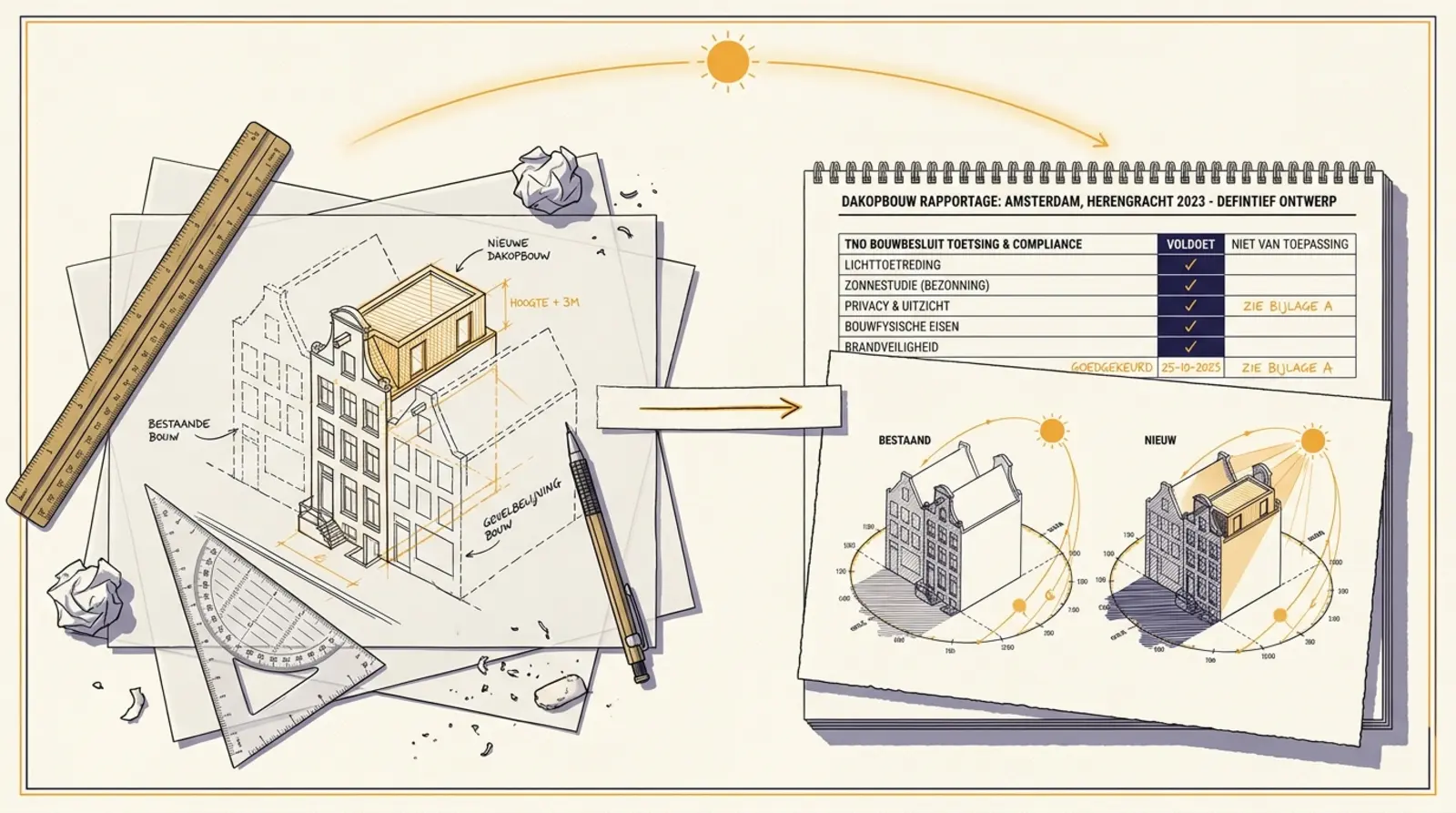
A manual sunlight study in SketchUp or Revit takes 4 to 16 hours of architect time per project. With Schaduwplan you generate an auditable PDF report in 5 minutes from 3DBAG, BAG and AHN4, tested against the light TNO, strict TNO or municipal standards. The time saved per permit application is worth € 300 to € 2,400 in architect fees.
Why sunlight studies are separate work for architects
A sunlight study for the environmental permit is a quantitative document: a table of sun hours per measurement point, a test against the TNO standard or the municipal variant, a methodology appendix and a source list. The case officer assesses it as a stand-alone attachment alongside the building plan. That is something different from what SketchUp Shadows or Revit Solar Study deliver out of the box, namely a visualisation for use in the design. The visualisation is part of your design process; the report is part of the permit.
In almost all cases the municipality asks for a PDF report that reads like a Handel Bouwadvies or DGMR report. That means: a north arrow, a scale bar, side-by-side diagrams for the reference situation and the proposed situation, a sun-hour table to the minute, an explicit standard test and a separate appendix with all assumptions and sources. You have to build that format by hand in a reporting tool such as Word or InDesign, based on screenshots from your CAD tool. That is the structural time gap between “shadow visualisation in my model” and “report for the permit”.
The manual workflow: SketchUp or Revit to an auditable PDF
The steps an architecture firm goes through for a routine permit application for an extension, roof addition or small new build usually look like the table below. The hours are realistic estimates for an experienced building designer using SketchUp Pro or Revit 2024 with the built-in shadow tools.
| Step | What happens | Manual | With Schaduwplan |
|---|---|---|---|
| Build the surrounding model | Model all neighbouring buildings within 150 m with eaves height, ridge height and roof shape | 2 to 8 hours | Automatic from 3DBAG, 5 seconds |
| Set the geo-reference | Position the model on Dutch national grid (EPSG:28992) coordinates for the correct sun position | 30 min | Automatic via BAG geocoding |
| Define measurement points | At 75 cm height on the inside of the window, centre of the living room; a separate point per window | 1 to 2 hours | Click and place, 2 minutes |
| Shadow calculation | Render shadows per hour for each test date (19 February, 21 June, 21 October); first sun position, last sun position, testing minutes of direct sun | 1 to 3 hours of manual work plus rendering | Full 1-hour grid in 30 seconds |
| Compile the report | Screenshots into Word, type up the table, reference sources, add a disclaimer, export the PDF | 1 to 3 hours | PDF generated automatically |
| Total | 4 to 16 hours | 5 to 10 minutes |
According to the BNA guideline for advisory rates, the hourly rate for an experienced building designer sits between € 75 and € 150 excluding VAT. That means the manual workflow per permit application comes to € 300 to € 2,400 in architect fees, for the sunlight study alone. Outsourcing to an independent firm costs € 295 to € 535 with a turnaround of five to ten working days. Each design iteration requires a fresh cycle under both options.
What a permit report must contain at minimum
The municipality of Krimpen aan den IJssel has set out in its guideline the six sections a sunlight report must contain. This structure is used nationwide as the de facto standard, including in the advisory practice of Handel Bouwadvies, Blauwdruk Bouw and Bezonningsingenieur. According to the Administrative Jurisdiction Division of the Council of State (ECLI:NL:RVS:2023:172, Almelo) TNO standards based on such structural work are “not unusual” to apply. The six sections:
- Introduction. Project name, address, client, applicant, scope and scale.
- Assumptions. Chosen standard (light TNO, strict TNO, The Hague, Rotterdam, Eindhoven), test dates, time intervals, coordinate system, reference situation (existing or maximum planning-permitted).
- 3D sunlight diagrams. Side by side per test date and per hour. North arrow, scale bar, legend.
- Quantification. A table of sun duration per measurement point, before and after the planned construction, delta in minutes.
- TNO standard test. Explicit pass, near-miss or fail per measurement point, tied to the applied standard.
- Conclusions and source list. A clear final conclusion, a list of the data sources used (3DBAG, BAG, AHN4), the software used, assumptions, a disclaimer.
The Voorburg ruling (ECLI:NL:RVS:2023:1329) shows where manual workflows go wrong: in that case a recently built roof addition on the neighbour’s house was missing from the municipal 3D model, which led to additional investigation at the applicant’s expense. Because 3DBAG is rebuilt every quarter from the current BAG registrations and AHN data (and BAG itself updates within a few working days), such an omission is structurally ruled out in an automated tool: by definition the model contains all construction registered at that moment.
Unit economics: what a sunlight study costs per project
How much you save per building application depends on the complexity of the job and the number of design iterations you go through with the client. The table below shows what a typical concerned-neighbour case (an extension) and a mid-sized new-build plot cost across three scenarios.
| Scenario | Manual (BNA rate) | Outsourced to a firm | Schaduwplan |
|---|---|---|---|
| Rear-façade extension, one iteration, standard TNO | 4 hours × € 100 = € 400 | € 295 to € 350, 5 working days | € 49, 5 minutes |
| Roof addition in The Hague with the RIS 180461 50% rule | 6 hours × € 125 = € 750 | € 450 to € 535, 7 working days | € 49, The Hague preset selected |
| Small new build with three iterations (eaves-height variants) | 16 hours × € 125 = € 2,000 | 3 × € 450 = € 1,350, 3 weeks turnaround | 3 × € 49 = € 147, 20 minutes total |
The real value is not only in the euro difference; iterating within the same client meeting changes the type of advisory relationship. You discuss three roof-type variants during the first conversation, the client chooses, and you move on. The traditional workflow forces a design proposal per iteration with a week’s wait. That not only slows delivery; it also narrows the design space, because as an architect you become more cautious about experiments that would mean calling the client back.
What Schaduwplan delivers specifically for architects
The core of the product proposition for building designers has four parts. One: automatic construction of the urban fabric from 3DBAG and AHN4, including roof shapes and ridge heights at LoD 2.2 level. Two: you draw your planned extension or addition (extension, roof addition, dormer or free polygon mass) directly on the 3DBAG model, at the correct national-grid coordinates. Three: a municipal standards library with presets for The Hague, Rotterdam, Eindhoven. Four: automatic PDF generation with all required elements, including a methodology appendix and a source list.
Schaduwplan works with one simple rate: € 49 per report, with no subscription or minimum purchase. For architecture firms with many reports or specific needs, we look at a tailored business track — email [email protected] if that applies. For most architecture firms and freelance architects, the one-off rate of € 49 per report is enough.
When you should still hire a firm or expert witness
Honest about the limits: our tool covers the standard permit application and many more complex briefs, but not everything. In the following scenarios an independent firm or a sworn expert remains the sensible choice:
- High-rise above 40 m where wind simulations, nuisance exposure and shadow impact are combined at large scale. Firms such as DGMR, Peutz and Nieman are equipped for that.
- Large area developments where “maximum planning possibilities” must be used as the reference situation and the planning rules have to be interpreted legally. The reference situation itself you model in Schaduwplan as an envelope — building area, eave and ridge height, roof form. Once the address is set, Schaduwplan consults the omgevingsplan: where the municipality publishes the building plot and its dimensions as data, the envelope arrives prefilled and you confirm or correct every value. Where the plan is not published digitally that layer stays away and you take the dimensions from the plan map — which says nothing about what may be built there. The paid report compares it against the building plan, with the provenance of every value. Interpreting the planning rules stays human work, and permit-free building, in-plan deviation powers and custom rules are not included in the envelope.
- Zoning-plan procedures where the plan itself is in dispute and an independent expert witness must give a statement at a hearing or in court.
- Listed monuments and protected townscapes and village scenes where a cultural-historical assessment requires a separate review.
In all other cases a Schaduwplan report is sufficient for the permit. And even in the exceptional cases named above, it serves as a starting point with which the follow-up firm can cut its intake by 50% or more.
Sources (15)
We back every article with public sources. Click to see all the original documents, rulings and datasets.
Sources (15)
We back every article with public sources. Click to see all the original documents, rulings and datasets.
Data sources
- 3DBAG — LoD 2.2 roof shapes and ridge heights of all Dutch buildings— TU Delft and 3DGI
- BAG — Key Register of Addresses and Buildings— Kadaster
- AHN4 — Actueel Hoogtebestand Nederland, 50 cm resolution— Rijkswaterstaat and water authorities
Standards and guidelines
- TNO sunlight standard (light and strict variant)— TNO report 2005-BBE-R0036
- The Hague sunlight standard — RIS 180461— City of The Hague
- Rotterdam sunlight assessment framework— City of Rotterdam
- Sunlight study guideline, Krimpen aan den IJssel— Municipality of Krimpen aan den IJssel
- Sunlight in the environment plan — Environment Act guidance— IPLO (Informatiepunt Leefomgeving)
Case law
- Council of State 5 April 2023 — Voorburg: missing roof addition triggers additional investigation— ECLI:NL:RVS:2023:1329
- Council of State 18 January 2023 — Almelo: TNO standards not unusual— ECLI:NL:RVS:2023:172
- Council of State 3 July 2013 — Ootmarsum: zoning plan annulled, no sunlight study— ECLI:NL:RVS:2013:191
Software and CAD
- SketchUp Shadows — built-in shadow simulation based on lat-long— Trimble
- Revit Solar Study — Autodesk documentation— Autodesk
- Ladybug Tools — open-source environmental analysis for Rhino and Grasshopper— Ladybug Tools LLC
- BNA advisory rates — hourly rate guideline for architects— Koninklijke Maatschappij tot Bevordering der Bouwkunst BNA
Frequently asked questions
- Why does SketchUp Shadows not produce a sunlight report for the municipality?
- SketchUp Shadows is a visualisation tool: you get real-time shadows in the model view, but no quantifiable sun-hour table per measurement point, no TNO test, no methodology appendix and no source list. The output is a screenshot, not a report. For the environmental permit the municipality wants a PDF with side-by-side diagrams (reference versus proposed), sun hours per measurement point on the TNO test dates, and explicitly named data sources. Compiling that by hand takes 4 to 16 hours per project.
- How do I draw my planned design in Schaduwplan?
- You draw your planned extension or addition with the drawing tool (extension, roof addition, dormer or free polygon mass) directly on the 3DBAG model; the surrounding buildings come automatically from 3DBAG. Importing your own CAD or BIM model (IFC/GLB/OBJ) or exporting the 3D scene is not possible — the verifiability lies in the appendix (measurement-point coordinates, heights, the standard used and the 3DBAG version), with which an expert can retrace the calculation.
- Which municipal standards does the tool support?
- By default the light and strict TNO standard. Presets for The Hague (RIS 180461 with a 50% reduction rule for roof additions), Rotterdam (the Sunlight Assessment Framework) and Eindhoven. For other municipalities the tool tests against the national TNO standards. Does your municipality have its own standard that is not yet included? Email us the policy document and we will build it in (usually within a working week).
- Can I submit the Schaduwplan report as an attachment to a permit application?
- Yes. The PDF report contains the usual sections of a sunlight study: introduction and assumptions, 3D sunlight diagrams, quantification per measurement point, TNO test and conclusions with a source list. You can attach the report to the application submitted through the Omgevingsloket (the Dutch environmental permit portal).
- How many scenarios can I run for a single project?
- Unlimited. Every iteration of your design (eaves height 6 m versus 6.5 m versus 7 m; gable roof versus flat roof; building line 2 m further back) takes one click on the drawing tool and generates a new report. Traditional outsourced work has turnaround times of five to ten working days per iteration at firms such as HoeveelZon, SchaduwSimulator or HBA. With Schaduwplan you generate five variants in an hour and can even present them during the first client meeting.
- What if a BNA colleague or the municipality challenges my report?
- Because all inputs are stated explicitly in the appendix (chosen standard, test dates, measurement-point coordinates on the Dutch national grid, the 3DBAG version used, the AHN4 survey year, the sun-path model), the report can be reproduced by a third party. A critical colleague can retrace the calculation from those same inputs and verify our results one to one. That transparency is precisely an advantage: defending the report is a matter of reference, not of explanation.
Deliver your next permit application, report included, in a single session
Enter the address, draw your planned extension or addition, place measurement points, test against TNO and the municipal standard. Download the auditable report for € 49 instead of 4 to 16 hours of manual work. You can generate the first report on your current project within a single coffee break.
Read more
How Schaduwplan works
Verifying a sunlight report: how to check it is genuine
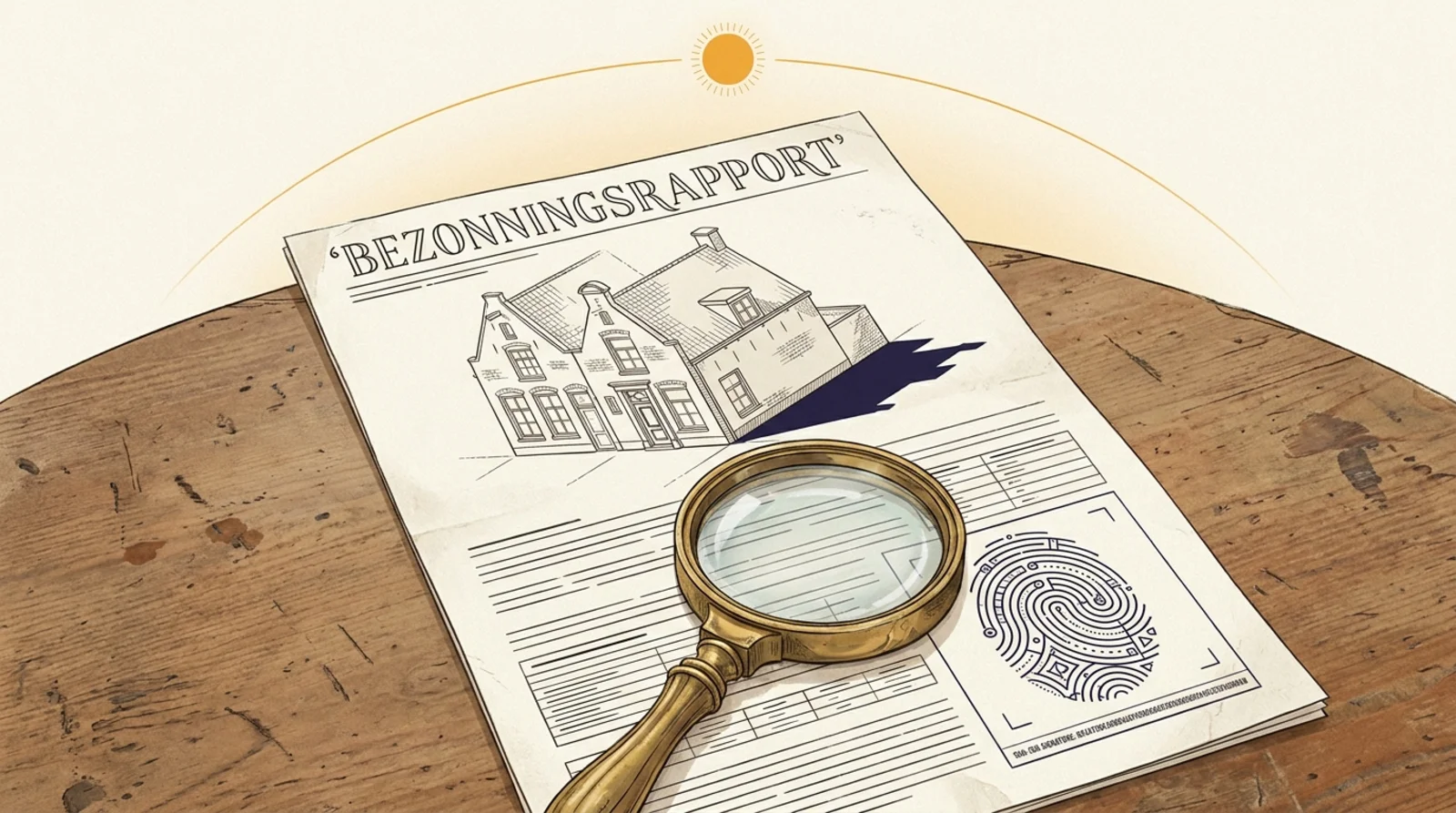
Every Schaduwplan PDF carries a unique SHA-256 hash that we publish at the moment of issue on schaduwplan.nl/verify. A judge, lawyer or neighbour can confirm in under thirty seconds that the file has not been altered since issue, without having to trust us. As far as we know, no other sunlight-study provider in the Netherlands does this.
How Schaduwplan works
Why Schaduwplan has no subscription: € 49, one time
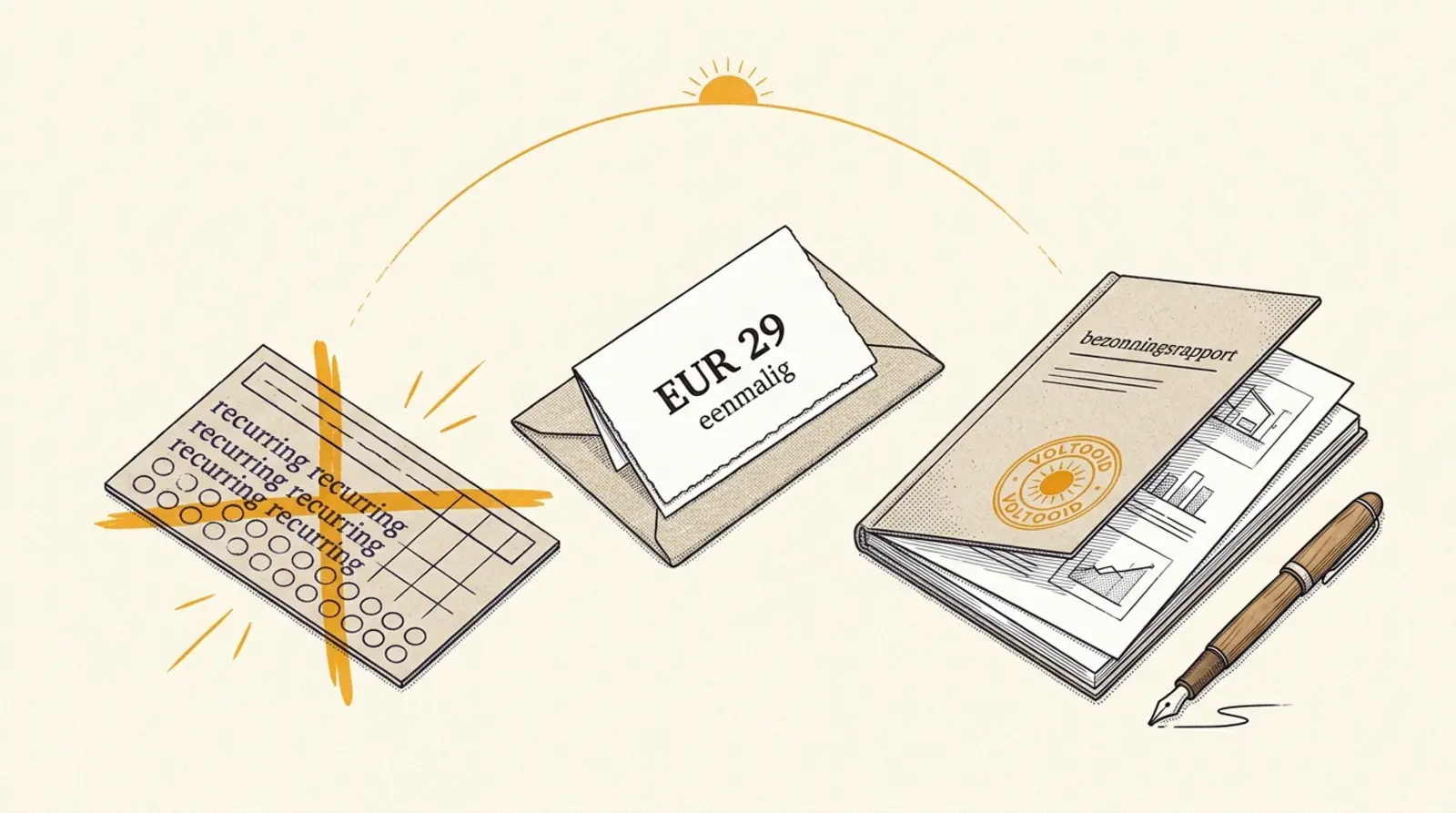
Schaduwplan charges € 49 per report, one time. No subscription, no trial. Most people need one report per permit procedure: once every 5 to 10 years for homeowners. A consumer subscription of € 2.49 per 90 days costs € 50.62 over 5 years, while Schaduwplan stays a single, clear transaction.
How Schaduwplan works
Is a sunlight study admissible in an objection or in court?
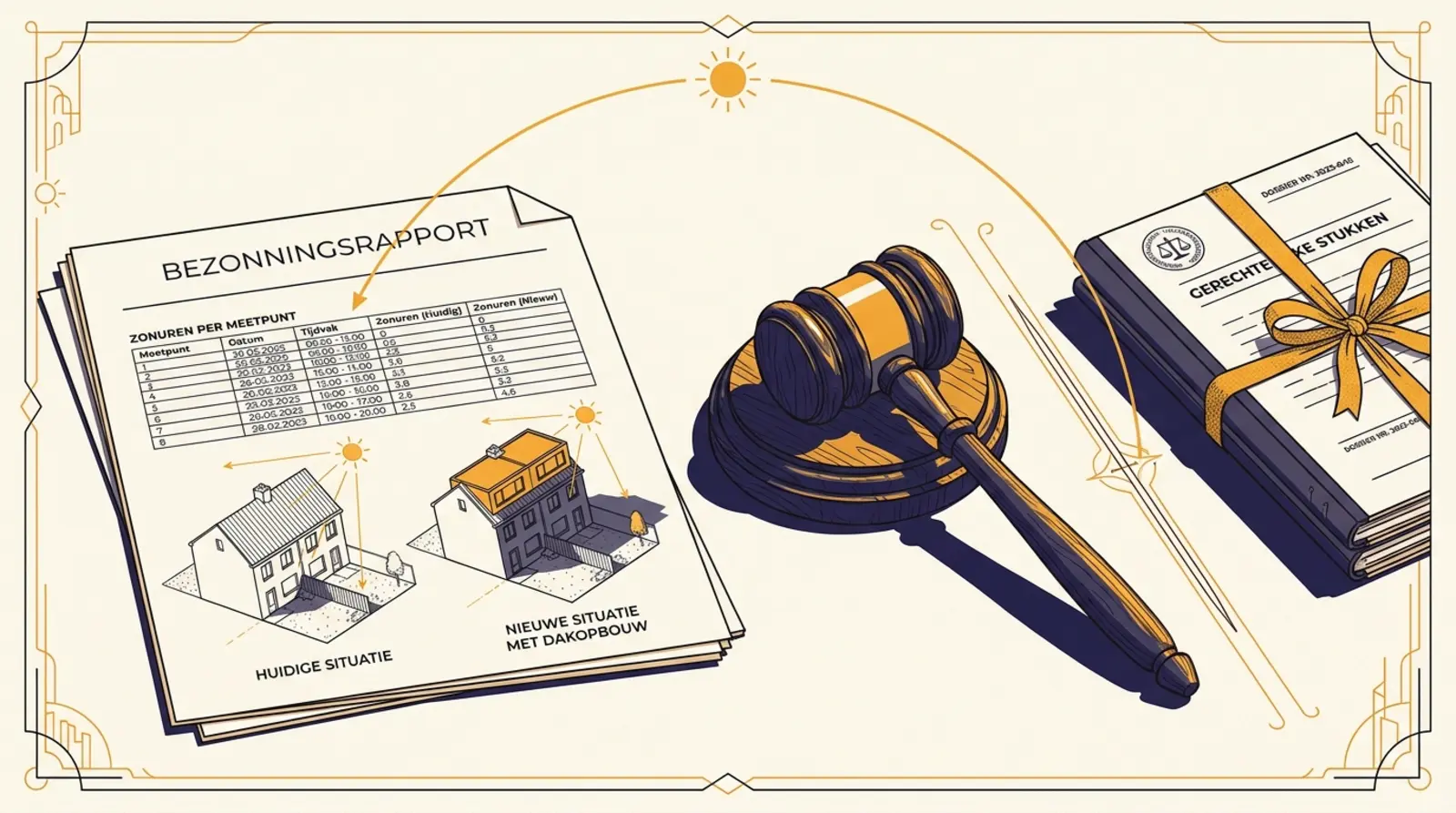
A Schaduwplan sunlight report is indicative and admissible in court. For formal views (zienswijzen), objection procedures and civil neighbour-law cases it is sufficient in almost all situations, because it uses the same 3DBAG, BAG and AHN4 sources that professional firms and the Administrative Jurisdiction Division of the Council of State rely on. For formal administrative appeal proceedings we recommend verification by a sworn expert.