How Schaduwplan works
From address to sunlight report in 3 minutes
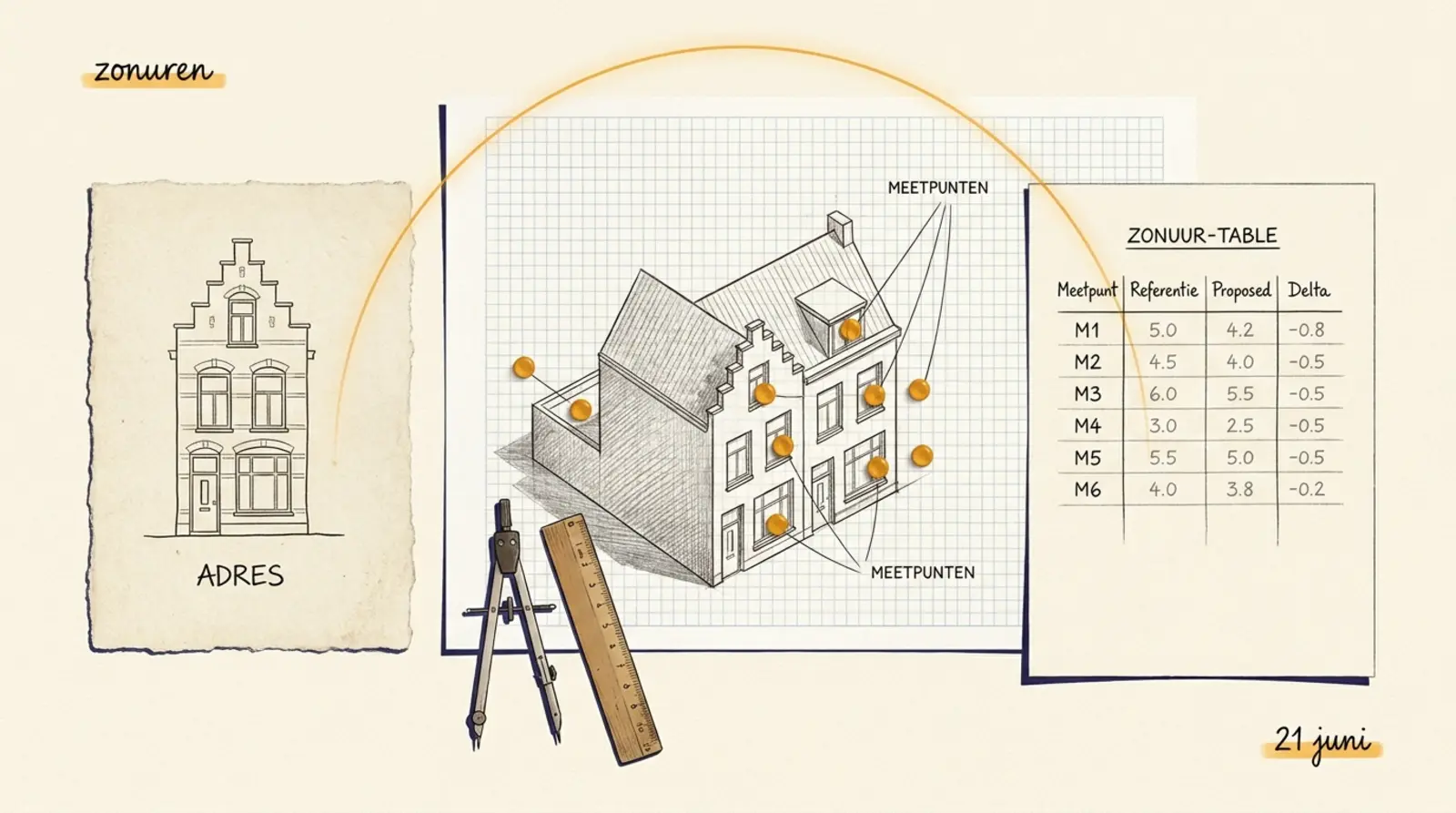
A full walkthrough: what you enter, which open government data (3DBAG, BAG, AHN4) sits underneath, what the PDF report contains and when the report is legally sufficient. From address to sunlight report in about five minutes — for € 49 instead of the € 295 to € 535 a firm charges.
What is Schaduwplan?
Schaduwplan is a web app that turns any Dutch address into a court-admissible sunlight report within five minutes. The tool runs entirely in the browser, uses open government data from 3DBAG, BAG and AHN4, and tests the results against the TNO standard and municipal variants. A report that costs €295 to €535 at an independent consultancy such as HoeveelZon, SchaduwSimulator or HBA runs up to €2,000 to €5,000 per report at large engineering firms (DGMR, Peutz, Nieman), with a turnaround of one to three weeks. At Schaduwplan the same report costs €49 and takes five minutes.
The report contains a 3D scene of the existing buildings, a drawing tool for the planned extension or roof addition, measurement points at the relevant windows and outdoor spaces, sun-hour calculations on the test dates, and a side-by-side comparison of the reference situation with the proposed situation. No subscription, no account required for the preview, payment only on download.
From address to report: the steps explained
The core claim — three minutes — refers to the active time at the computer. Reckon on five minutes if you place measurement points carefully and take the planned construction from a building drawing. The order is always the same.
- Enter an address. You start with a Dutch address (street, house number, town or postcode). The PDOK Locatieserver geocodes it to a specific BAG building. The 3D scene loads automatically with every building within a 150-metre radius, based on 3DBAG. No 3D knowledge or CAD software required.
- Draw the planned construction. Select your own parcel or the neighbours’ and draw the planned extension, roof addition, veranda or complete new build. The tool snaps to parcel boundaries from BAG, roof heights from AHN4, and the heights from the building drawing you have. For free-standing objects (a shed, a carport) a free-form shape is available.
- Place measurement points. Click on the relevant windows (75 cm above floor level, as the TNO standard prescribes) and on outdoor spaces such as a terrace or garden bed. Per measurement point you automatically calculate sun hours on the TNO test dates (19 February, 21 June, 21 October) plus a date of your own choosing if you want to highlight a specific scenario, such as a garden party in August.
- Choose a standard and run the analysis. The tool automatically tests against the light and strict TNO standard, plus your municipality’s own standard (for example the The Hague standard in The Hague). The analysis runs at 1-hour intervals, positioned on the Dutch national grid (EPSG:28992) — the same projection the official government sources use. Result: a table of sun hours before and after the planned construction per measurement point, and a heatmap at ground level.
- Download the report. The PDF is generated client-side. Contents: a cover with the address and 3D render, the assumptions (chosen standard, test dates, coordinate system), sunlight diagrams per test date with clock times at 1-hour intervals, the TNO test table (measurement point, reference, proposed, delta, status), a methodology appendix and a source list. You pay €49 and download immediately.
Which data sits underneath — and why it matters legally
Schaduwplan uses three public sources: 3DBAG for 3D building models, BAG for address and parcel data, and AHN4 for ground heights. All three are open, managed by the national government or renowned knowledge institutions, and accepted as authoritative by the Council of State and professional firms.
| Source | What it provides | Custodian | Legal status |
|---|---|---|---|
| 3DBAG | 3D models (LoD1, LoD2) of roughly 10 million Dutch buildings, with roof shapes and ridge heights | TU Delft (3D geoinformation) + 3DGI | Updated quarterly, open CC-BY. Attribution: “3DBAG by tudelft3d + 3DGI” |
| BAG | Addresses, buildings, dwelling units, parcel boundaries, year of construction, floor area | Kadaster (key register) | Authentic source under the Addresses and Buildings Register Act |
| AHN4 | Ground and object heights from laser surveys (2020–2022), 50 cm resolution | Rijkswaterstaat + water authorities | Open data, connected to PDOK, vertical accuracy 5 cm |
According to the Council of State (Almelo ruling, 18 January 2023, ECLI:NL:RVS:2023:172), TNO standards based on this type of data are “not unusual” to use. In the 2013 Ootmarsum ruling (ECLI:NL:RVS:2013:191) the Council of State in fact annulled a zoning plan precisely because no sunlight study using these sources had been carried out. The availability of authentic sources has become so self-evident that their absence is judged a procedural error.
What the PDF report contains
A sunlight report that judges and municipalities take seriously contains fixed elements. Schaduwplan generates these by default, in line with the Krimpen guideline — the most detailed official municipal template in the Netherlands. The report contains:
- A cover with the address, the date of the study and a 3D render at midsummer sun (21 June, 12:00 CEST).
- The assumptions: chosen standard (light TNO, strict TNO, The Hague, etc.), test dates, time intervals, coordinate system and all adjusted parameters.
- 3D sunlight diagrams per test date and per hour, side by side (reference and proposed), with a north arrow and a scale bar.
- Quantification per measurement point in table form: sun hours to the minute, before and after the planned construction, including the delta.
- An explicit TNO test: per measurement point a pass, a near-miss or a fail, tied to the two-hour standard or the strict three-hour standard.
- A methodology appendix: which sources (3DBAG, BAG, AHN4), which software, which assumptions (greenery and fences kept outside the formal TNO test), and a disclaimer noting that the report is indicative and that, for formal administrative proceedings, verification by a sworn expert is recommended.
The table of contents follows exactly the structure that consultancies such as Handel Bouwadvies, Blauwdruk Bouw and Bezonningsingenieur use. As a result your report reads to civil servants and judges like a familiar document, not an app export.
How accurate is the calculation?
Sun hours are calculated at 1-hour intervals across 365 days per measurement point. Per measurement point that is roughly 5,840 calculations per year. The sun path is modelled with the SunCalc algorithms, which match the official ephemeris tables of the US Naval Observatory at the level of seconds. Positioning uses the Dutch national grid (EPSG:28992), the projection of the Dutch government, and converts to WGS84 for display.
Time is computed internally in UTC and converted to CET or CEST for display, with correct DST transitions on the last Sunday of March and October. That matters: the TNO test date of 21 October falls in the week of the DST switch, so a 13:00 clock moment means something different on 20 October than on 28 October. Our model accounts for that.
In the Voorburg ruling of 5 April 2023 (ECLI:NL:RVS:2023:1329) the Council of State accepted that a height discrepancy of 3 cm (8.21 m versus 8.24 m) is negligible. The 50 cm resolution of AHN4 sits well below any reported relevant threshold, but we document our assumptions explicitly in the appendix so that any counter-expert can reproduce the inputs used.
When you still need a firm
Honest about the limits: Schaduwplan covers roughly 95% of the sunlight questions Dutch homeowners, architects and municipalities encounter. The remaining 5% call for a human firm. That is the case for:
- Large area developments with complex aesthetic-quality requirements, where a sworn expert must appear as an expert witness at a hearing.
- Municipalities that require “maximum planning possibilities” as the reference and where the planning rules have to be interpreted legally. The comparison itself you can make in Schaduwplan. As soon as you enter the address, we check the omgevingsplan for a published building plot with a maximum eave and ridge height. If there is one, the permitted volume appears in the objects panel, its building plot cut off at the cadastral parcel boundary (indicative, can be switched off), and you confirm or correct every value. If there is not — the plan is then not published digitally and its building plot exists only on the plan map — you draw the envelope over yourself; that says nothing about what may be built there. What we do not do is derive that envelope from the planning rules; that interpretation stays with you and your architect. Permit-free building, in-plan deviation powers and custom rules are not included in it either, so the envelope does not show the complete permitted building volume.
- Historic inner cities with an unusual shadow history, where additional literature research is required.
- Situations where the building plan may still change substantially and iterative design with an architecture firm is simpler than downloading a new report each time.
In those cases we recommend using the Schaduwplan analysis as a starting point. You then already have a substantiated first estimate, and a conversation with the firm goes faster — they need not spend a week on intake and 3D modelling.
Who Schaduwplan makes the difference for
The tool was designed first and foremost for four groups. A concerned neighbour who must file a substantiated objection within six weeks. A homeowner planning an extension who wants to avoid conflicts with neighbours or the municipality. An architect or building designer who delivers sunlight studies as part of the permit application. And a municipal officer who must validate a submitted study against the local assessment framework.
For curious gardeners who simply want to know how much sun their terrace gets, the free preview is usually enough — the PDF report is meant for official use, not for hobby questions. For large developers and high-rise specialists the tool is a starting point; complex scenarios with dozens of towers call for a specialised firm.
Sources (12)
We back every article with public sources. Click to see all the original documents, rulings and datasets.
Sources (12)
We back every article with public sources. Click to see all the original documents, rulings and datasets.
Data sources
- 3DBAG — automatically reconstructed 3D models of Dutch buildings— TU Delft (3D geoinformation) and 3DGI
- BAG — Key Register of Addresses and Buildings— Kadaster
- AHN4 — Actueel Hoogtebestand Nederland, laser surveys 2020–2022— Rijkswaterstaat and the water authorities
- PDOK Locatieserver — address and geocoding service— Publieke Dienstverlening Op de Kaart
Standards and guidelines
- TNO sunlight standard (light and strict variant)— TNO report 2005-BBE-R0036
- Sunlight in the environment plan— IPLO (Informatiepunt Leefomgeving)
- The Hague sunlight standard — RIS 180461— City of The Hague
- Rotterdam sunlight assessment framework— City of Rotterdam
- Sunlight study guideline, Krimpen aan den IJssel— Municipality of Krimpen aan den IJssel
Case law
- Council of State 18 January 2023 — TNO standards not unusual— ECLI:NL:RVS:2023:172
- Council of State 3 July 2013 — Ootmarsum: no sunlight study = plan annulled— ECLI:NL:RVS:2013:191
- District Court of The Hague 17 January 2024 — roof addition demolished at 75 to 80% sunlight loss— ECLI:NL:RBDHA:2024:1206
Frequently asked questions
- How long does a sunlight analysis really take?
- Entering an address and generating the first 3D scene takes less than a minute. Drawing the planned construction and measurement points takes about two minutes. The sun-hour calculation with PDF generation runs in about two minutes. Total: five minutes for a complete report, including TNO testing.
- Do I need to create an account to start?
- No. You enter an address and work directly in the 3D viewer. You get a free preview with sun hours per measurement point, complete with the graphical analysis. Only when you want to download the PDF report for official use (for example as an attachment to an objection or a permit application) do you pay € 49.
- Which data does Schaduwplan use under the hood?
- Three public sources: 3DBAG from TU Delft and 3DGI for 3D building models, BAG from the Kadaster for address and parcel data, and AHN4 for the ground level and vegetation heights. None of these sources requires an API key or payment. They are the same sources that professional firms and the Council of State use.
- How accurate are the sun-hour calculations?
- Sun hours are calculated at 1-hour intervals across 365 days, positioned on the Dutch national grid (EPSG:28992). Per measurement point that is roughly 5,840 calculations per year. The sun-path calculation uses the SunCalc algorithms, which match the official ephemeris tables at the level of seconds. Accurate to the minute, accounting for DST transitions.
- Does a Schaduwplan report count as legal evidence?
- The report is indicative and admissible. For formal views (zienswijzen), objection phases and civil neighbour-law cases it is sufficient in almost all cases — provided the report refers to the sources and methodology used, which it does by default. For formal administrative appeal proceedings before the court or the Council of State we recommend confirmation by a sworn expert. In 2023 (ECLI:NL:RVS:2023:172) the Council of State accepted TNO standards as not unusual.
- Which municipal standards does the tool support?
- By default the tool tests against the light and strict TNO standard. There are also presets for the The Hague sunlight standard (RIS 180461), the Rotterdam assessment framework and the Eindhoven policy. Municipalities that use the light TNO standard as their reference (such as Krimpen aan den IJssel) automatically fall back to that standard. For municipalities without their own policy we use the light TNO standard as the default — the de facto standard in most Dutch permit decisions.
Try Schaduwplan on your own address
Enter a Dutch address. Within one minute, see in 3D what the sun and shadow do throughout the year. Draw a planned extension or roof addition, place measurement points, and download the report — court-admissible, TNO-tested, € 49.
Read more
How Schaduwplan works
Verifying a sunlight report: how to check it is genuine
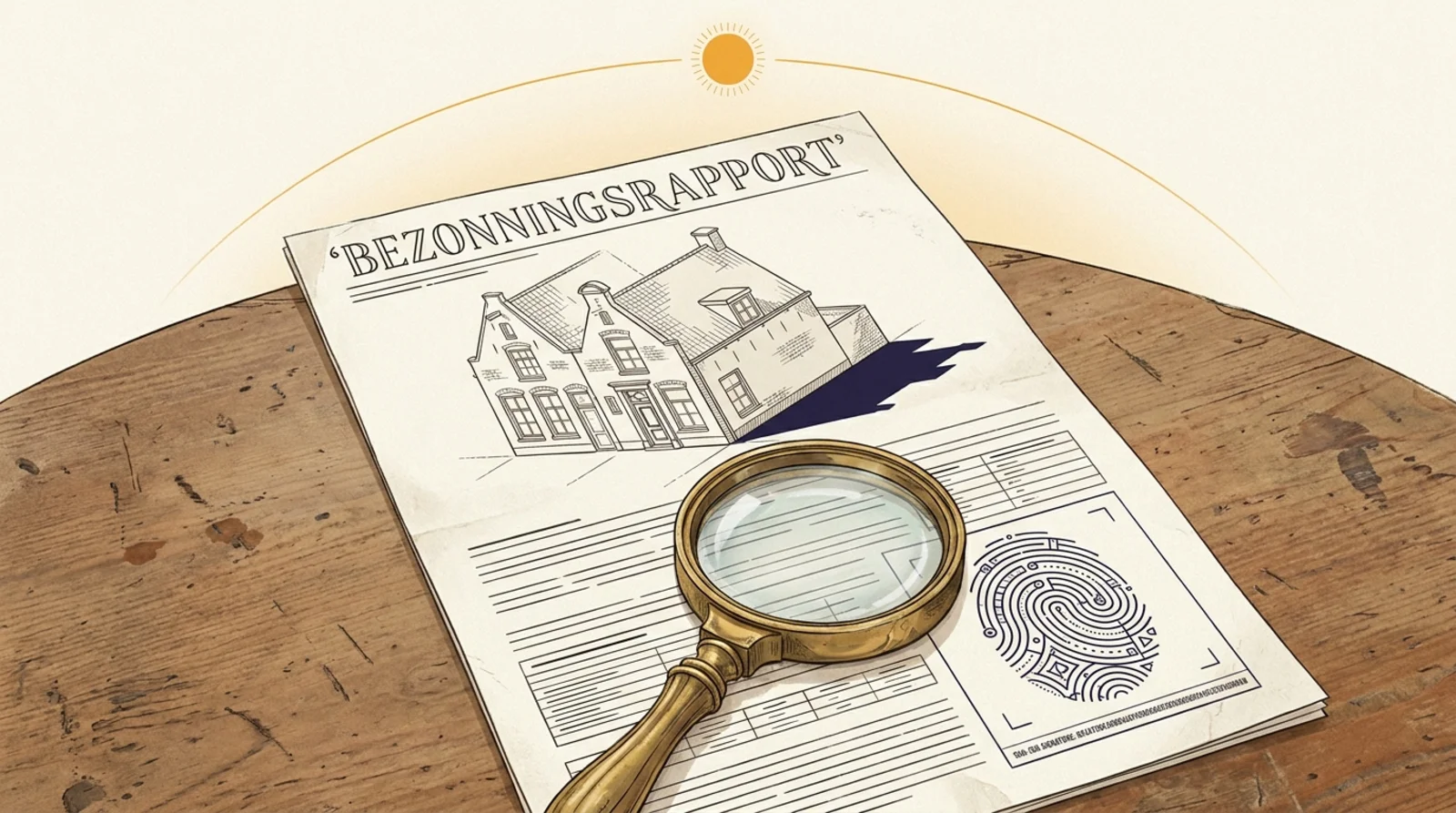
Every Schaduwplan PDF carries a unique SHA-256 hash that we publish at the moment of issue on schaduwplan.nl/verify. A judge, lawyer or neighbour can confirm in under thirty seconds that the file has not been altered since issue, without having to trust us. As far as we know, no other sunlight-study provider in the Netherlands does this.
How Schaduwplan works
Why Schaduwplan has no subscription: € 49, one time
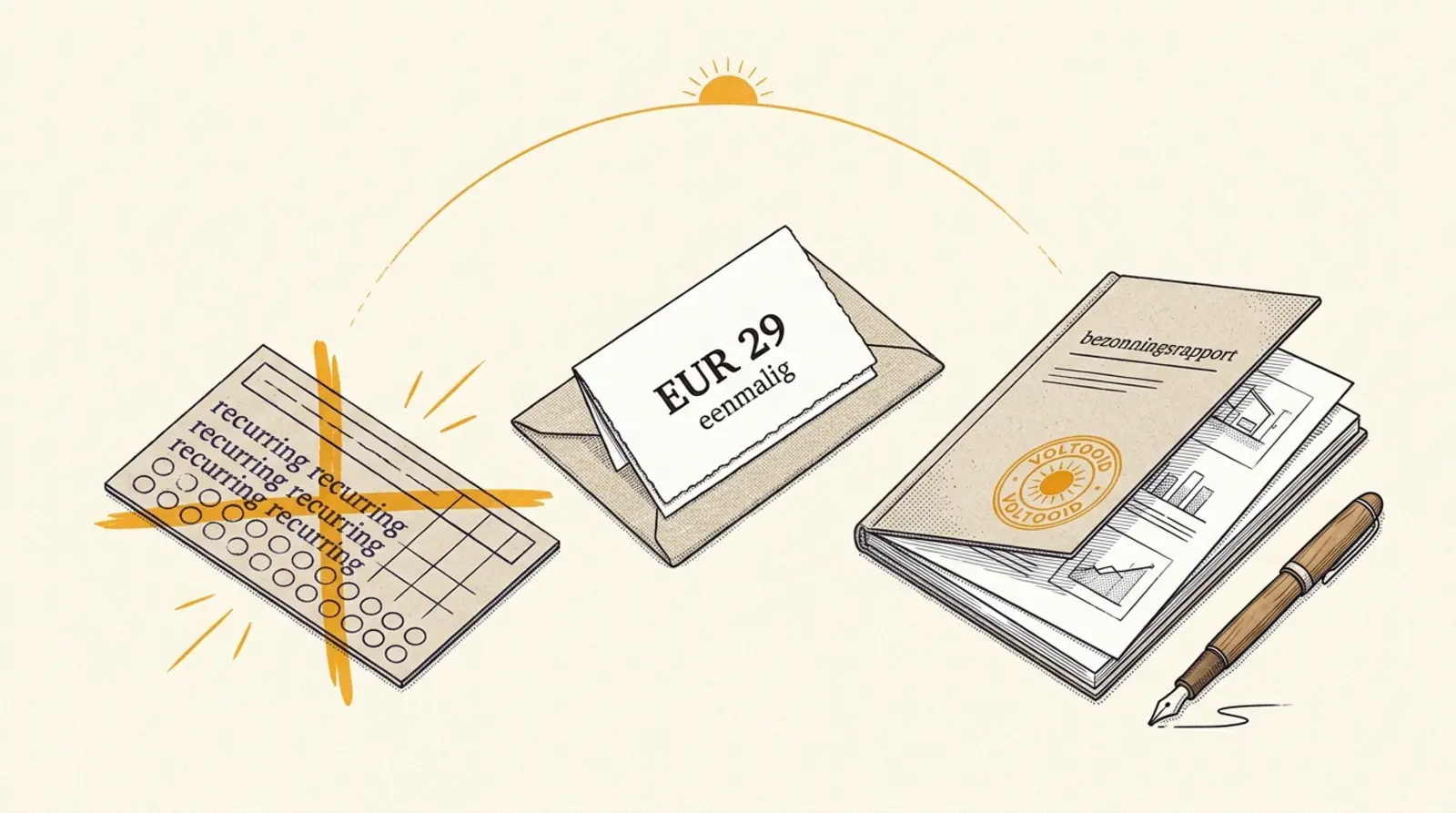
Schaduwplan charges € 49 per report, one time. No subscription, no trial. Most people need one report per permit procedure: once every 5 to 10 years for homeowners. A consumer subscription of € 2.49 per 90 days costs € 50.62 over 5 years, while Schaduwplan stays a single, clear transaction.
How Schaduwplan works
Sunlight study for a permit: SketchUp to auditable PDF
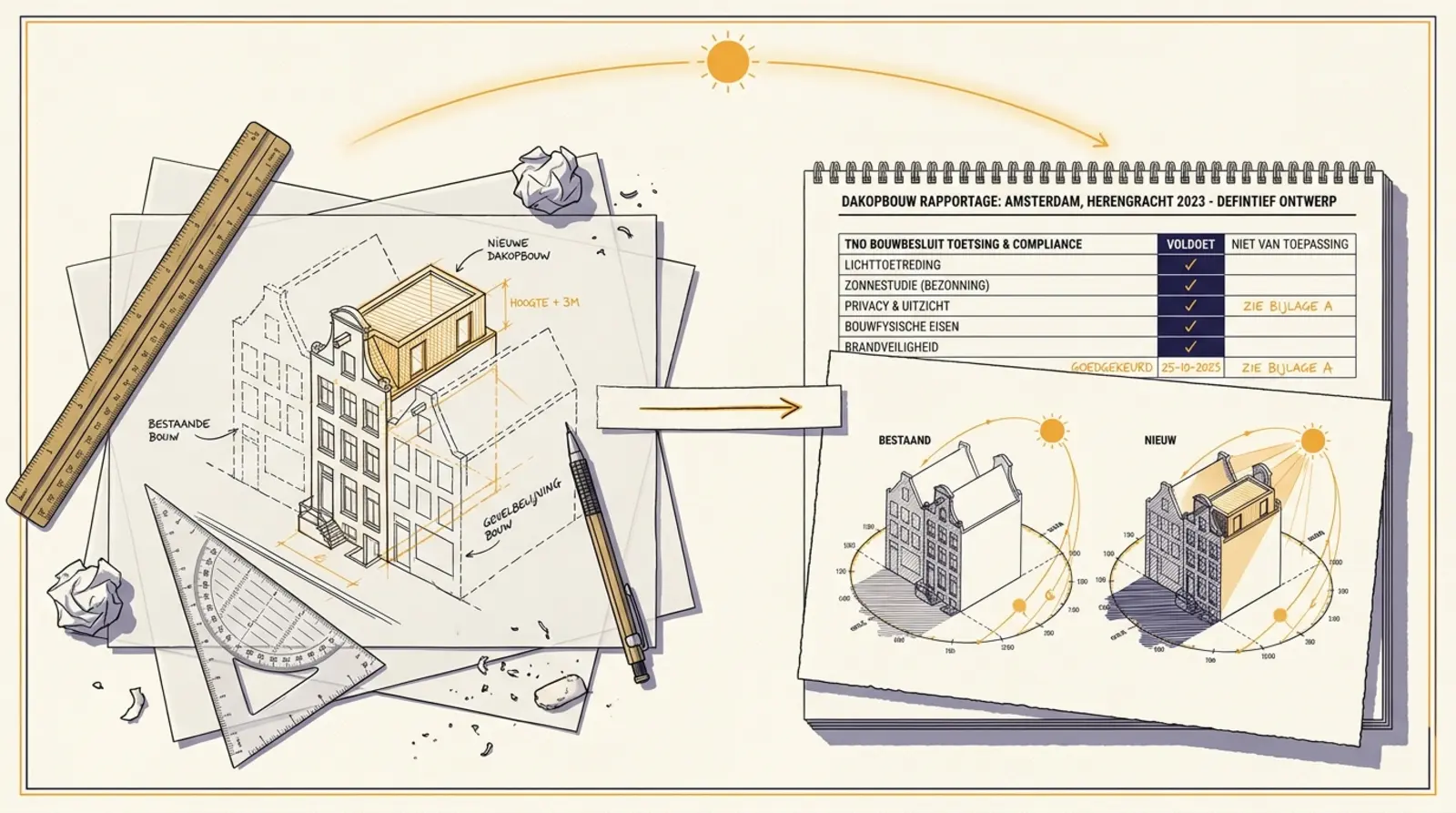
A manual sunlight study in SketchUp or Revit takes 4 to 16 hours of architect time per project. With Schaduwplan you generate an auditable PDF report in 5 minutes from 3DBAG, BAG and AHN4, tested against the light TNO, strict TNO or municipal standards. The time saved per permit application is worth € 300 to € 2,400 in architect fees.