Renovating
Extension permit: does it need a sunlight study?
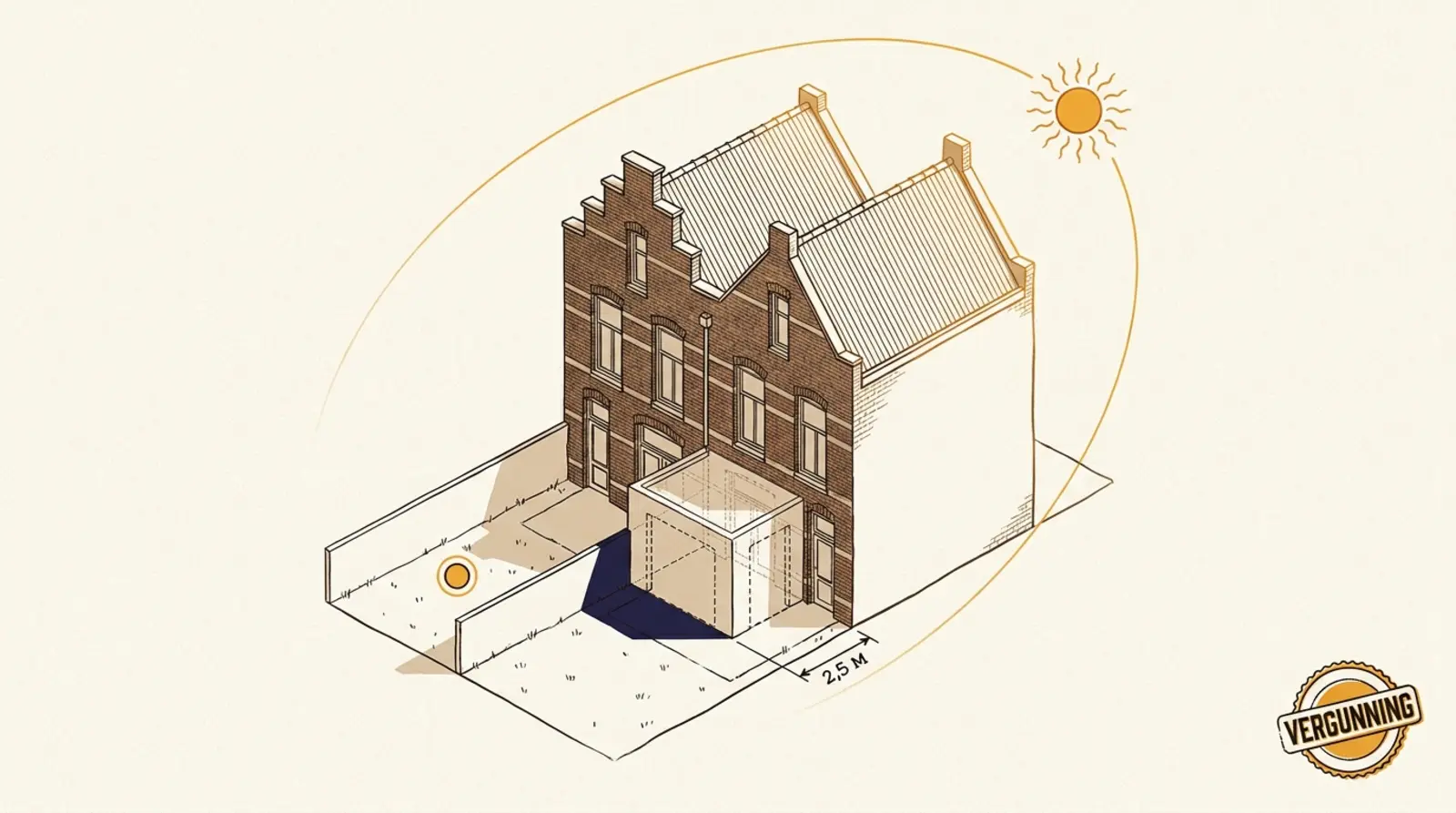
A rear extension is often permit-free up to 2.5 m deep and below the eaves line of the main house. Above that you need an environmental permit, and municipalities such as The Hague and Rotterdam almost always require a sunlight study with it. Substantiating this up front prevents neighbour objections and redesign costs.
Do I need an environmental permit for my extension?
An extension is often permit-free if it sits at the back of a home, is no deeper than 2.5 metres, no higher than the existing eaves line, stands within the rear-yard zone, and keeps sufficient distance from the plot boundary. If your plan does not meet all of these conditions, you need an environmental permit via Omgevingsloket.nl. The Environment Act (Omgevingswet) (in force since 1 January 2024) governs this through the Buildings (Living Environment) Decree (Bbl); for your specific situation the permit check at omgevingsloket.nl is decisive.
This article is about the permit-required category. If your extension needs an environmental permit, the municipality can require a sunlight study as an additional attachment. That happens more and more under the Environment Act (Omgevingswet), particularly in densely built cities such as The Hague, Rotterdam and Amsterdam. In the Ootmarsum case (3 July 2013, ECLI:NL:RVS:2013:191) the Council of State ruled that a municipality which fails to carry out a sunlight study before granting a permit breaches article 3:2 Awb (duty of careful preparation). Municipalities want to avoid that risk by requiring the study from the applicant.
Permit-free building: the limits in 2026
Permit-free building is relatively generous in the Netherlands. The national government states that, for a home with a back garden, the following is usually allowed without a permit. These values are indicative; municipalities can be stricter through the environment plan.
| Element | Permit-free up to | Exceeding requires a permit |
|---|---|---|
| Rear extension | 2.5 m deep, up to the eaves line of the main building | Yes, usually with a sunlight assessment |
| Side extension | 2 m wide, 5 m high, within the rear-yard zone | Yes, often also an aesthetic-quality assessment |
| Roof addition or dormer | Dormer permit-free at the rear under conditions | Roof addition almost always permit-required |
| Surface area per rear yard | Max 50 m² for yards of 100 to 300 m² | Larger areas are permit-required |
| Distance to plot boundary | Usually no minimum at the rear; at the side there is | At a side plot boundary, aesthetic-quality advice is often needed |
This is a heavily simplified representation. The exact rules are in the Buildings (Living Environment) Decree and in your municipality’s environment plan. The definitive test is the permit check at omgevingsloket.nl: a free digital decision tool that gives you the right outcome step by step.
When does the municipality require a sunlight study?
Not every permit application requires a sunlight study. The municipality assesses per project whether the chance of shadow nuisance is significant. In practice most Dutch municipalities use one of the following thresholds:
- Building height. Above 10 m (Rotterdam) or above the existing eaves line (many other municipalities) a sunlight study is a standard part of the submission set.
- Roof addition on a terraced house. Under RIS 180461, The Hague requires a sunlight study for every roof addition on a terraced house, regardless of height. The The Hague 50% rule is the direct reason.
- Large extension. Extensions deeper than 3 m (where 2.5 m is permit-free) routinely attract a sunlight request in densely built neighbourhoods, including in Eindhoven after the 2022 policy revision.
- New build on an empty plot. In most municipalities, all new build above the height of the surrounding existing buildings gets a sunlight assessment.
In cities that use the standard light TNO standard (the majority of the 342 Dutch municipalities) an assessment on the three test dates 19 February, 21 June and 21 October is sufficient. In The Hague, Rotterdam, Eindhoven and Krimpen aan den IJssel the local guideline applies on top. Schaduwplan tests automatically against all relevant standards at once.
The Environment Act since 1 January 2024: what changed
The Environment Act (Omgevingswet) (introduced on 1 January 2024) bundles 26 existing laws into a single system for the physical living environment. For an extension permit, three things change in practice.
- One digital counter. You submit your permit application via Omgevingsloket.nl, no longer via the old digital Omgevingsloket (DSO) or municipal portals. The permit check up front determines whether a permit is needed.
- The environment plan replaces the zoning plan. Every municipality draws up an environment plan that sets out the local rules. Sunlight is covered under article 2.1 of the Environment Act (Omgevingswet) and is governed by municipalities through this environment plan. Some municipalities explicitly require a sunlight study above a certain building height.
- Shorter decision periods. The regular procedure has a decision period of 8 weeks, extendable once by 6 weeks. For complex projects this can run up to 6 months, but for standard extensions 8 weeks is the norm.
For you as the applicant, the most important practical impact is: the municipality may be stricter than the TNO standard if that is set out in the environment plan. Check the environment plan before you design, not only during the application. That way you prevent a design that would have worked elsewhere from failing on a local rule in your municipality.
Preventing objections from neighbours: map the sunlight up front
The fastest way to lose a permit application is an objection from the neighbours. Even if the municipality assesses your application favourably, your neighbours can object within six weeks of publication under article 6:7 Awb. If their objection is substantiated with a quantitative sunlight report, that can delay or revoke the permit. On 17 January 2024 the District Court of The Hague (ECLI:NL:RBDHA:2024:1206) even ordered the demolition of an already completed roof addition at 75 to 80% sunlight loss, even though the owner held an irrevocable permit.
The reverse route is also possible and more favourable: a sunlight report from your side, shared proactively with your neighbours before you submit, defuses many potential objections in advance. If your report shows that the sunlight loss stays below the light TNO standard (less than 2 sun hours per day) and outside the The Hague 50% threshold, an objection has little legal basis left. Your neighbours then see hard data, not a substantiated suspicion, and the dialogue shifts from conflict to execution.
Practical tip: add a sunlight report both to the permit application and to an accompanying neighbour letter. The municipality values the file as complete, and your neighbours have the information they need not to raise an objection. For a €49 report that is a sharp insurance against a €10,000-plus delay if the building permit is halted by an objection.
How Schaduwplan fits into a permit application
For a proactive homeowner or architect, Schaduwplan is primarily an iteration tool. Enter your address, draw the planned extension, change heights and depths until all measurement points meet the light TNO standard — iterating in the free 3D tool costs nothing. Only once you are satisfied do you pay €49 once for the PDF report (one address, one scenario). An independent building consultant (HoeveelZon, HBA), by contrast, charges again for each redesign.
The final report contains the standard elements the municipality expects: a cover with the address and date, the assumptions (chosen standard, test dates, coordinate system), 3D sunlight diagrams side by side (current versus with extension), a TNO test table per measurement point, a methodology appendix with source references (3DBAG, BAG, AHN4), and a disclaimer. You add this report as an attachment to your Omgevingsloket application. The civil servant can see straight away whether your design meets the standard, without having to carry out the calculation themselves.
For architects who submit several permit applications a year, this becomes a fixed part of the portfolio. One Schaduwplan report per permit adds €49 to the invoice, versus €295 to €535 at a small building-advice firm — a 90% discount on the same attachment, with the freedom to refine the design iteratively before you submit the final version.
Sources (15)
We back every article with public sources. Click to see all the original documents, rulings and datasets.
Sources (15)
We back every article with public sources. Click to see all the original documents, rulings and datasets.
Laws and regulations
- Rijksoverheid — When do I need an environmental permit to build?— rijksoverheid.nl
- Omgevingsloket — permit check— omgevingsloket.nl
- Buildings (Living Environment) Decree (Bbl) — permit-free building— wetten.overheid.nl
- Environment Act (Omgevingswet) — art. 2.1 physical living environment— wetten.overheid.nl
- General Administrative Law Act, art. 6:7 (objection period)— wetten.overheid.nl
Case law
- Council of State 3 July 2013 — Ootmarsum: zoning plan annulled due to a missing sunlight study— ECLI:NL:RVS:2013:191
- District Court of The Hague 17 January 2024 — roof addition demolished at 75 to 80% sunlight loss— ECLI:NL:RBDHA:2024:1206
- Council of State 5 April 2023 — Voorburg: additional study for a missing roof addition— ECLI:NL:RVS:2023:1329
- Council of State 18 January 2023 — Almelo: TNO standards not unusual— ECLI:NL:RVS:2023:172
Standards and municipal policy
- TNO sunlight standard — original report 2005-BBE-R0036— TNO Delft
- The Hague sunlight standard — RIS 180461— City of The Hague
- Rotterdam sunlight assessment framework— City of Rotterdam
- Eindhoven sunlight policy— City of Eindhoven
Data sources
- 3DBAG — open 3D models of Dutch buildings— TU Delft and 3DGI
- AHN4 — Actueel Hoogtebestand Nederland— Rijkswaterstaat and the water authorities
Frequently asked questions
- What is the difference between permit-free and permit-required building?
- Permit-free means you can build without permission from the municipality, provided the plan falls within the rules of the Buildings (Living Environment) Decree. Permit-required means you must apply for an environmental permit via Omgevingsloket.nl before you start. Roughly: a rear extension up to 2.5 m deep, no higher than 5 m and within the rear-yard zone is usually permit-free; larger or higher requires a permit. You will find the exact rules at rijksoverheid.nl.
- Do I always have to supply a sunlight study with my permit application?
- Not by default. The municipality requires a sunlight study if the project could cause substantial shadow nuisance for neighbours or public space. In The Hague that is often already the case for roof additions in dense terraced housing; in Rotterdam an additional assessment applies above 10 metres in height. For a standard extension on a spacious plot the municipality may waive the study. Always check your municipality’s environment plan.
- What happens if my neighbours object after the permit has been granted?
- Your neighbours can object within six weeks of publication (art. 6:7 Awb). If their objection is upheld, the permit can be revoked. Even after completion they can take the matter to the civil court under art. 5:37 of the Civil Code. In January 2024 the District Court of The Hague (ECLI:NL:RBDHA:2024:1206) even ordered the demolition of a roof addition that had a valid permit. Substantiating your plans up front with a sunlight report reduces these risks considerably.
- How do I avoid a refusal by the municipality?
- Three actions at once work best. First: test your design in advance against the local sunlight standard (light TNO, strict TNO, or the The Hague 50% rule). Second: consult adjoining neighbours before you submit — a neighbour letter with a sunlight report prevents objections. Third: include the report itself as an attachment to the application, even if the municipality does not require it. This speeds up processing and strengthens your file in the event of an objection.
- Which heights and depths apply to permit-free building?
- A rough indication (consult rijksoverheid.nl for the exact rules): a rear extension up to 2.5 m deep at the back of a home, up to the eaves line of the existing home in height, within the rear-yard zone and with sufficient distance from the plot boundaries. At the side up to 2 m wide and under 5 m high. Above these values an environmental permit is required. The Omgevingsloket permit check gives the answer for your specific situation.
- Can I assess in advance whether my design causes problems?
- Yes, that is exactly what Schaduwplan was built for. Enter your address, draw your planned extension or roof addition in 3D, and within five minutes see sun hours before and after for both your own home and the adjoining homes. Does your design meet the light TNO standard? Does it creep above the The Hague 50% rule? You know before you send the drawing to the architect. Iterating in the free tool costs nothing; a change afterwards costs €5,000 in building materials.
Test your design before you submit it
Enter your address, draw your planned extension or roof addition, and download a report with sun hours for your home and the adjoining homes. You know on day one whether the municipality will approve it — and whether your neighbours will object.
Read more
Standards & municipalities
Sunlight and Dutch neighbour law: which rules apply
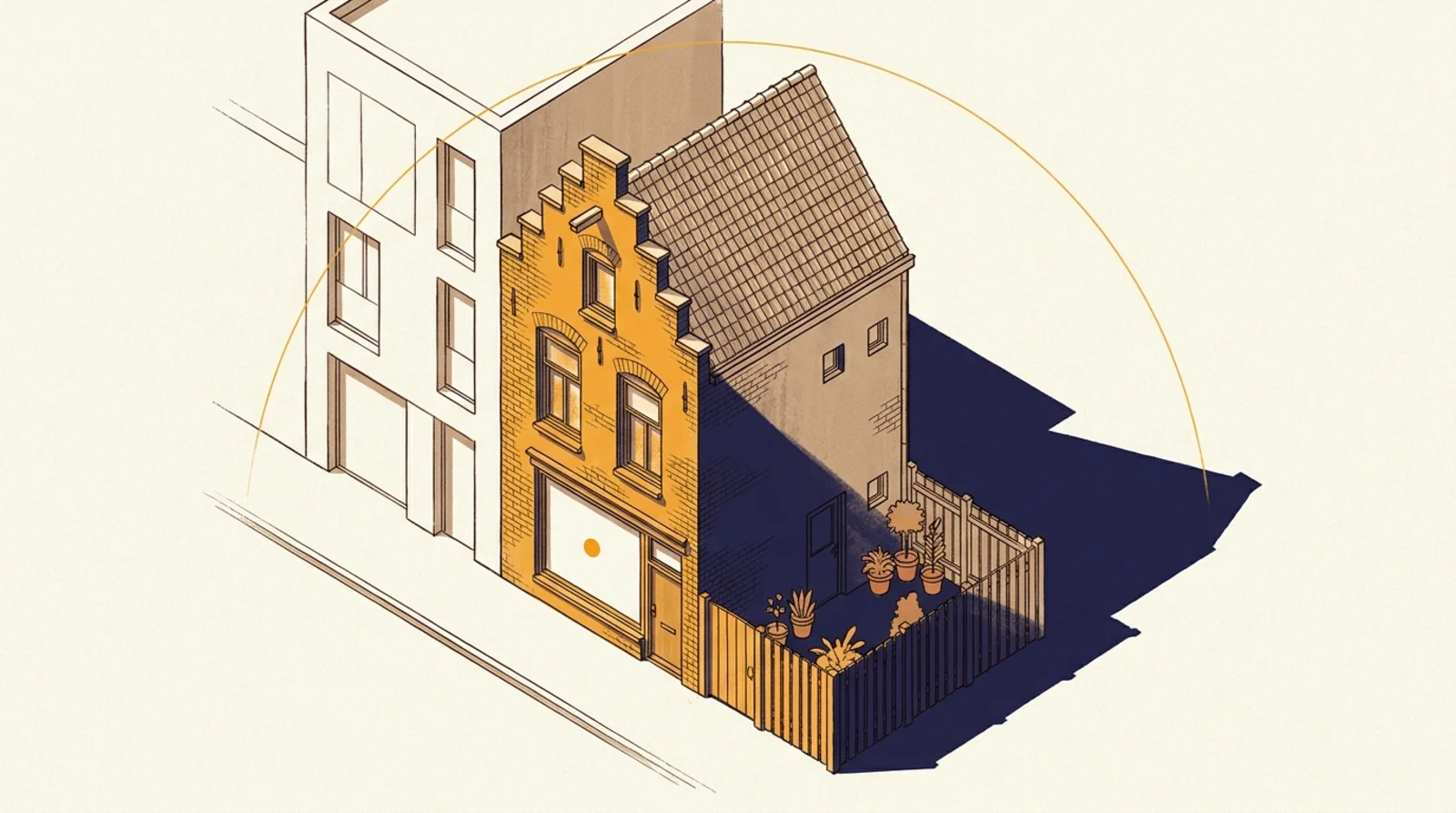
Three separate frameworks govern sunlight at a home. Sunlight access (the TNO standard) is a guideline, not a law. Daylight (Articles 4.146 and 4.147 of the Building Works Environment Decree) is the only one written into national law. Neighbour law (Article 5:37 of the Civil Code) governs unlawful nuisance. Window size counts for daylight, not for sunlight access.

How Schaduwplan works
Verifying a sunlight report: how to check it is genuine
Every Schaduwplan PDF carries a unique SHA-256 hash that we publish at the moment of issue on schaduwplan.nl/verify. A judge, lawyer or neighbour can confirm in under thirty seconds that the file has not been altered since issue, without having to trust us. As far as we know, no other sunlight-study provider in the Netherlands does this.
Data sources
Drone, LiDAR or photogrammetry for height data
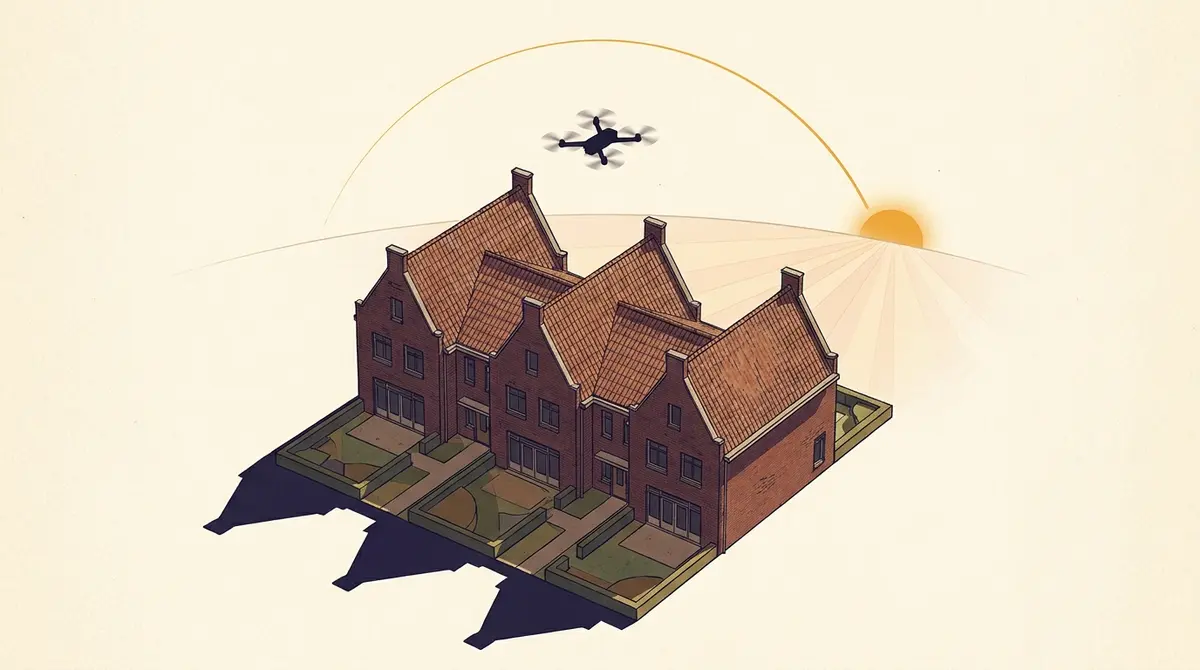
When 3DBAG and AHN have not surveyed your home yet, you can commission height data yourself. Three routes are open: hire a surveying firm (€500–€5,000, 1–2 weeks), fly a drone yourself and process it in WebODM or RealityCapture (from €750 in hardware, one weekend), or use a phone photogrammetry app for visualisation. Thresholds, rules (Open A1/A2/A3, Remote ID 2026) and the GeoTIFF format Schaduwplan accepts.