Standards & municipalities
Sunlight and Dutch neighbour law: which rules apply
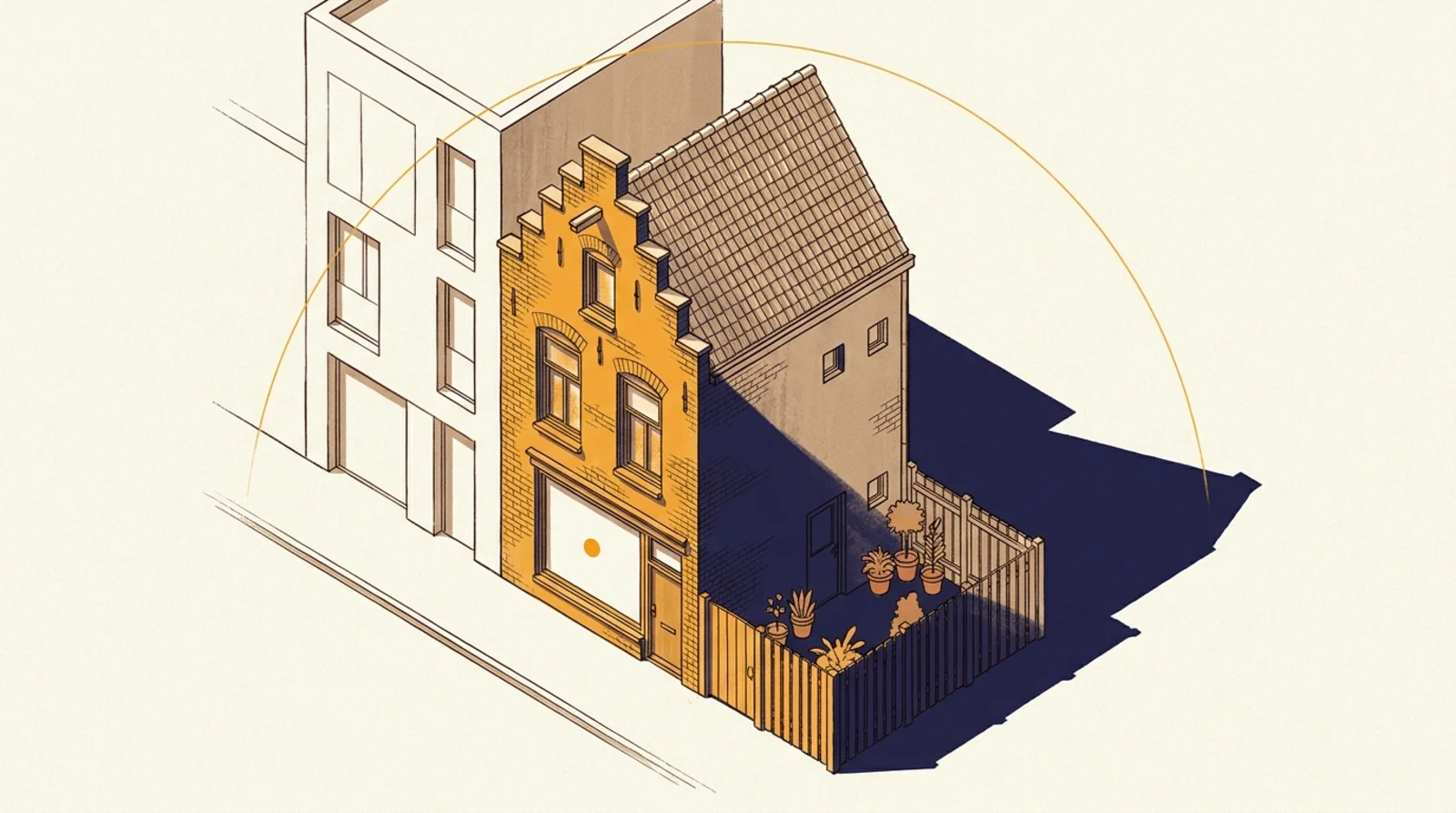
Three separate frameworks govern sunlight at a home. Sunlight access (the TNO standard) is a guideline, not a law. Daylight (Articles 4.146 and 4.147 of the Building Works Environment Decree) is the only one written into national law. Neighbour law (Article 5:37 of the Civil Code) governs unlawful nuisance. Window size counts for daylight, not for sunlight access.
Three frameworks for sunlight: sun exposure, daylight and neighbour law
In the Netherlands, three separate frameworks govern sunlight and daylight at a home. Sun exposure (bezonning) measures the number of sun hours and is tested against the TNO standard — a guideline, not a law. Daylight measures the amount of daylight indoors and is laid down nationally in the Building Works Environment Decree (Bbl). Neighbour law (article 5:37 of the Civil Code, BW) governs unlawful nuisance between neighbours, including the withholding of light.
These three are often confused, even though they measure different things and have a different legal status. The table below sets them side by side. After that we go through them one by one, plus the two questions that come up most often: does the size of your window count, and what happens if one façade is built up against?
| Framework | What it measures | Legal status | Does window size count? | Who assesses |
|---|---|---|---|---|
| Sun exposure (TNO, The Hague, municipal) | Number of hours of direct sun at a measurement point | Guideline, not a national law | No | Municipality, administrative court |
| Daylight (Bbl, art. 4.146 and 4.147) | Amount of daylight in the habitable room | Hard, national statutory law | Yes | Building-plan assessment at the permit stage |
| Neighbour law (art. 5:37 BW) | Unlawful nuisance, incl. withholding of light | Civil law, case by case | Indirect | Civil court |
Sun exposure: how many hours of sun, tested against the TNO standard
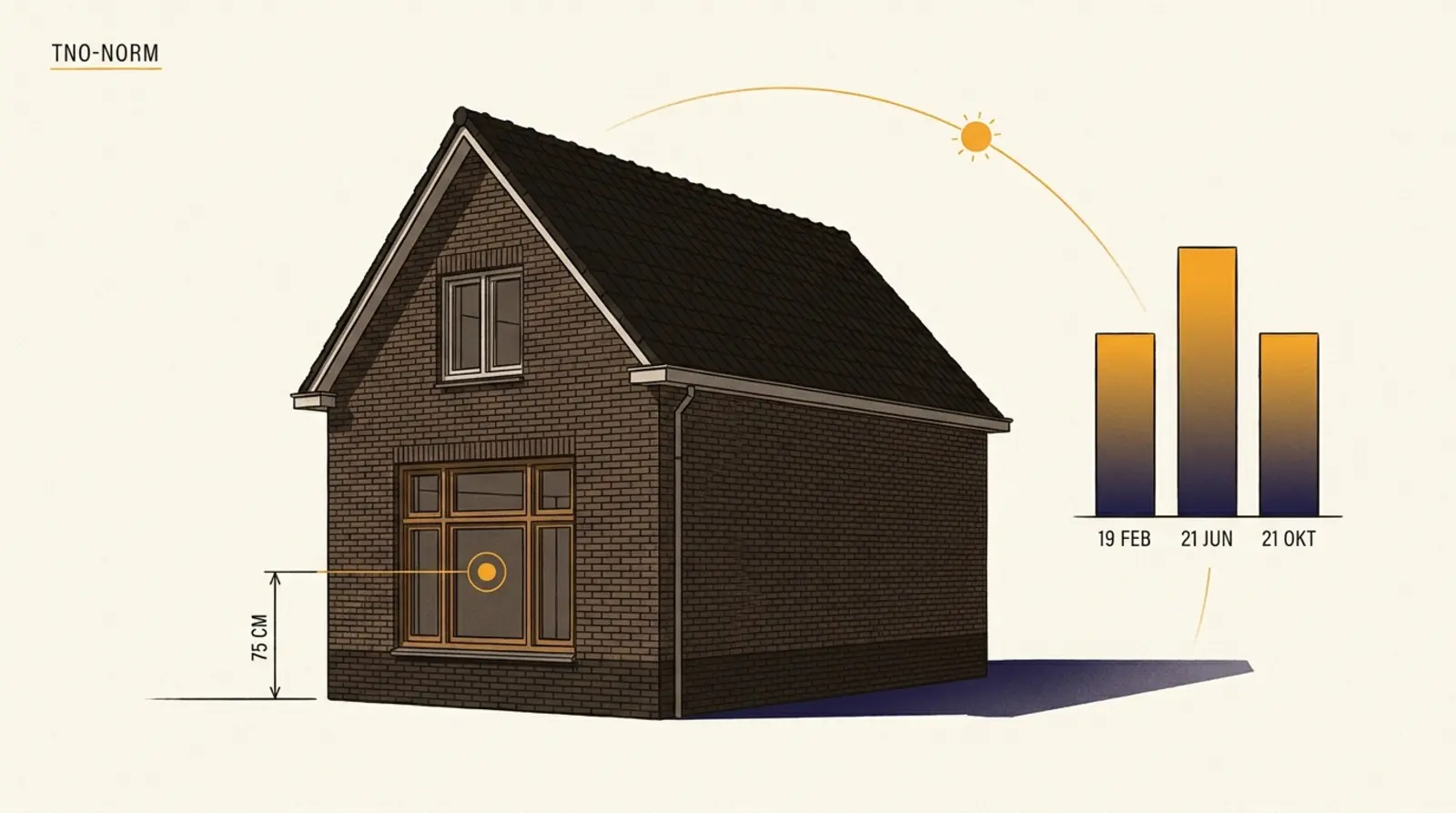
Sun exposure is the duration of direct sun at a measurement point, expressed in hours per day on fixed test dates. The test is against the TNO standard: the light standard requires at least 2 sun hours between 19 February and 21 October, the strict standard 3 sun hours between 21 January and 22 November, measured at the middle of the windowsill at a height of 75 cm. This is the most commonly used test in permit decisions, but it is a guideline, not a law.
According to the Information Point for the Living Environment (IPLO), central government has not laid down instruction rules for sun exposure: under the Environment Act (Omgevingswet), each municipality decides for itself how it weighs sun exposure in the environment plan. In the Almelo ruling (18 January 2023, ECLI:NL:RVS:2023:172), the Council of State confirmed that there are “no statutory standards for the sunlight of dwellings”, but that it is “not unusual” to align with the light or strict TNO standard.
A number of municipalities have their own variant. The Hague measures at the façade rather than the window, with a lower limit of 10° solar altitude and a 50% threshold for roof additions. Rotterdam and Eindhoven work with an assessment framework in which a reduction in sun exposure of up to 15% is acceptable. The full explanation of the test dates, the measurement point and the municipal variants is in our article The TNO sunlight standard explained.
Daylight: the only sunlight rule genuinely written into law
Daylight — in full, daylight admission — is the amount of daylight that a habitable room receives, and this is the only sunlight aspect that is nationally and mandatorily written into law. Since 1 January 2024 the requirements have been laid down in the Building Works Environment Decree (Bbl), the successor to the 2012 Building Decree (Bouwbesluit 2012). For new construction, articles 4.146 and 4.147 apply; for existing buildings, articles 3.81 and 3.82.
The requirement is a minimum equivalent daylight area, calculated according to NEN 2057. For new construction with a residential function, a habitable area must have at least 10% of its floor area as equivalent daylight area, and each separate habitable room at least 0.5 m². The calculation corrects the glazed area for orientation, type of glass and the obstruction angle of objects in front of it. Here, therefore, window size does count heavily — unlike with the sunlight standard.
Important for anyone expecting nuisance from the neighbours: the daylight requirement is tested at the moment a building is itself granted a permit. Obstructions on another parcel are, under article 4.147(3), left out of consideration (IPLO). A roof addition or tower built later by the neighbours therefore does not trigger a new daylight test on your existing home. The daylight requirement protects your home at the design stage, not against what a neighbour later puts up next to it. For that, the sunlight framework and neighbour law are the appropriate routes.
This article lists the rules. If the plan has already been permitted or built and you want to know how a court looks at it, read on below on how a court measures daylight loss.
Does the size of your window count?
For sun exposure, no; for daylight, yes. That difference is large enough to lead to opposite outcomes for exactly the same home. The TNO sunlight standard measures the sun at a single point — the middle of the windowsill, at 75 cm — and does not look at the window’s surface area. A small window of 10 by 10 cm counts the same number of sun hours at that measurement point as a sliding door of 3 by 2 m, as long as the sun reaches that point.
The daylight requirement in the Bbl works the other way round. There it is precisely the glazed area — corrected for orientation and obstruction — that determines whether a room complies. Three small windows of 10 by 10 cm together provide 0.03 m² of glass, well below the lower limit of 0.5 m² per habitable room. A large south-facing window that is 90% screened plummets in the daylight calculation because of the large obstruction angle.
The result: a room can comply with the sunlight standard on paper through a few small windows on sun-oriented façades, while the actual light intake is dismal and the daylight requirement is missed by a wide margin. This is a well-known limitation of the point measurement. For large windows where the middle of the windowsill is not representative, sunlight consultancies therefore sometimes recommend a sun-duration grid calculation across the entire glazed surface instead of a single measurement point.
A room with windows on several façades: how does that count?
The TNO standard tests per habitable room, not per window. If a living room has several windows — for example a corner room with a window facing south and one facing west — the sun hours of the measurement points are added together, with simultaneous sun counting only once. So it is the sum of the separate time slots, not the maximum and not a double count.
That answers the frequently asked question: if a new building completely blocks your south-facing window but the room still keeps windows on other façades, the room can still meet the light standard — provided those remaining windows together still reach 2 hours. Orientation is decisive here. In the Netherlands a north-facing window receives almost no direct sun, an east-facing window only morning sun and a west-facing window only afternoon sun. The south-facing window is usually the biggest supplier, so it is precisely the loss of it that can push a room below the standard, even if three windows remain.
In addition to this absolute lower limit, some municipalities apply a relative test. Rotterdam (CVDR662444) and Eindhoven accept a reduction in sun exposure of up to 15% relative to the existing situation; above that, a further assessment follows. The loss of a dominant south-facing window quickly reaches that threshold, even when the room only just still reaches the 2 hours.
Neighbours take away your sun: which rule helps then?
If a neighbour builds and takes away your sun, there are two routes — and the daylight requirement is not one of them. It only tests the neighbour’s own building, leaving your home out of consideration. The first route is public law: against an environmental permit you can submit a formal view (zienswijze) or an objection, in which the municipality weighs sun exposure as part of sound spatial planning. The TNO standard is the usual benchmark there. Incidentally, a plan may be permitted even if a single dwelling drops below the standard, as the Council of State ruled in Delft (3 July 2019, ECLI:NL:RVS:2019:2257).
The second route is private law. Article 5:37 BW expressly names the “withholding of light” as possible unlawful nuisance. The threshold is high and the court weighs the nature, severity and duration of the nuisance case by case. A valid permit does not indemnify the builder in this respect: in the Heemstede building-permit judgment (21 October 2005, ECLI:NL:HR:2005:AT8823) the Supreme Court held that a permit does not offer full indemnity against civil liability. In one concrete case, the District Court of The Hague on 17 January 2024 (ECLI:NL:RBDHA:2024:1206) even ordered the demolition of a roof addition that reduced sun exposure by 75 to 80% — despite the permit.
Beware one misconception: article 5:50 BW, which prohibits windows and balconies within 2 m of the boundary, is about outlook and privacy, not about sunlight. It is not an instrument against shadow nuisance. The substantive treatment of the neighbour-law route is in Neighbours’ roof addition: when is shadow legally unlawful?
How does a court measure daylight loss?
First the distinction that goes wrong in almost every discussion. In these cases a court has an expert calculate the interior daylight factor (DF): how much daylight reaches a working plane inside the room, under NEN-EN 17037 or the equivalent daylight area of NEN 2057. That is a different, more complete figure than a sky-view indication. A sky-view, or Vertical Sky Component, measures on the outside of the window how much sky it still sees. The sky-view is a useful, conservative first indication; it does not replace the expert calculation.
With that distinction in hand: courts have genuinely weighed the interior daylight factor. On 18 October 2023 the Limburg district court ( ECLI:NL:RBLIM:2023:6456) had an expert calculate the average daylight factor per room, and called both sunlight and that daylight factor "generally accepted methods" for assessing the deprivation of light. The court found unlawful nuisance on the basis of both the drop in sunlight and the drop in the daylight factor.
That ruling does not stand alone. On 2 June 2025 the Northern Netherlands district court ( ECLI:NL:RBNNE:2025:2378) ordered construction halted in summary proceedings because daylight admission after an extension would fall below the recommended value of NEN-EN 17037; the court considered that standard usable even though it is not yet written into legislation. And on 26 July 2024 The Hague district court ( ECLI:NL:RBDHA:2024:11706) ordered a construction stop where the expert report showed the daylight factor dropping by roughly 19%, alongside substantial loss of sunlight.
The practical lesson: you stand strongest with sunlight and daylight together. A large loss of sun makes the case, a demonstrable loss of daylight strengthens it — especially on a north or side façade where the sun hours are limited anyway and the blocked sky is the real problem. One piece of evidence showing both is more convincing than a complaint based on impression. Courts regularly dismiss claims that carry no measurable substantiation.
How Schaduwplan fits into this
Schaduwplan calculates the framework where hard numbers make the difference: sun exposure. The tool tests your address against the light and strict TNO standard and against the The Hague, Rotterdam or Eindhoven variant where it applies, and delivers per measurement point the number of sun hours before and after a planned construction. That is exactly the substantiation you need for a formal view, an objection, or as factual evidence in a neighbour-law dispute over unlawful nuisance.
In addition to sun exposure, Schaduwplan shows for each window a sky-view indication: the proportion of the sky that the window still sees from the outside (the Vertical Sky Component). That is a supplementary, conservative measure of daylight loss — useful as a second line of substantiation, because under art. 5:37 BW the court also weighs daylight, not just sun. It is expressly not the statutory daylight requirement: the internal daylight factor that a court has an expert calculate in such a case (NEN-EN 17037 or the equivalent daylight area according to NEN 2057) is a more complete, internal building-physics figure that our exterior indication does not replace.
What Schaduwplan deliberately does not do is that statutory daylight calculation. That test belongs with a new-build or renovation design and with an expert; if you need it, a building consultancy is the right place. For the question “how much sun and sky light am I losing, and does that still meet the standard?” you calculate it yourself, in a few minutes, on the basis of the same open government data (3DBAG, BAG, AHN) that the Council of State also accepts.
Sources (14)
We back every article with public sources. Click to see all the original documents, rulings and datasets.
Sources (14)
We back every article with public sources. Click to see all the original documents, rulings and datasets.
Legislation
- Daylight admission in new construction — art. 4.146 and 4.147 Bbl— Informatiepunt Leefomgeving
- Daylight admission in existing buildings — art. 3.81 and 3.82 Bbl— Informatiepunt Leefomgeving
- Building Works Environment Decree (Bbl)— wetten.overheid.nl
- Civil Code Book 5, art. 37 — unlawful nuisance— wetten.overheid.nl
- Civil Code Book 5, art. 50 — windows and balconies near the boundary— wetten.overheid.nl
- Sunlight in the environment plan — no national standard— Informatiepunt Leefomgeving
Case law
- Council of State 18 January 2023 — Almelo: TNO standards not unusual— ECLI:NL:RVS:2023:172
- Council of State 3 July 2019 — Delft: TNO not decisive— ECLI:NL:RVS:2019:2257
- Supreme Court 21 October 2005 — Heemstede building permit: a permit does not indemnify— ECLI:NL:HR:2005:AT8823
- District Court of The Hague 17 January 2024 — roof addition demolished at 75 to 80% sunlight loss— ECLI:NL:RBDHA:2024:1206
Standards and guidelines
- TNO sunlight standard — light and strict variant— bezonningsingenieur.nl
- The Hague sunlight standard — RIS 180461— Gemeente Den Haag
- Rotterdam sunlight assessment framework — 15% threshold— Gemeente Rotterdam, CVDR662444
- NEN 2057 — daylight area of buildings— NEN
Frequently asked questions
- Is the TNO sunlight standard a law?
- No. The TNO standard is a guideline, not a law. There is no national statutory standard for sunlight: the Environment Act (Omgevingswet) leaves this to municipalities (IPLO). In 2023 (ECLI:NL:RVS:2023:172) the Council of State did rule that it is “not unusual” to use the light or strict TNO standard as an assessment framework. The only sunlight rule genuinely written into law is the daylight requirement in the Building Works Environment Decree (Bbl).
- What is the difference between sun exposure and daylight?
- Sun exposure (bezonning) is the number of hours of direct sun a measurement point receives, tested against the TNO standard (a guideline). Daylight is the amount of daylight in a habitable room, expressed as an equivalent daylight area, and is laid down in law in the Building Works Environment Decree (Bbl, art. 4.146 and 4.147). Sun exposure is about sun on a point; daylight is about light entering the whole room. They are separate regimes with a different legal status.
- Does the size of my window count towards the sunlight standard?
- Not for the TNO sunlight standard. It measures the sun at a single point — the middle of the windowsill — independently of the window size. A window of 10 by 10 cm counts the same at that point as a 3 by 2 m frontage. For the daylight requirement in the Bbl the size does matter a great deal: there the glazed area (corrected for orientation and obstruction) determines whether a room complies.
- My south-facing window is being blocked, but I still have windows on other façades — do I still comply?
- Possibly. The TNO standard adds up the sun hours of all windows of the same living room, counting simultaneous sun only once. If the remaining windows together still reach 2 hours, the room meets the light standard. Watch the orientation: a north-facing window supplies almost no direct sun in the Netherlands, so three windows on other façades often cannot compensate for the loss of a south-facing one. Municipalities such as Rotterdam and Eindhoven also apply a limit of at most 15% reduction in sun exposure.
- Can I rely on the daylight requirement if the neighbours take away my sun?
- As a rule, no. The daylight requirement in the Bbl is tested at the moment a building is itself granted a permit, and obstructions on another parcel are, under art. 4.147(3), left out of consideration. A new building by the neighbours therefore does not trigger a new daylight test on your existing home. The routes that are open in that case are the municipal sunlight framework (a formal view or objection) and neighbour law (unlawful nuisance, art. 5:37 of the Civil Code (BW)).
- Does Schaduwplan test daylight as well?
- In part. The core remains sun exposure: direct sun hours per measurement point, tested against the light and strict TNO standard and against the The Hague, Rotterdam or Eindhoven variant where it applies. In addition, for each window we show a sky-view indication: how much sky the window still sees from the outside — a supplementary, conservative measure of daylight loss. That is not the statutory daylight requirement in the Bbl (the equivalent daylight area / internal daylight factor according to NEN 2057); Schaduwplan does not perform that internal building-physics calculation — for that, a building consultancy is the appropriate route. Our sky-view indication measures the outside of the window and does not replace that expert calculation.
Back up your sunlight loss with numbers
Schaduwplan calculates per measurement point how many sun hours you gain or lose, tested against the light TNO standard, the strict TNO standard and the municipal variant. One address, one PDF report for €49 — usable for a formal view, an objection or a neighbour-law dispute.
Read more
Standards & municipalities
What does a sunlight study cost in 2026? A price comparison
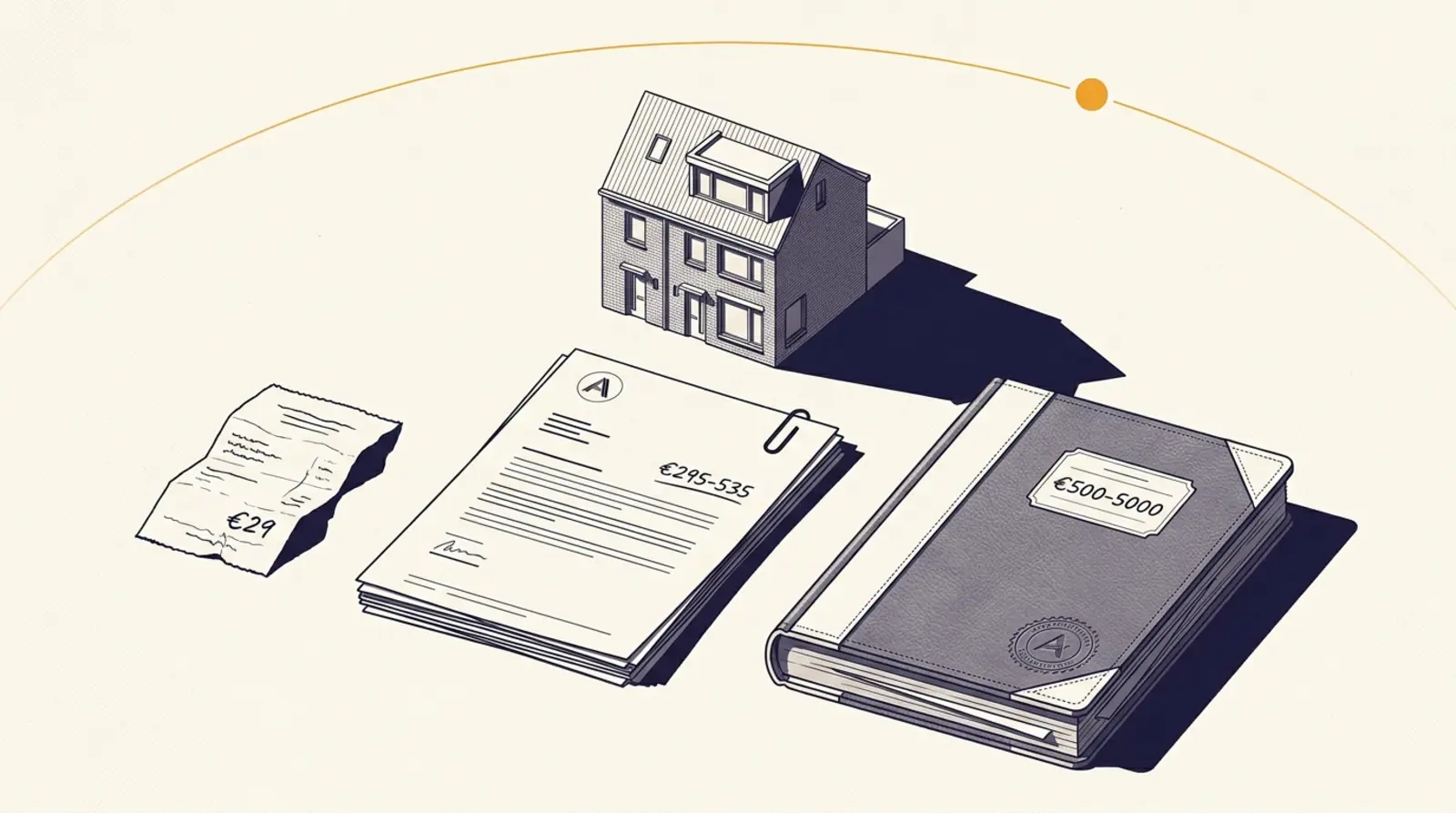
A sunlight study in the Netherlands ranges from € 39 for an automated self-service report to € 5,000 for a large engineering firm with a sworn expert. This guide sets four price tiers side by side — self-service tools, an independent building-advice consultant, a small firm and a large engineering firm — with honest trade-offs in turnaround, legal weight and iteration.
Standards & municipalities
The TNO sunlight standard: light and strict variants
The TNO sunlight standard defines how many sun hours a home must receive on set test dates. The light standard requires 2 sun hours from 19 February to 21 October; the strict standard 3 sun hours from 21 January to 22 November. The Hague, Rotterdam, Eindhoven and Krimpen use their own variants. This is the de facto standard in Dutch permit decisions.
Standards & municipalities
What the zoning plan permits: the building plot explained
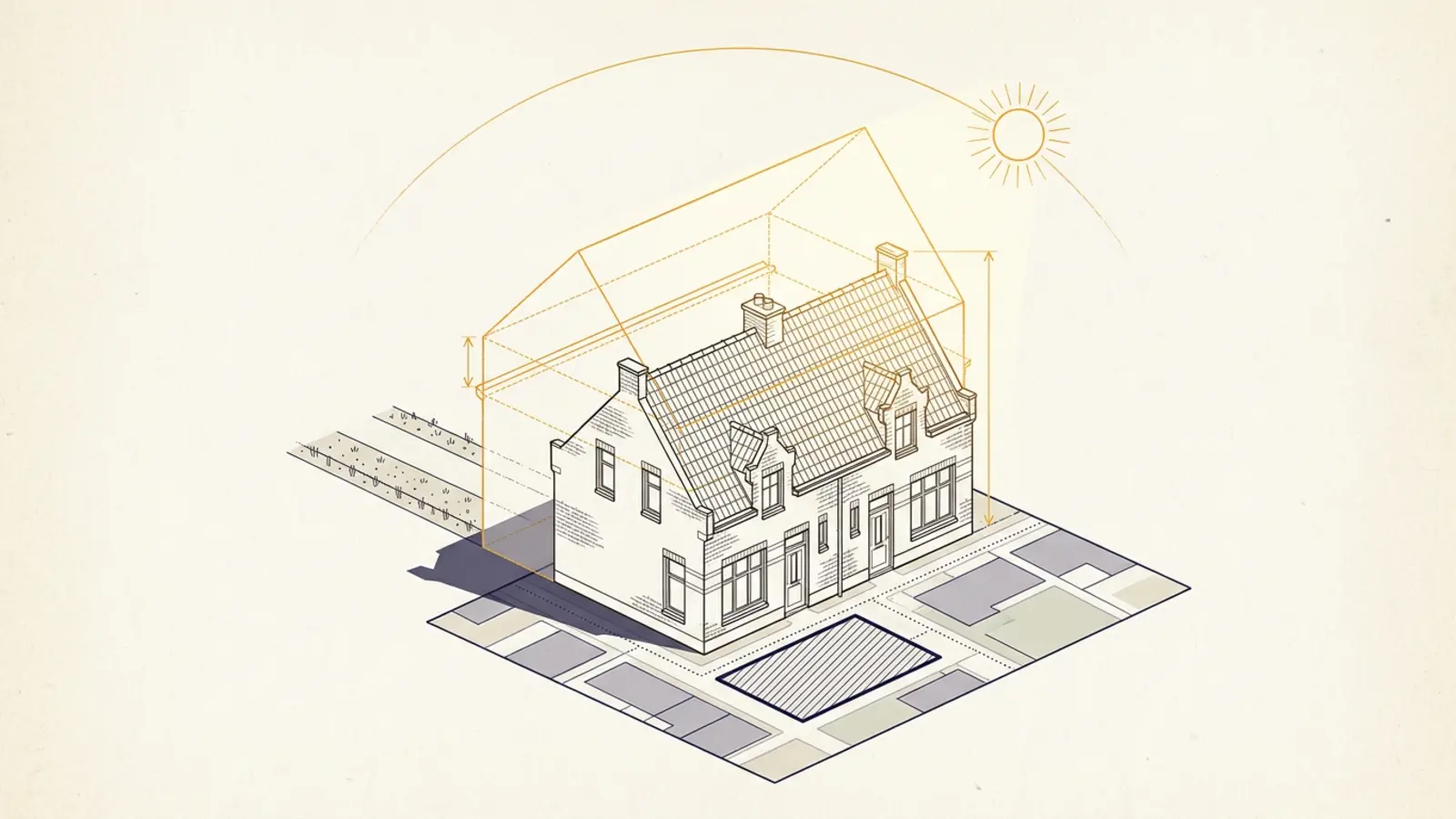
A Dutch municipality’s omgevingsplan records a building plot per parcel with a maximum eaves and building height: the planning-permitted volume. Every Dutch address has one, but only newer plans publish it as data. What it leaves out: permit-free building, in-plan deviation powers and custom rules.