Standards & municipalities
The TNO sunlight standard: light and strict variants
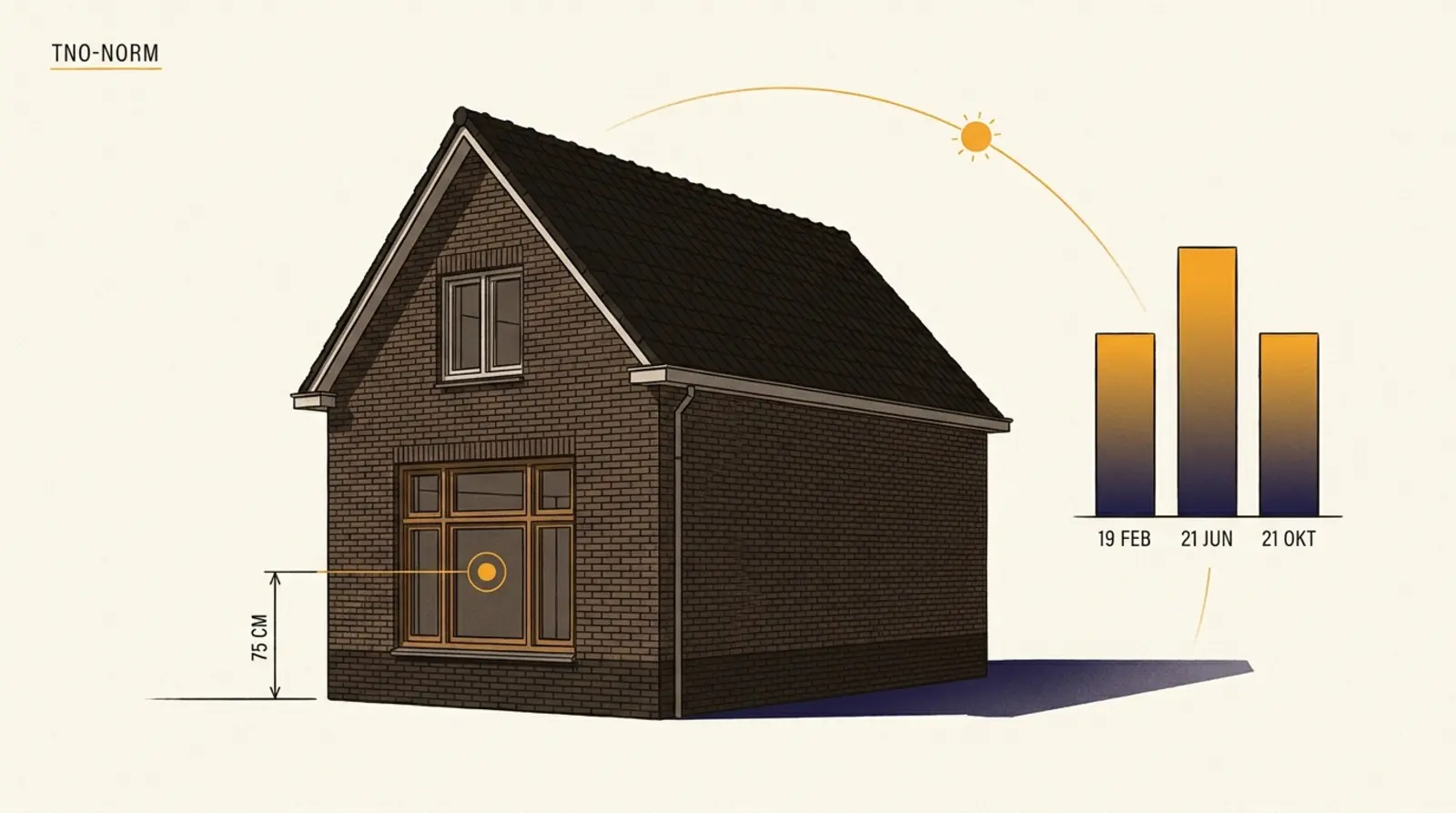
The TNO sunlight standard defines how many sun hours a home must receive on set test dates. The light standard requires 2 sun hours from 19 February to 21 October; the strict standard 3 sun hours from 21 January to 22 November. The Hague, Rotterdam, Eindhoven and Krimpen use their own variants. This is the de facto standard in Dutch permit decisions.
What is the TNO sunlight standard?
The TNO sunlight standard is a Dutch guideline from TNO report 2005-BBE-R0036 for the minimum acceptable amount of sunlight for residential buildings. There are two variants: the light standard with at least 2 sun hours per day between 19 February and 21 October, and the strict standard with at least 3 sun hours per day between 21 January and 22 November. The measurement point sits 75 cm above the finished floor of the living room.
The standard is not legally mandatory. Under the Environment and Planning Act (in force since 1 January 2024), each municipality sets its own assessment framework in the environment plan. In practice almost every Dutch municipality uses the TNO standard as the default. According to the Council of State (Almelo, 18 January 2023, ECLI:NL:RVS:2023:172) that choice is “not unusual” and the municipality may choose between the light and strict standard.
Light versus strict standard: what is the difference?
The difference between the light and strict standard lies in two parameters: the minimum number of sun hours per day, and the period over which it must hold. The table below sets them side by side.
| Parameter | Light standard | Strict standard |
|---|---|---|
| Minimum sun hours per day | 2 hours | 3 hours |
| Period start date | 19 February | 21 January |
| Period end date | 21 October | 22 November |
| Total duration | 8 months | 10 months |
| Hours consecutive? | No | No |
| Measurement point | Middle of windowsill, 75 cm, living room | Middle of windowsill, 75 cm, living room |
| Most used by | Medium-sized municipalities, rural areas | Large cities, high-rise sites, inner-city |
The choice between the light and strict standard is up to the municipality. A larger city with dense development usually chooses the strict standard because there is less inherent sunlight loss between neighbours. In rural or spaciously laid-out neighbourhoods the light standard is sufficient. Worth knowing: the hours do not have to be consecutive. A window that gets 1 hour of sun in the morning and 1 hour in the afternoon counts as sufficient under the light standard.
Measurement method: where and how do you measure?
The TNO methodology prescribes a specific measurement point: 75 cm above the finished floor of the storey where the living room is located, in the middle of the windowsill, on the inside of the glass. The height is a convention — comparable to the eye level of someone sitting on a sofa. For a living room on the ground floor that means roughly 75 cm above the floor slab; for a living room on the first floor roughly 75 cm above that storey floor.
Not every façade receives sun. In the Netherlands, north-facing façades receive no direct sun (except for short intervals in June early in the morning and late in the evening), so they fall outside the TNO test. Only façades that can in principle receive sun — south, east, west and sub-planes of these — are tested. For a mid-terrace house with only a front and rear façade, that usually means two measurement points: one to the south, one to the north, of which only the southern one counts for TNO.
Several windows in the same living room may be added together. A corner living room with a front window facing south and a side window facing west combines both sun-hour streams into a single value. An open-plan kitchen adjoining the living room also counts. Separated spaces do not: each living room has its own measurement point and its own test.
The test dates: why 19 February, 21 June and 21 October specifically?
The light TNO standard defines a period from 19 February to 21 October. Those dates are not arbitrary. 19 February and 21 October mark exactly the points in the year at which the sun’s path lies symmetrically around the summer solstice (21 June). On both dates the sun stands at the same elevation, so the shadow cast by a structure is virtually identical. That makes them the “worst” days within the light standard period: low sun elevation, long shadows.
The strict standard extends the period to 21 January and 22 November, which makes the sun even lower and the shadows even longer. On those dates the sun stands so low that even small structures cast enlarged shadows. That is also why the Council of State in Ootmarsum (3 July 2013, ECLI:NL:RVS:2013:191) accepted that a wintertime shortfall in the sunlight study is “inherent to the low sun position” and need not be grounds for rejection.
For the calculation it is enough to test three test dates: 19 February, 21 June and 21 October. The sunlight loss on all the intervening days follows a parabolic pattern between these extremes, so the three test dates sufficiently define the average situation. For the strict standard you add 21 January and 22 November. A complete audit often also uses the equinoxes (21 March and 23 September) and the winter solstice (22 December) as context, although these do not count towards the standard test.
Municipal variants: The Hague, Rotterdam, Eindhoven, Krimpen
Four Dutch municipalities have adopted their own, deviating sunlight standard. This applies on top of the light or strict TNO standard as a local test. The table below lists the standards that Schaduwplan tests automatically, with their test window, test dates and any reduction threshold.
| Standard | Min. sun hours | Test dates | Test window | Reduction threshold |
|---|---|---|---|---|
| TNO light | 2 hours | 19 Feb, 21 Oct | sunrise–sunset | none |
| TNO strict | 3 hours | 21 Jan, 22 Nov | sunrise–sunset | none |
| The Hague | 2 hours | 19 Feb, 21 Oct | whole day, sun above 10° | 50% (roof addition) |
| Rotterdam | 2 hours | 21 Sep | sunrise–sunset | 15% (assessment) |
| Eindhoven | 2 hours (1 façade) | 21 Mar | sunrise–sunset | 15% (assessment) |
- The Hague — RIS 180461. Measurement at 75 cm height in the middle of the façade (not the window), regardless of whether there is a window. Sun hours of the front and rear façade may be added together. Sun only counts when the sun elevation is above the 10° horizon angle. A planned roof addition may reduce the sunlight duration of neighbouring dwellings by at most 50%.
- Rotterdam — Sunlight Assessment Framework (CVDR662444). A three-step assessment framework: retaining at least 2 sun hours on 21 September, measured from sunrise to sunset. Step 1 — all measurement points keep 2 hours of sun, then it is approved. Step 2 — below that, but less than 15% reduction compared with the current situation, then the plan can still proceed. Step 3 — more than 15% reduction, then a qualitative assessment follows between the interest in densification and the loss of sunlight.
- Eindhoven — Residential sunlight policy rules 2024 (CVDR723135). At least 2 hours of direct sun on at least one façade in the period from 21 March to 21 September, tested on 21 March across the whole day. A decrease of up to 15% of the sunlight duration is acceptable; above that a further assessment follows. For 18 designated public sunny spots, separate shadow-free time windows apply.
- Krimpen aan den IJssel — Sunlight study guideline. The most detailed official municipal template in the Netherlands. It describes exactly which elements a report must contain: 3D model, test dates, measurement points, tables, conclusions. It is used by other municipalities as a reference model.
Always check in advance whether your municipality has its own variant. Schaduwplan automatically selects the right set based on the address: the two TNO standards everywhere, plus the The Hague, Rotterdam or Eindhoven standard as soon as your address falls within that municipality. Krimpen aan den IJssel does not prescribe its own sun-hour standard, but a guideline for setting up the report; it does not count as a separate test. For the majority of the 342 municipalities (without their own policy) the light TNO standard applies as the reference. View the detail page with sources per municipality: The Hague, Rotterdam, Eindhoven or Krimpen aan den IJssel.
The TNO standard under the Environment and Planning Act (since 1 January 2024)
The Environment and Planning Act has been in force since 1 January 2024. Sunlight falls under article 2.1 (physical living environment) and is regulated by municipalities through the environment plan (art. 2.4 and 4.2). There are no national instruction rules; each municipality fills in the details itself. This means that municipalities formally have the freedom to choose their own standard, but in practice the vast majority stick to the TNO standard for procedural simplicity.
For you as an objector or permit applicant, little changes administratively. The Environment Desk (Omgevingsloket) replaces the old permit procedure, the six-week objection period remains intact, and the administrative-law assessment still revolves around sound spatial planning with sunlight as a component. What does change: municipalities can now explicitly state in the environment plan that a sunlight study is mandatory above a certain building height. That lowers the threshold for applicants, because the obligation is clear in advance.
How Schaduwplan applies this
By default Schaduwplan tests your address against all relevant standards at once. For a home in a municipality without its own policy, the tool runs the light TNO test on 19 February, 21 June and 21 October, plus a strict test on the extended test dates. If your address is in The Hague, Rotterdam or Eindhoven, the municipal standard is added automatically — with the corresponding 50% or 15% reduction threshold.
All standards count “possible sunlight hours” across the whole day, from sunrise to sunset — exactly as the TNO guideline formulates it (“per day”). Within that, the The Hague standard only counts sun that stands higher than 10° above the horizon. For each standard Schaduwplan states which window applies, and it also shows the sunlight-duration timeline with the sunrise and sunset times included, so you can see when during the day you gain or lose sun.
Alongside the test dates, Schaduwplan also estimates the loss across the whole year. The tool samples one representative day per week (52 days) and calculates every eight minutes whether a building stands between the sun and the measurement point. That yields two annual figures: the percentage of less sun across the full day, and within the daytime hours (09:00–17:00). This way you see not only whether the home passes on the test dates, but also how much sun you actually lose on an annual basis.
The result is a PDF report with a test table per measurement point: your sun hours before and after the planned construction, tested against every relevant standard, with an explicit pass / near-miss / fail status per measurement point. Each measurement point has its own row, each standard its own column. That allows a municipal officer or judge to see immediately whether the situation is problematic — without having to carry out the standard test themselves.
Sources (13)
We back every article with public sources. Click to see all the original documents, rulings and datasets.
Sources (13)
We back every article with public sources. Click to see all the original documents, rulings and datasets.
Standards and guidelines
- TNO sunlight standard — original report 2005-BBE-R0036— TNO Delft
- IPLO — Sunlight in the environment plan— Informatiepunt Leefomgeving
- The Hague sunlight standard — RIS 180461— City of The Hague
- Rotterdam sunlight assessment framework— City of Rotterdam
- Sunlight study guideline, Krimpen aan den IJssel— Municipality of Krimpen aan den IJssel
- Eindhoven sunlight policy— City of Eindhoven
- Bezonningsingenieur — TNO standard explained— bezonningsingenieur.nl
Case law
- Council of State 18 January 2023 — Almelo: TNO standards not unusual— ECLI:NL:RVS:2023:172
- Council of State 5 April 2023 — Voorburg: additional study for a missing roof addition— ECLI:NL:RVS:2023:1329
- Council of State 3 July 2013 — Ootmarsum: zoning plan annulled— ECLI:NL:RVS:2013:191
Legislation and regulations
- Environment and Planning Act — art. 2.1 physical living environment— wetten.overheid.nl
Data sources
- 3DBAG — open 3D models of Dutch buildings— TU Delft and 3DGI
- AHN4 — Actueel Hoogtebestand Nederland— Rijkswaterstaat and the water authorities
Frequently asked questions
- Do I have to use the TNO standard, or can the municipality require a different one?
- The TNO standard is not legally mandatory. Under the Environment and Planning Act, each municipality sets its own assessment framework in the environment plan. In practice the light TNO standard is used most often. In 2023 the Council of State ruled (ECLI:NL:RVS:2023:172) that TNO standards are "not unusual" to apply. The Hague, Rotterdam, Eindhoven and Krimpen aan den IJssel have additional variants.
- What if my window is not exactly 75 cm high?
- The measurement point sits 75 cm above the finished floor of the storey where the living room is located — that is a methodological convention, not an architectural requirement. If your window is lower or higher, you still use 75 cm as the reference height. Measure the sun hours at the middle of the windowsill on the inside of the glass, except in The Hague (where the middle of the façade is measured).
- Can you add up the sun hours of several windows?
- Yes, provided they open onto the same living room. Sun hours from several windows in one living room may be summed. Sun hours from an open-plan kitchen connected to the living room also count as one space. For separated spaces (individual rooms) you do not add them up: each living room has its own measurement point and its own test against the standard.
- Do trees and fences count in the calculation?
- Not in the formal TNO test. Legally, trees and fences are regarded as temporary landscape elements — the owner can remove them — so the TNO standard itself does not prescribe including them, and firms usually leave them out of the standard test (as does the Krimpen guideline). Note: the TNO standard does not explicitly exclude them; ultimately a court decides whether the shadow of trees counts. In a neighbour-law procedure (unlawful nuisance, art. 5:37 of the Civil Code) the shadow of trees or a fence can indeed be weighed. That is why Schaduwplan calculates the shadow of greenery and fences separately — outside the formal TNO test, but usable as factual evidence.
- Does the TNO standard also apply to balconies, terraces or gardens?
- The original TNO standard was written for dwellings — a measurement point in the living room at 75 cm height. There is no formal TNO standard for outdoor spaces. In practice firms and courts use the same test dates (19 February, 21 June, 21 October) and the same hourly intervals, but measure at the surface of the terrace or garden. For roof additions, The Hague applies a 50% reduction rule for adjacent gardens.
- What does the court do when a municipality has its own standard?
- Then the court tests against that local standard as part of local policy (sound spatial planning, art. 3:2 of the General Administrative Law Act). The Council of State (Almelo, 2023, ECLI:NL:RVS:2023:172) ruled that the choice between light and strict TNO or a municipality’s own variant is reasonably up to the municipal council. Your objection must show that the municipal standard was applied incorrectly, not that the standard itself is wrong.
Test your address against every standard
Schaduwplan automatically tests against the light TNO standard, the strict TNO standard, the The Hague 50% rule, the Rotterdam assessment framework and the Eindhoven standard. One address, all relevant tests, one PDF report for €49.
Read more
Standards & municipalities
Sunlight and Dutch neighbour law: which rules apply
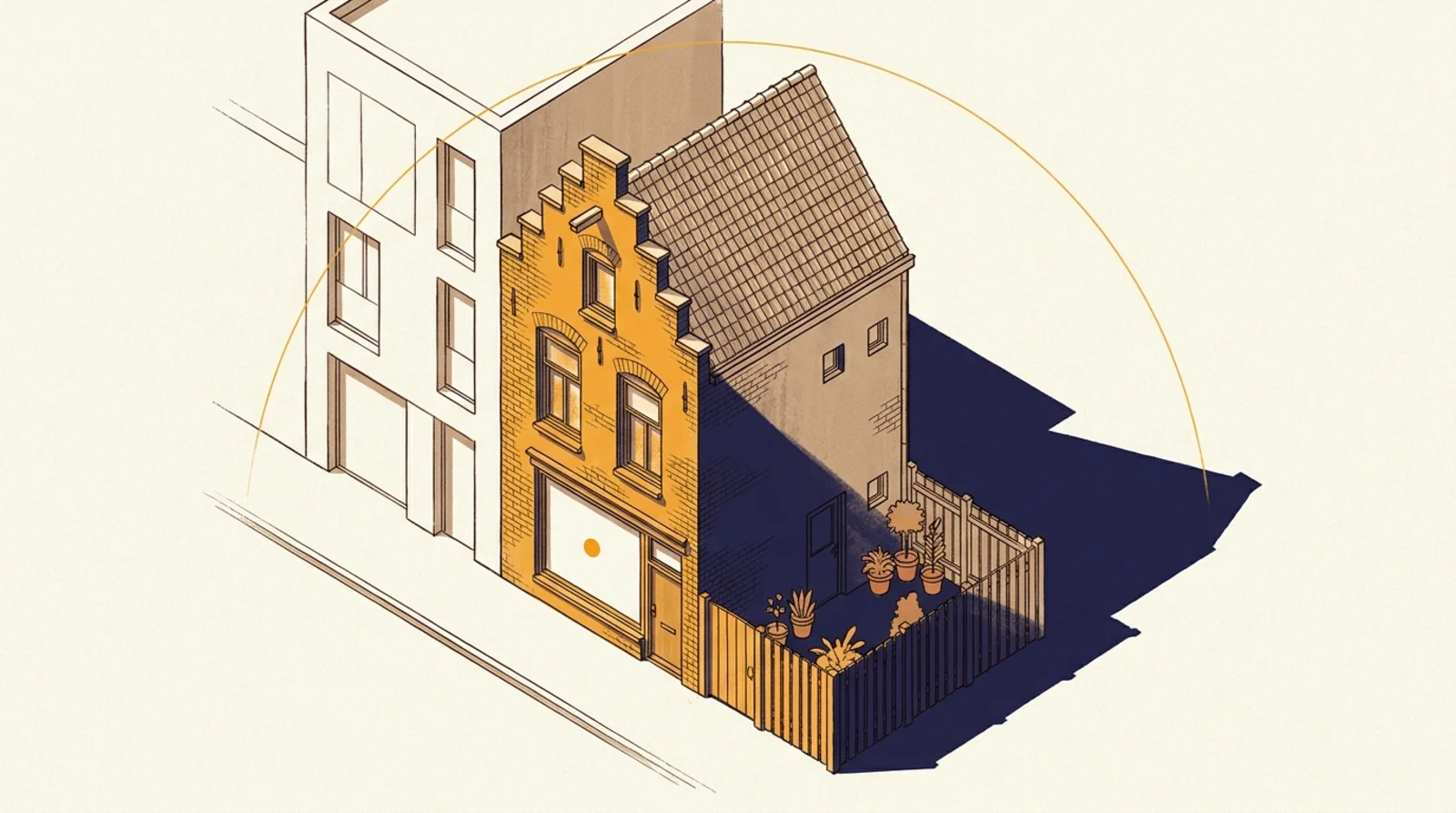
Three separate frameworks govern sunlight at a home. Sunlight access (the TNO standard) is a guideline, not a law. Daylight (Articles 4.146 and 4.147 of the Building Works Environment Decree) is the only one written into national law. Neighbour law (Article 5:37 of the Civil Code) governs unlawful nuisance. Window size counts for daylight, not for sunlight access.
Standards & municipalities
What does a sunlight study cost in 2026? A price comparison
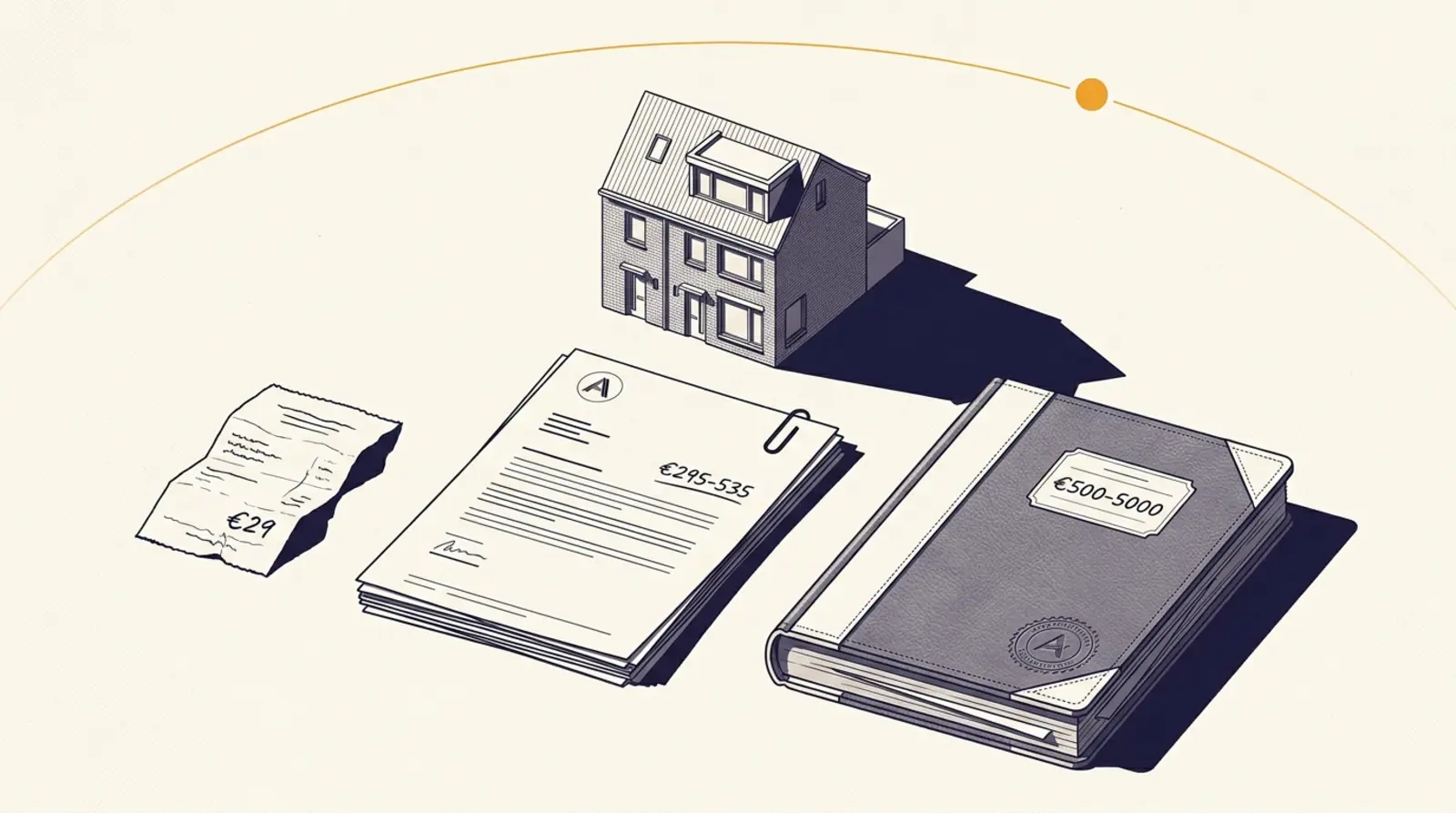
A sunlight study in the Netherlands ranges from € 39 for an automated self-service report to € 5,000 for a large engineering firm with a sworn expert. This guide sets four price tiers side by side — self-service tools, an independent building-advice consultant, a small firm and a large engineering firm — with honest trade-offs in turnaround, legal weight and iteration.
Standards & municipalities
What the zoning plan permits: the building plot explained
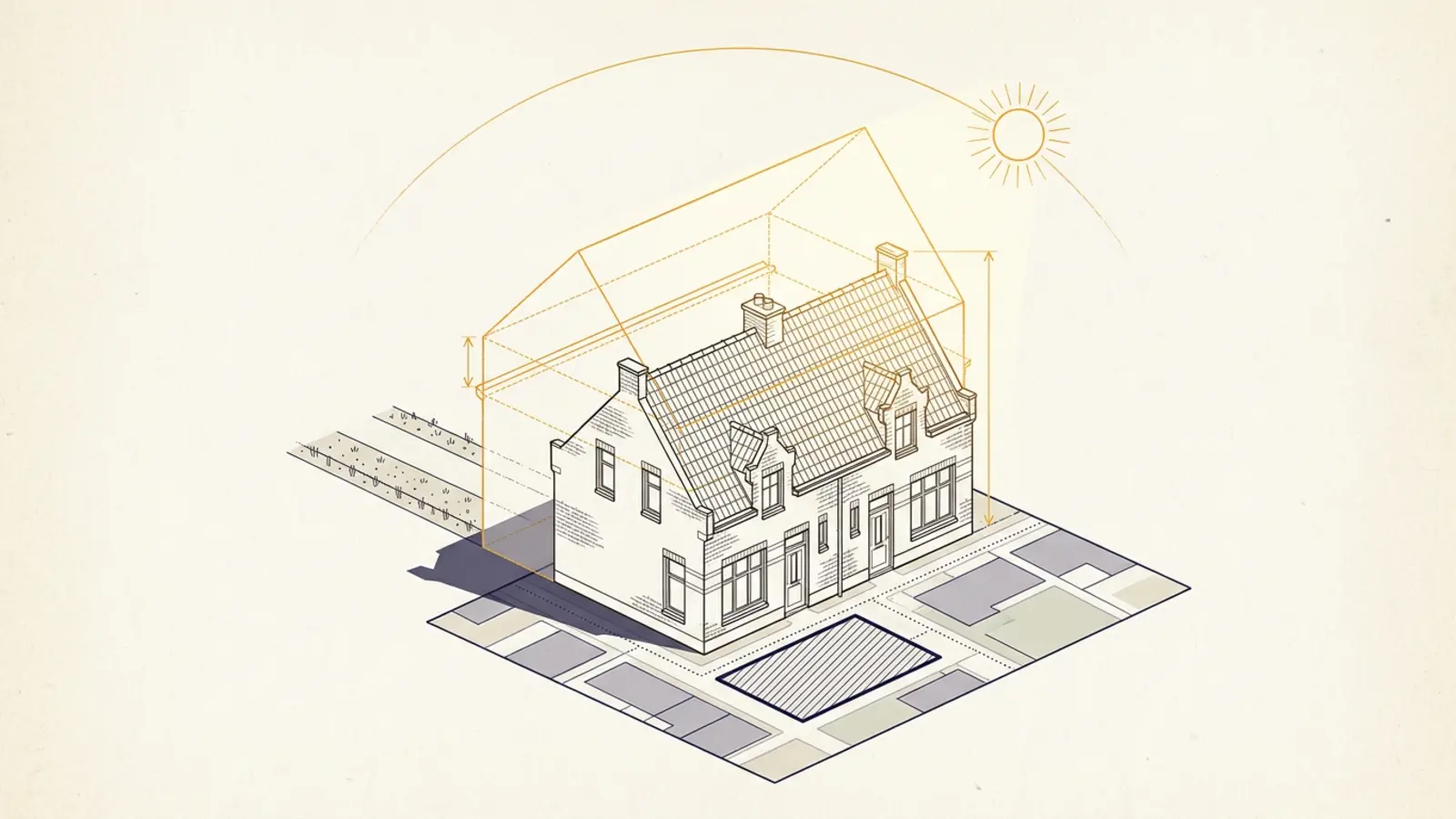
A Dutch municipality’s omgevingsplan records a building plot per parcel with a maximum eaves and building height: the planning-permitted volume. Every Dutch address has one, but only newer plans publish it as data. What it leaves out: permit-free building, in-plan deviation powers and custom rules.