Standards & municipalities
What does a sunlight study cost in 2026? A price comparison
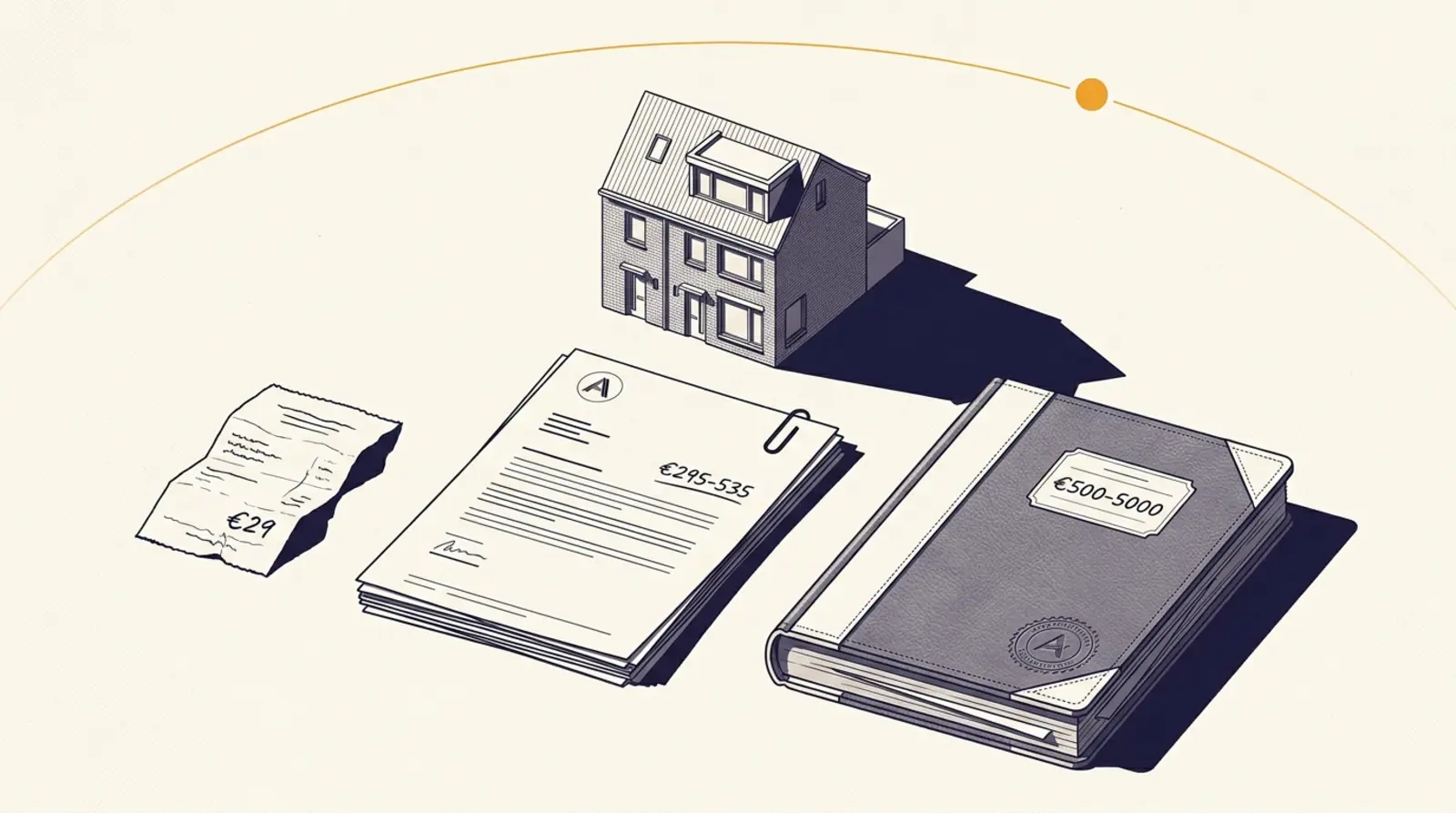
A sunlight study in the Netherlands ranges from € 39 for an automated self-service report to € 5,000 for a large engineering firm with a sworn expert. This guide sets four price tiers side by side — self-service tools, an independent building-advice consultant, a small firm and a large engineering firm — with honest trade-offs in turnaround, legal weight and iteration.
What does a sunlight study cost in the Netherlands?
A sunlight study in the Netherlands costs between €39 and €5,000 per report. The price is set by the provider: a self-service tool runs the analysis in minutes, a small building-advice firm reckons 5 to 10 working days, a large engineering firm delivers in 1 to 3 weeks with a sworn expert. All four price brackets use the same public government data — 3DBAG, BAG and AHN4 — and the same TNO standard.
The difference lies in who prepares the report, how quickly you receive it, and to what extent a human expert is involved. Below is an honest comparison of the four segments, with the prices that were common at the well-known Dutch providers in April 2026.
| Segment | Price | Turnaround | Legal status | Iteration | Sworn expert |
|---|---|---|---|---|---|
| Self-service tools (Schaduwplan, ZonScenario) | €39 to €99 | Minutes | Indicative, admissible in objection and neighbour-law cases | Unlimited free iteration before purchase | No |
| Small building-advice firm (HoeveelZon, SchaduwSimulator, HBA, Zonnestudie) | €295 to €535 | 5 to 10 working days | Usable in objection and appeal | New study per change | Depends on the firm |
| Large engineering firm (DGMR, Peutz, Nieman) | €500 to €5,000 | 1 to 3 weeks | Hearing support, expert witness | One iteration included | Yes |
The table makes one thing immediately clear: the final legal quality scales more slowly than the price. According to the Council of State (Almelo, 18 January 2023, ECLI:NL:RVS:2023:172), TNO standards based on the same data that all four segments use are “not unusual” to apply. What a more expensive firm adds is primarily human interpretation, a cover letter and a possible appearance as an expert witness — not the underlying calculation.
If you would rather see the comparison per provider than per price segment, they sit side by side in sunlight tools compared. If you already know what you need, you can order a sunlight study directly.
Self-service tools: €39 to €99 per report
Self-service tools deliver a sunlight report without human intervention, in minutes. Schaduwplan costs €49 per report and uses 3DBAG, BAG and AHN4 directly from the browser. ZonScenario charges €39 as an introductory price (rising to €99) for a month of unlimited access including PDF export. Zonnegrens offers no report but consumer access from €2.49 per 90 days. The advantages are speed, cost-free iteration before purchase and reproducibility.
What you miss compared with a firm: human commentary, a cover letter and the option to have a sworn expert appear as an expert witness. For the objection phase of an environmental permit — where the examining magistrate assesses only the case file — that rarely matters. The same holds for civil proceedings at the District Court of The Hague, as the ruling of 17 January 2024 (ECLI:NL:RBDHA:2024:1206) showed: what proved decisive was that the report explicitly tested against the TNO standard and cited public data sources.
Who self-service works for: concerned neighbours within the six-week window, proactive homeowners who want to see up front whether their design poses a risk, and architects who run several variants in an early design phase before ordering a formal report.
Independent building-advice firms: €295 to €535
Independent building-advice firms deliver a report prepared by a human, with an explanatory foreword and the option to contact the adviser directly. HoeveelZon starts at €295, SchaduwSimulator at €310, Zonnestudie between €330 and €350, and HBA (Handel Bouwadvies) charges €400 to €535 depending on the complexity of the project. Turnaround: 5 to 10 working days.
What you get at this price point: a PDF report that often already meets local guidelines (such as that of Krimpen aan den IJssel), an adviser who answers questions by phone or email, and at some firms a template for a covering letter to accompany your notice of objection or permit application. The legal status is equivalent to a self-service report. The difference for the judge or the municipality lies in the signature of a professional, which lowers the threshold in official procedures.
Where it pinches is iteration. Every firm works from the building drawings you supply. If you want to lower the roof height by 20 centimetres to see whether you then stay within The Hague 50% rule, that is in almost all cases a new study with a corresponding extra charge. For anyone having a single final design assessed, this segment is usually the best balance between price and quality.
Large engineering firms: €500 to €5,000
Large engineering firms such as DGMR, Peutz and Nieman Raadgevende Ingenieurs charge €500 to €5,000 per sunlight study. The price varies strongly with complexity: a stand-alone roof addition sits at the bottom, an area development with dozens of volumes and aesthetic-quality requirements at the top. Turnaround: 1 to 3 weeks.
What you get for this investment: analysis by a senior building physicist or sunlight specialist, extensive scenario variants, an explicit assessment against both the TNO standard and the local guideline, and — if the project goes to appeal or higher appeal — the option to have the author appear as an expert witness before the administrative court or the Administrative Jurisdiction Division of the Council of State. The latter is, for example, what tipped an Amsterdam Nieuw-West case (2023) about roof additions.
For most homeowners this segment is overkill. The Council of State ruled in Ootmarsum (3 July 2013, ECLI:NL:RVS:2013:191) that the absence of a sunlight study can annul a plan — but an existing, well-substantiated study does not have to come from a large firm to fulfil that same role. Large firms are functionally necessary for high-rise visions and inner cities with a historic sunlight record. For projects where the zoning plan requires “maximum planning possibilities” as the baseline that no longer holds: that comparison is in the paid Schaduwplan report. Schaduwplan consults the omgevingsplan at your address: where the building plot and its dimensions are published as data, the permitted envelope arrives prefilled in the viewer and you confirm or correct every value. Where they are not — with older plans they exist only on the plan map — you take the dimensions over yourself, which says nothing about what may be built there. Schaduwplan does not derive that envelope from the planning rules, and permit-free building, in-plan deviation powers and custom rules are not included in it. For the legal interpretation of those rules you still go to your architect or lawyer.
Which price point fits your situation?
The pricing question does not hinge on the report, but on the risk that the case ends up in appeal or higher appeal. That is why, where the risk is limited, it is advisable to start small and escalate only if it proves necessary. Below are four common scenarios with a suitable price bracket.
- Concerned neighbour, six-week window running. Start with self-service (€39 to €99). The objection phase calls for a case file, not a hearing. Escalate to a firm only if your objection is declared unfounded and you go to appeal before the court.
- Proactive homeowner, preparing a permit. Self-service (€49) for the design phase and iteration, a small firm (€295 to €535) for the final report you attach to the application. Total: from around €345 with several design variants tested.
- Architect with a residential project. Self-service for preview and client presentation, a small firm for the official permit annex. The architect saves one to three iterative firm reports and keeps client budget free for other advice.
- Complex high-rise project or historic inner city. A large engineering firm straight away (€500 to €5,000). Self-service remains useful for interim design choices, but the final report with an expert witness justifies the investment.
Hidden costs: legal aid and excess
The list price is not always the net price. Many Dutch homeowners hold home legal expenses insurance with providers such as DAS, Achmea or Univé. In disputes about building permits and neighbour law, these insurers in many cases reimburse the cost of a sunlight study, provided the report contributes substantively to the case and has been agreed in advance. Zonnestudie mentions this explicitly as a service.
That changes the calculus. A €350 report that is fully reimbursed is effectively free, whereas a €49 report via Schaduwplan usually falls within the excess and is therefore not claimable. For low-threshold research questions self-service is still faster; for formal procedures with fully covering insurance, the firm report at no extra cost is a reasonable choice.
Note the following: always request written confirmation of cover from your insurer before ordering, with an explicit reference to the policy clause. Insurers sometimes maintain a preferred list of firms. Schaduwplan and ZonScenario are not (yet) on it; HoeveelZon, HBA and SchaduwSimulator are.
How Schaduwplan fits into this price spectrum
Schaduwplan positions itself in the self-service segment at €49 per report, with no subscription. The tool automatically builds a 3D scene based on 3DBAG, BAG and AHN4 — the same sources that both HoeveelZon and DGMR use. The report contains the standard elements that officials and judges expect: a north arrow, a scale bar, TNO testing per measurement point, a methodology appendix with source references, and a disclaimer about the indicative status.
In practice you use Schaduwplan in three ways. As a starting point to gauge for yourself whether the sunlight loss is material before you decide to bring in a firm. As a final report for objection phases and civil neighbour-law cases where the cost-benefit balance makes a more expensive route hard to justify. Or as an iteration tool alongside a firm: run the variants in Schaduwplan, then take the final design to HBA or Peutz for the official annex. In all three cases €49 is a fraction of the alternatives, with the same data underneath.
Sources (16)
We back every article with public sources. Click to see all the original documents, rulings and datasets.
Sources (16)
We back every article with public sources. Click to see all the original documents, rulings and datasets.
Case law
- District Court of The Hague 17 January 2024 — roof addition demolished at 75 to 80% sunlight loss— ECLI:NL:RBDHA:2024:1206
- Council of State 3 July 2013 — Ootmarsum: zoning plan annulled for lack of a sunlight study— ECLI:NL:RVS:2013:191
- Council of State 18 January 2023 — TNO standards not unusual to apply— ECLI:NL:RVS:2023:172
Providers and pricing
- HoeveelZon — online sunlight study from € 295— hoeveelzon.nl
- SchaduwSimulator — sunlight study from € 310— schaduwsimulator.nl
- Zonnestudie — packages between € 330 and € 350— zonnestudie.nl
- Handel Bouwadvies (HBA) — sunlight study € 400 to € 535— handelbouwadvies.nl
- ZonScenario — self-service simulation € 39 to € 99— zonsimulatie.nl
- DGMR — engineering firm for sunlight and daylight— dgmr.nl
- Peutz — building-physics and sunlight consultancy— peutz.nl
- Nieman Raadgevende Ingenieurs — building physics and sunlight studies— nieman.nl
Legal aid and insurance
- DAS Rechtsbijstand — neighbour law and unlawful nuisance— das.nl
- Stichting Achmea Rechtsbijstand — dispute with neighbours— achmearechtsbijstand.nl
Standards and data sources
- TNO sunlight standard (light and strict variant)— TNO report 2005-BBE-R0036
- 3DBAG — open 3D models of Dutch buildings— TU Delft and 3DGI
- AHN4 — Actueel Hoogtebestand Nederland— Rijkswaterstaat and the water authorities
Frequently asked questions
- Is a sunlight study covered by my legal expenses insurance?
- Often yes, under home legal expenses insurance. DAS, Achmea, Univé and most other insurers cover research costs in disputes about building permits or neighbour law. Request written confirmation of cover in advance, referring to the relevant policy clause. A € 49 report via Schaduwplan usually falls within the excess, which simplifies the reimbursement claim.
- How long does a sunlight study take?
- That depends on the provider. Schaduwplan delivers the report in about five minutes. ZonScenario works at a comparable speed. Independent firms such as HoeveelZon or SchaduwSimulator typically need 5 to 10 working days. Large engineering firms such as DGMR, Peutz or Nieman reckon on 1 to 3 weeks, depending on the complexity of the project and the involvement of a sworn expert.
- Is a cheaper report worth less legally?
- Not necessarily. All four price brackets use the same public sources (3DBAG, BAG, AHN4) and the same TNO standard. In 2023 (ECLI:NL:RVS:2023:172) the Council of State accepted that TNO standards based on this data are not unusual. What an expensive report adds is human interpretation, sworn-expert status and possible hearing support. For the objection phase that is usually not needed.
- Can I choose which firm makes the report, or does the municipality decide?
- The municipality requires a report that meets the methodology, not a report from a specific provider. You are free to choose. A self-made or self-service report is acceptable in practice, provided it refers to the data sources, explicitly tests against the standard and documents the methodology. Do check whether your municipality has its own guideline, such as The Hague, Rotterdam or Krimpen aan den IJssel.
- What is the difference between "bezonningsonderzoek", "bezonningsstudie" and "bezonningsrapport"?
- These terms are used interchangeably with no legal difference. "Bezonningsonderzoek" refers to the process of measuring and testing. "Bezonningsstudie" is the same, but more often used in academic and consultancy contexts. A "bezonningsrapport" is the end product: the PDF document you attach to a permit application or notice of objection. In all three cases the same TNO standard and the same data requirements apply.
- Can I iterate on my design with an independent firm?
- Usually not without an extra charge. Independent firms charge per report and bill a new study for every design change. In Schaduwplan you iterate free in the 3D viewer and the free preview pages, paying only on download; ZonScenario offers unlimited access within its subscription period. For architects comparing different roof heights or extension depths, self-service is therefore roughly 6 to 18 times cheaper.
Start with €49 — escalate only if you must
Enter your address, draw the planned extension or roof addition, and download a report using the same data sources the firms use. In most cases this is enough for an objection or a neighbour-law dispute. Escalate to a firm only if the municipality asks for an expert witness.
Read more
Standards & municipalities
Sunlight and Dutch neighbour law: which rules apply
Three separate frameworks govern sunlight at a home. Sunlight access (the TNO standard) is a guideline, not a law. Daylight (Articles 4.146 and 4.147 of the Building Works Environment Decree) is the only one written into national law. Neighbour law (Article 5:37 of the Civil Code) governs unlawful nuisance. Window size counts for daylight, not for sunlight access.
Standards & municipalities
The TNO sunlight standard: light and strict variants
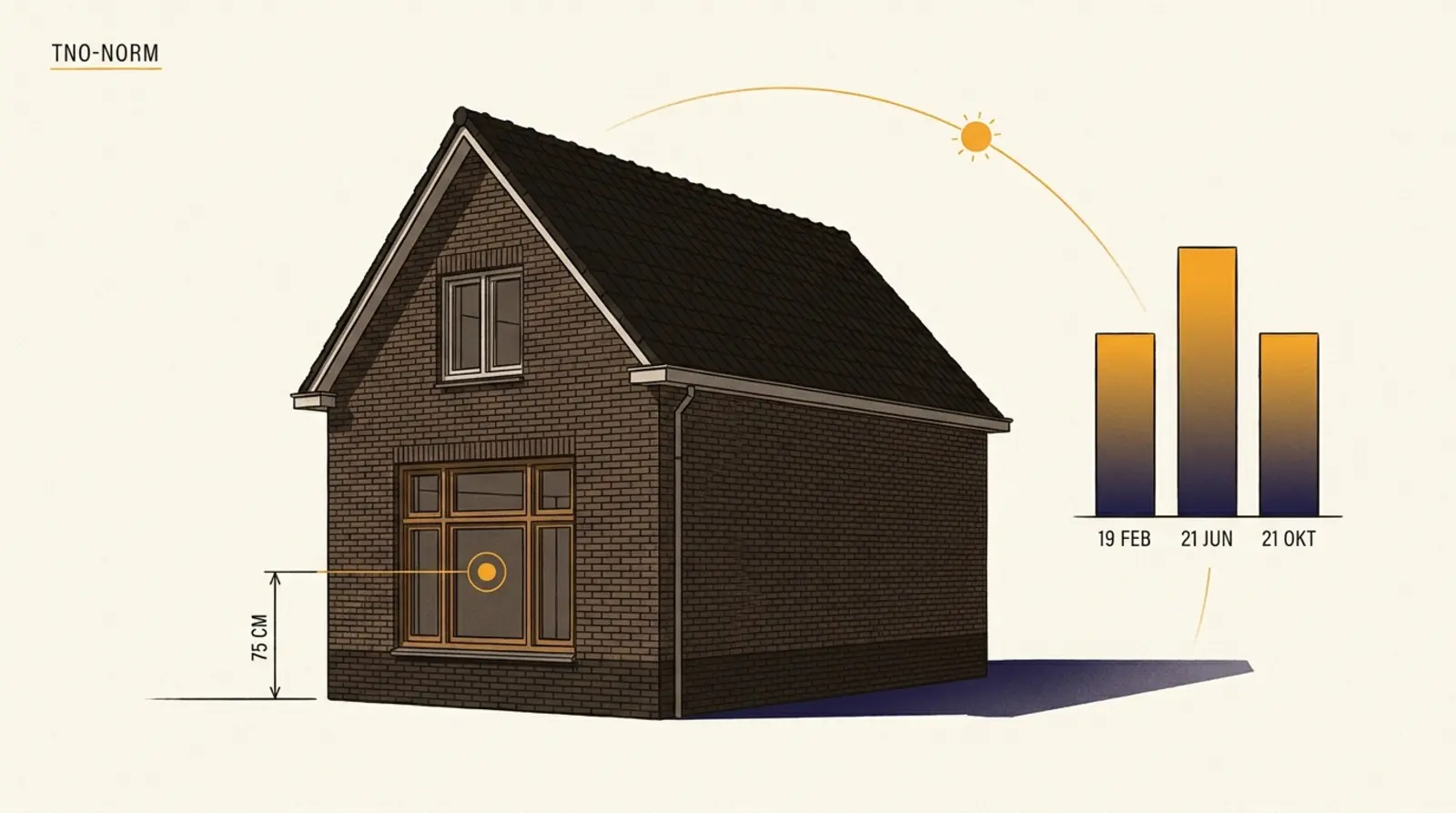
The TNO sunlight standard defines how many sun hours a home must receive on set test dates. The light standard requires 2 sun hours from 19 February to 21 October; the strict standard 3 sun hours from 21 January to 22 November. The Hague, Rotterdam, Eindhoven and Krimpen use their own variants. This is the de facto standard in Dutch permit decisions.
Standards & municipalities
What the zoning plan permits: the building plot explained
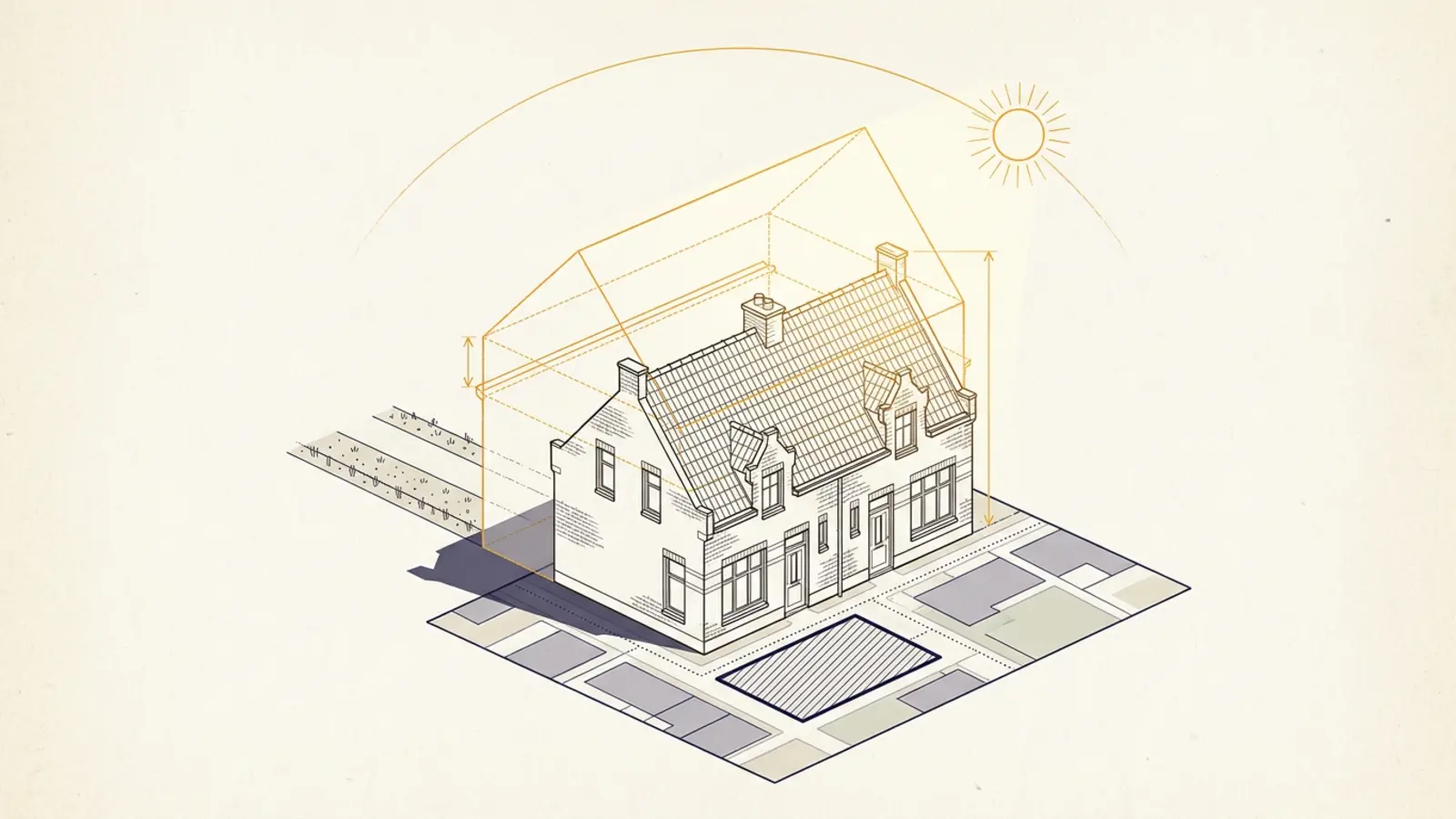
A Dutch municipality’s omgevingsplan records a building plot per parcel with a maximum eaves and building height: the planning-permitted volume. Every Dutch address has one, but only newer plans publish it as data. What it leaves out: permit-free building, in-plan deviation powers and custom rules.