Objections & legal
Objecting to a neighbour's building permit: the steps
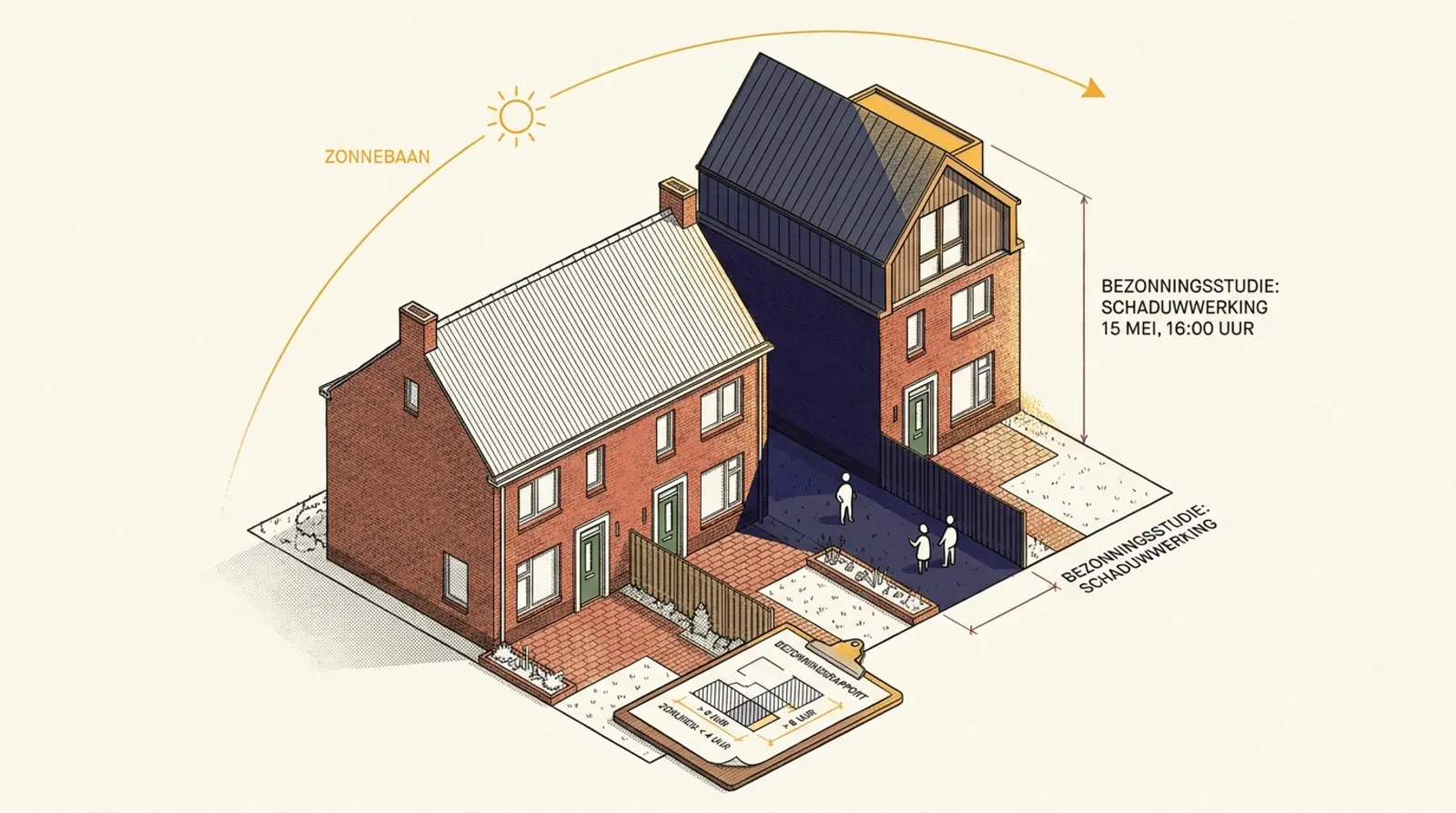
An objection based on gut feeling rarely succeeds. This step-by-step plan shows how, within six weeks, you use 3DBAG, BAG and AHN4 to quantify exactly how many sun hours you lose — the evidence on which the District Court of The Hague ordered a roof addition demolished at 75 to 80% sunlight loss on 17 January 2024.
What is objecting to an environmental permit?
Objecting to an environmental permit is a formal administrative-law procedure in which you ask the municipality to reconsider its permit decision. You file an objection within six weeks of publication, based on concrete spatial grounds such as disproportionate sunlight loss, invasion of privacy or a departure from the zoning plan. Under article 7:1 of the General Administrative Law Act, the municipality must deal with your objection on its merits.
An objection based only on gut feeling is almost always declared unfounded. What the municipality and the court look for is quantifiable substantiation: exactly how many sun hours do you lose, on which days, at which measurement points? That is where a sunlight report comes in. According to the Council of State (Ootmarsum ruling, ECLI:NL:RVS:2013:191) a lack of a sunlight study can even annul a zoning plan entirely.
Who is across the table from you — and why it matters
There are three parties: you as the interested party, your neighbours as the permit holder, and the municipality as the permit issuer. In the objection phase the municipality handles your objection itself. That means the same officials who granted the permit also have to reconsider it. They approach this professionally, but often see your objection as criticism of their earlier work.
According to the Council of State (Almelo, 18 January 2023, ECLI:NL:RVS:2023:172) the municipality can only be overruled if the sunlight study is demonstrably incorrect or if a weighty interest was left out of account. So your objection must not merely complain, but show why the original assessment framework was incomplete. A sunlight report delivers exactly that evidence: new facts that the municipal executive could not reasonably ignore.
The six-week deadline: how to calculate your cut-off date
The six-week deadline starts on the day after the environmental permit is published in the municipal gazette or on the national site officielebekendmakingen.nl. Publication on Thursday 23 April means you must file your objection by Thursday 4 June at the latest. You can send your objection by post (the postmark date counts) or digitally via the municipality’s online desk, if available.
Important: the deadline is hard. Under article 6:7 Awb an objection that arrives one day later is in principle inadmissible, even if you are entirely right on the merits. The exception — an excusable exceedance of the deadline — is rarely granted. Plan backwards from the publication date and set aside at least two weeks to prepare your substantiation.
At the same time, check your municipal standard. The Hague, Rotterdam, Eindhoven and Krimpen aan den IJssel each have their own assessment framework that departs from the standard TNO norm. The The Hague standard, for example, requires at least two sun hours on the façade from 19 February to 21 October, measured at 75 cm height in the middle of the façade, plus an additional rule that a roof addition may not reduce a neighbour’s sunlight duration by more than 50%.
Step-by-step plan: from publication to filed objection
The steps below can be carried out within six weeks without having to engage a lawyer. A lawyer is advisable once it moves to appeal or further appeal, but is not necessary in the objection phase.
- Week 1 — check the publication and request the file. Find the publication in the municipal gazette via officielebekendmakingen.nl. Request the complete permit file from the municipality (Open Government Act, formerly the Wob). Note the building drawings, the aesthetic-quality advice and any sunlight study by the applicant.
- Week 2 — your address and the planned construction in 3D. Enter your neighbours’ address into Schaduwplan. The tool automatically retrieves the existing buildings via 3DBAG and AHN4. Then draw the planned extension or roof addition according to the building drawing from the file. Add measurement points at each window on the sunny side of your home and on the terrace or seating area in your garden.
- Week 3 — calculate sunlight on the test dates. Run the analysis for 19 February, 21 June and 21 October — the three test dates of the TNO standard — and, if you live in The Hague or Rotterdam, on the local test dates as well. Note the sun hours before and after the planned construction per measurement point. Download the PDF report. It sets out the reference situation, the proposed situation and the delta per measurement point side by side.
- Week 4 — testing against the standard. Check which measurement points drop below the two-hour standard after the planned construction, or in The Hague lose more than 50%. These are the measurement points your objection rests on. List the breaches in a table with three columns: measurement point, existing sunlight duration, new sunlight duration, status (pass, near-miss, fail).
- Week 5 — write the objection. Start with a clear summary: your name, address, permit number and the key conclusion of your sunlight report. Refer explicitly to the measurement points that drop below the standard. Attach the report in full as an appendix. Cite — where relevant — the District Court of The Hague ruling of 17 January 2024 (ECLI:NL:RBDHA:2024:1206): there a roof addition was demolished at 75 to 80% sunlight loss.
- Week 6 — file and keep the acknowledgement of receipt. File via the digital desk or by registered post. Keep the acknowledgement of receipt. The municipality must decide within six weeks, with a single extension of six weeks possible (article 7:10 Awb). During that period you can request a hearing — do so, because at a hearing you can explain the report.
This article describes the procedure. The substantive evidence — the figures a municipality and a judge expect from you — is set out on objecting to a building plan, and you order the report itself via sunlight study.
Gut feeling versus data: what the municipality accepts as substantiation
The municipality and the administrative court apply a simple yardstick: is the claim quantifiable, traceable to public data and tested against a recognised standard? If not, it is subjective nuisance and barely counts in the assessment. The table below shows how the same objection looks in the two variants.
| Argument | Gut feeling (weak) | With sunlight data (strong) |
|---|---|---|
| Garden loses sun | “Soon we’ll get no more sun on the terrace.” | “Measurement point T1 (terrace, 3 m from the façade) loses 3 hours 42 min of sunlight duration on 21 June, calculated via 3DBAG and AHN4.” |
| Living room goes dark | “Our living room really becomes much darker.” | “Window R2 (south façade, 75 cm height) drops from 4 h 20 min to 1 h 05 min on 19 February. That is below the light TNO standard.” |
| Loss of value | “This costs us house value.” | “The sunlight situation has materially deteriorated; on the basis of the report a valuer established a value reduction of €12,000.” |
| Disproportionate nuisance | “What they are going to build is really unacceptable.” | “Sunlight loss on the rear façade is 68% on 21 October, above the 50% limit in RIS 180461 (The Hague sunlight standard).” |
The difference is not semantic. On 10 May 2022 the District Court of Limburg (ECLI:NL:RBLIM:2022:3564) rejected a claim of unlawful nuisance precisely because no sunlight report had been submitted and, during a site inspection, it turned out there was hardly any loss of light. Conversely, on 17 January 2024 the District Court of The Hague (ECLI:NL:RBDHA:2024:1206) ordered a roof addition to be demolished precisely because the report showed a sunlight loss of 75 to 80%. The data-based substantiation was decisive.
The District Court of The Hague, January 2024: why this ruling matters
On 17 January 2024 the District Court of The Hague ruled that a roof addition had to be demolished. As a result of that addition, the sunlight on the neighbours’ plot had been reduced by 75 to 80%. The court also considered it weighty that the claimants’ home already received relatively little sun, and that the municipality had not taken the neighbours’ concrete interests into account when granting the permit.
The striking part: the roof addition held a valid environmental permit. That did not help. The court ruled that a granted building permit does not protect against liability for unlawful nuisance under article 5:37 and article 6:162 of the Dutch Civil Code. In other words: even if you lose the administrative-law objection procedure, you can still force demolition or modification through civil proceedings — provided your sunlight loss is quantifiable.
For you as the person filing the objection, that matters in three ways. First, the objection phase carries more weight when the municipality knows that a civil court can still intervene later in the case of substantial sunlight losses. Second, you have an explicit precedent that 75% sunlight loss is legally assessed as unlawful nuisance. Third: the same sunlight report you use in the objection serves as the starting point for any follow-up step before the civil court. You invest in data once, and can deploy it across both tracks.
When objection and appeal fail: neighbour law as a second track
A rejected objection does not mean all legal options are exhausted. The civil-law route via neighbour law remains open as long as the nuisance is demonstrably unlawful. Under article 5:37 of the Dutch Civil Code an owner may not cause nuisance that is unlawful under article 6:162 of the Dutch Civil Code. The court weighs the “nature, severity and duration” of the nuisance, the local circumstances and the mutual interests.
In practice this means: you summons your neighbours (not the municipality) after construction has started or been completed. You demand modification or demolition of the structure, or damages. The sunlight report you used in the objection remains leading — supplemented with evidence such as photos of the before and after situation and possibly a valuation report for the loss of value. The deadline for a civil-law action is more generous: the limitation period is in principle five years after the nuisance became known (article 3:310 of the Dutch Civil Code).
How Schaduwplan supports this process
Schaduwplan is designed for exactly this scenario: a concerned neighbour who must file a substantiated objection within six weeks and cannot afford to spend €295 to €535 at an independent firm (HoeveelZon, SchaduwSimulator, HBA) or €2,000 to €5,000 at a large engineering firm (DGMR, Peutz, Nieman) with a turnaround of one to three weeks. The tool automatically builds a 3D model of the existing buildings based on 3DBAG, BAG and AHN4 — the same data sources that are accepted by professional firms and the Council of State.
You add the planned extension or roof addition via a drawing tool, place measurement points at relevant windows and outdoor spaces, and the sun-hour calculation runs at 1-hour intervals across the full TNO test dates. The PDF report contains a north arrow, a scale bar, a methodology appendix, a source list (including 3DBAG by tudelft3d + 3DGI) and a side-by-side comparison of the reference situation and the proposed situation. The result is a €49 report that you can attach as an appendix to your objection, and that follows the same structure and source attribution as the most common firm reports.
Sources (15)
We back every article with public sources. Click to see all the original documents, rulings and datasets.
Sources (15)
We back every article with public sources. Click to see all the original documents, rulings and datasets.
Case law
- District Court of The Hague 17 January 2024 — roof addition demolished at 75 to 80% sunlight loss— ECLI:NL:RBDHA:2024:1206
- District Court of Limburg 10 May 2022 — nuisance claim rejected, no sunlight report— ECLI:NL:RBLIM:2022:3564
- Council of State 3 July 2013 — Ootmarsum zoning plan annulled: no sunlight study— ECLI:NL:RVS:2013:191
- Council of State 18 January 2023 — TNO standards not unusual to apply— ECLI:NL:RVS:2023:172
- Council of State 5 April 2023 — Voorburg: a missing roof addition by the neighbour triggers additional study— ECLI:NL:RVS:2023:1329
Laws and regulations
- General Administrative Law Act (Awb), art. 6:7 (six-week objection deadline)— wetten.overheid.nl
- General Administrative Law Act (Awb), art. 7:1 (objection procedure)— wetten.overheid.nl
- Dutch Civil Code Book 5, art. 5:37 (nuisance to neighbours)— wetten.overheid.nl
- Dutch Civil Code Book 6, art. 6:162 (tort / unlawful act)— wetten.overheid.nl
Standards and guidelines
- TNO sunlight standard (light and strict variant)— TNO report 2005-BBE-R0036
- The Hague sunlight standard — RIS 180461— City of The Hague
- Sunlight: daylight and shadow in the environment plan— IPLO (Informatiepunt Leefomgeving)
Data sources
- 3DBAG — 3D models of all 10 million Dutch buildings— TU Delft and 3DGI
- BAG — Key Register of Addresses and Buildings— Kadaster
- AHN4 — Actueel Hoogtebestand Nederland, surveys 2020–2022— Rijkswaterstaat and the water authorities
Frequently asked questions
- How long do I have to object to the environmental permit of my neighbours?
- Six weeks from the day after the decision is published in the municipal gazette. This deadline is fixed in article 6:7 of the General Administrative Law Act. An objection that arrives one day later is in principle too late, even if you have sound substantive arguments.
- Does my objection have to include a sunlight report?
- Not mandatory, but decisive in practice. The municipality asks for concrete substantiation rather than a general complaint. A report with precise sun hours per measurement point on the test dates (19 February, 21 June, 21 October) makes the difference between a formal objection and a substantive reconsideration by the municipality.
- Does a Schaduwplan report count as evidence in court?
- A Schaduwplan report is indicative and admissible. It uses 3DBAG, BAG and AHN4 — the same sources that professional firms and the Council of State rely on. For formal appeal proceedings before the administrative court we recommend verification by a sworn expert. For formal views (zienswijzen) and objection phases the report is sufficient in almost all cases.
- What happens if my objection is rejected?
- You can appeal to the district court (administrative law division), and then lodge a further appeal with the Council of State. In parallel, you can start civil proceedings under article 5:37 of the Dutch Civil Code (nuisance). In January 2024 the District Court of The Hague ordered a roof addition to be demolished because the sunlight loss was 75 to 80% — even though the municipality had already granted the permit.
- Can my legal expenses insurance reimburse the cost of a sunlight report?
- In many cases yes, under home legal expenses insurance. Firms such as Zonnestudie and Bezonningsingenieur state this explicitly on their site. Ask in advance for a written confirmation of cover and a reference to the policy conditions. A €49 report via Schaduwplan, moreover, usually falls within the excess.
- Do I need to include trees or fences in the calculation?
- Not for the formal TNO test: it works with permanent structures, and trees and fences count legally as temporary landscape elements that the owner can remove. Schaduwplan therefore keeps them outside the formal standard. But is your dispute precisely about the shadow of trees or a fence belonging to the neighbours? Then that runs through neighbour law (unlawful nuisance, art. 5:37 of the Dutch Civil Code), where a judge can indeed weigh that shadow. Schaduwplan therefore calculates the shadow of greenery and fences separately, so that you can substantiate it factually.
Back up your objection with hard data
Enter the address of your neighbours, draw the planned extension or roof addition, and download a report with sun hours per measurement point. The same kind of figures the District Court of The Hague called decisive in January 2024. For €49, in about five minutes.
Read more
Objections & legal
Example zienswijze on an environmental permit
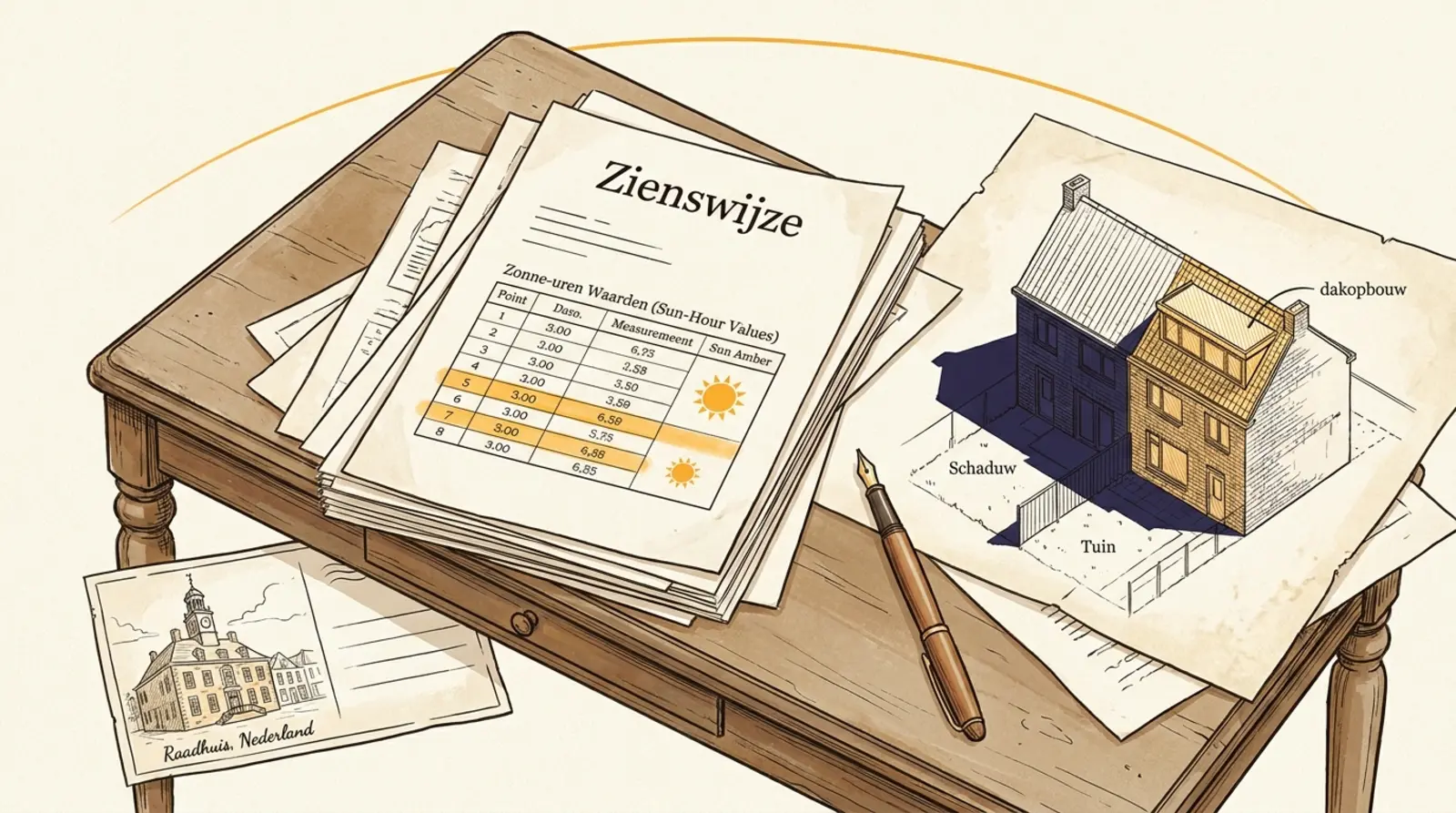
A zienswijze is your written response to a draft environmental permit during its six-week public-review window. This template combines the correct legal form under Article 3:16 of the General Administrative Law Act (Awb) with hard sunlight figures from 3DBAG and AHN4: three example paragraphs with placeholders for sun hours, measurement points and test dates from your report, plus guidance on when a zienswijze rather than a formal objection is the right route.
Objections & legal
Neighbour's roof addition: when is the shadow unlawful?
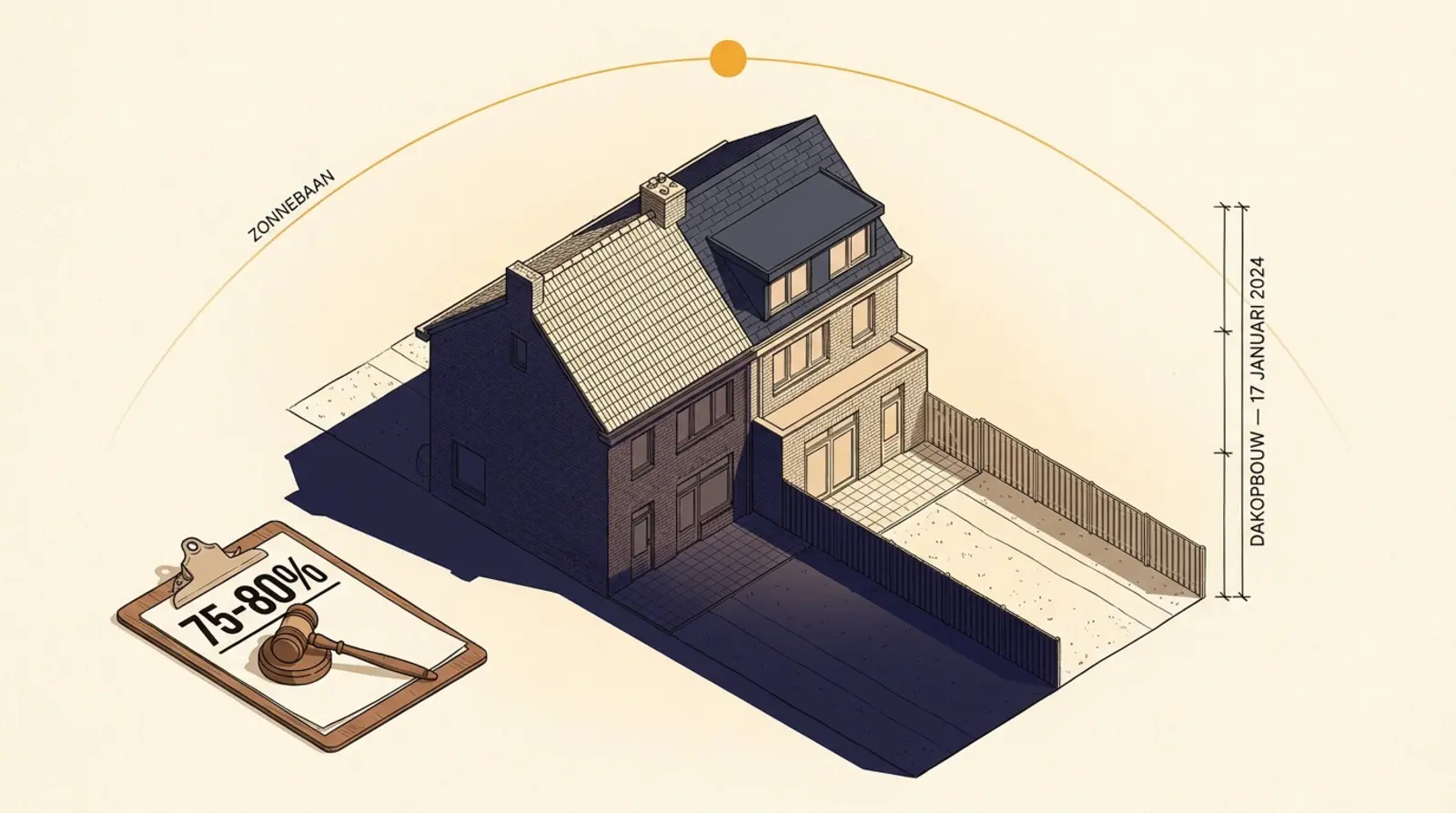
Shadow from a roof addition is legally unlawful when the loss of sunlight materially harms normal enjoyment of the home. On 17 January 2024 the District Court of The Hague ordered demolition at 75 to 80% sunlight loss — even with a valid permit, under Article 5:37 and Article 6:162 of the Civil Code.
Standards & municipalities
Sunlight and Dutch neighbour law: which rules apply
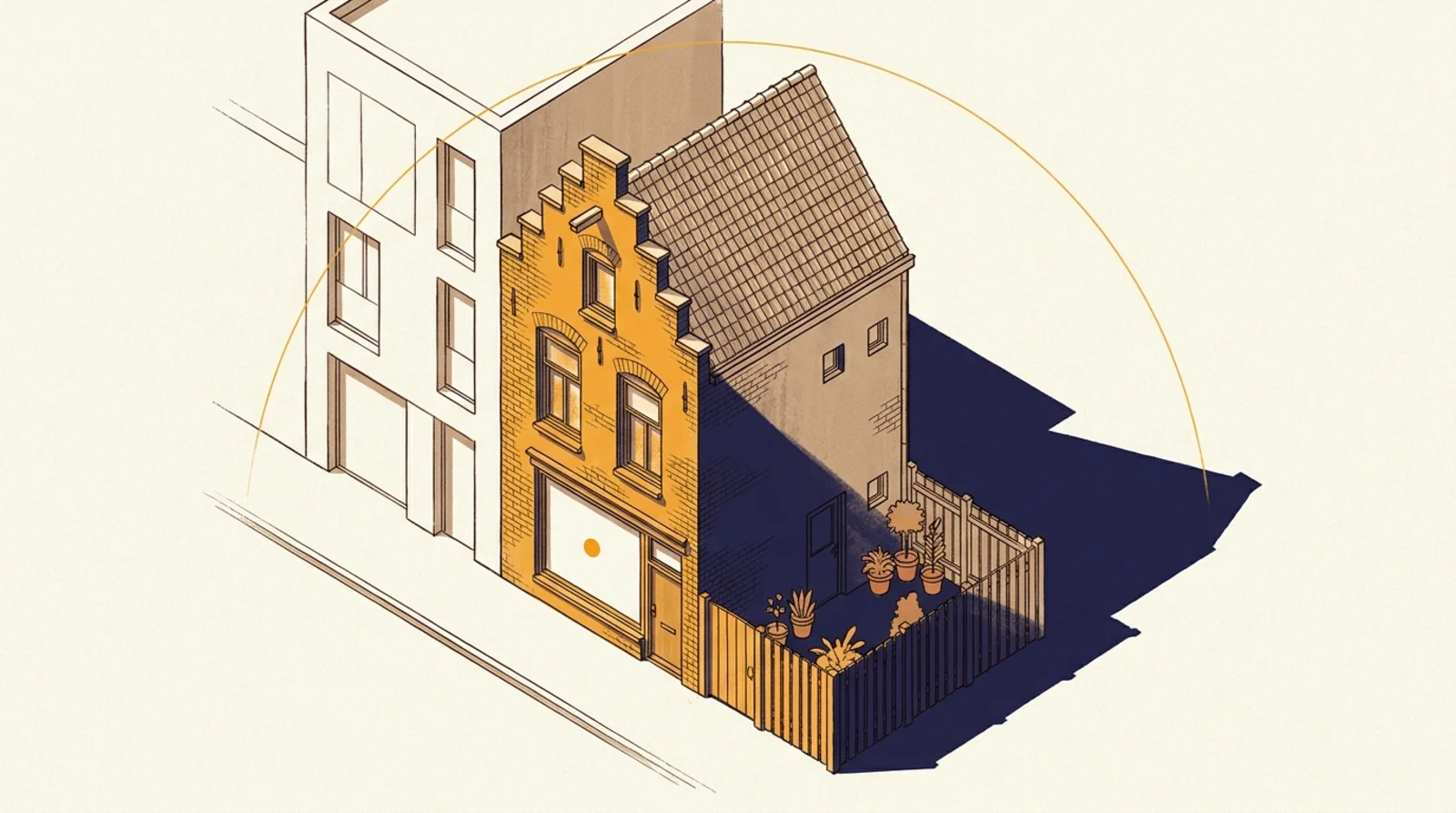
Three separate frameworks govern sunlight at a home. Sunlight access (the TNO standard) is a guideline, not a law. Daylight (Articles 4.146 and 4.147 of the Building Works Environment Decree) is the only one written into national law. Neighbour law (Article 5:37 of the Civil Code) governs unlawful nuisance. Window size counts for daylight, not for sunlight access.