Objections & legal
Neighbour's roof addition: when is the shadow unlawful?
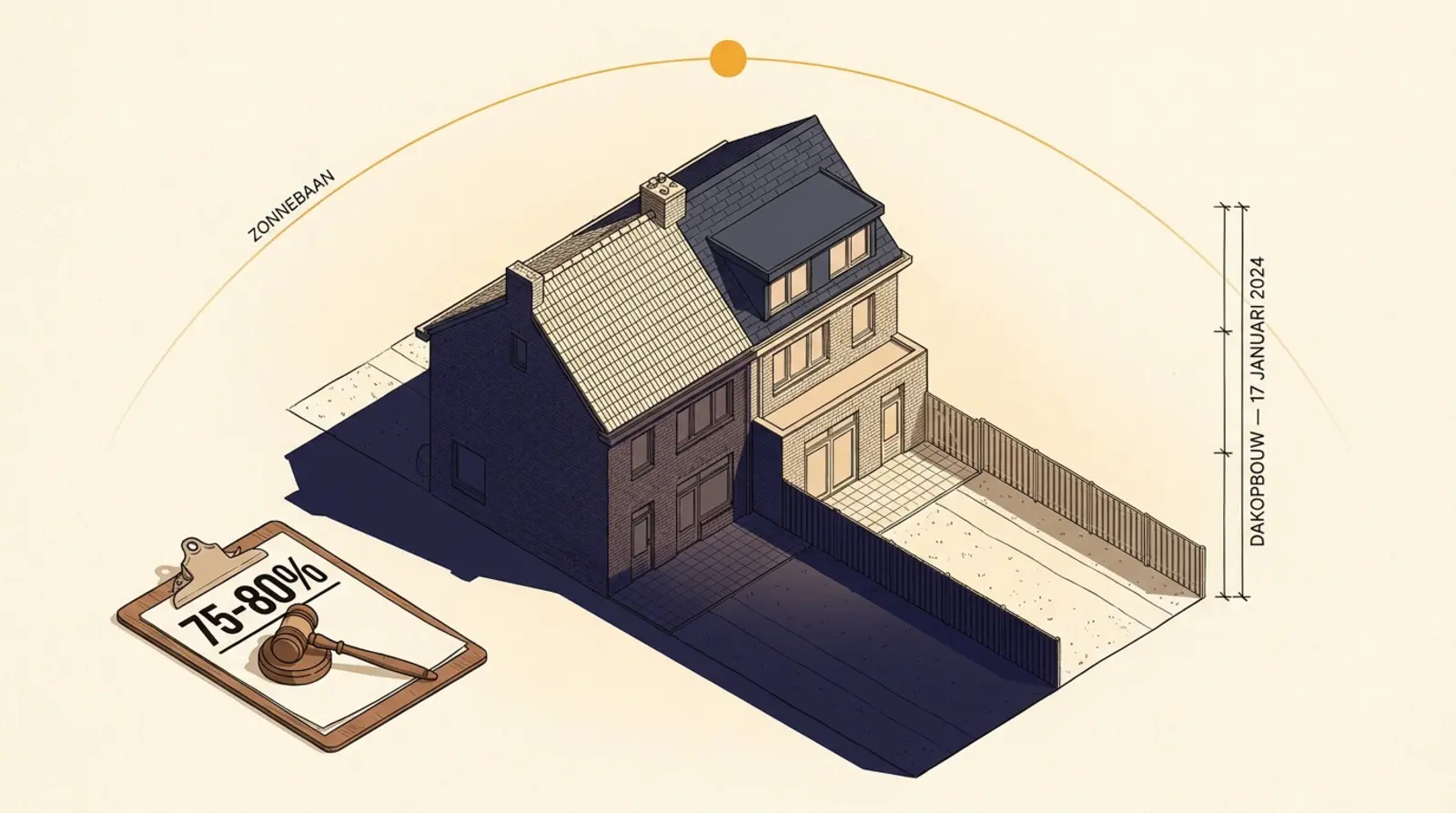
Shadow from a roof addition is legally unlawful when the loss of sunlight materially harms normal enjoyment of the home. On 17 January 2024 the District Court of The Hague ordered demolition at 75 to 80% sunlight loss — even with a valid permit, under Article 5:37 and Article 6:162 of the Civil Code.
When is shadow from a roof addition legally unlawful?
Shadow nuisance from a roof addition is legally unlawful when the sunlight loss is so large that it materially impairs the normal enjoyment of the home. Since January 2024 the District Court of The Hague has applied a threshold of 75 to 80% sunlight loss as its benchmark for demolition, even with a valid environmental permit. The legal basis is Article 5:37 of the Civil Code (BW), Book 5 (nuisance between neighbours), read together with Article 6:162 (unlawful act).
This assessment sits in civil law, not in administrative law. That distinction matters in practice: granting a permit is an administrative-law act by the municipality, whereas nuisance between neighbours is a private-law relationship between two landowners. The Supreme Court (Hoge Raad) has long confirmed that an administrative-law permit does not remove civil-law liability. The The Hague ruling of 17 January 2024 (ECLI:NL:RBDHA:2024:1206) is the most explicit confirmation of that principle in recent sunlight case law.
The District Court of The Hague, 17 January 2024: the anchor ruling
On 17 January 2024 the District Court of The Hague ordered the demolition of a roof addition under Article 5:37 and Article 6:162 of the Civil Code (BW). The claimants were the immediate neighbours; because of the roof addition their plot lost 75 to 80% of its existing sunlight. The court gave weight to three factors: the scale of the sunlight loss, the fact that the home already received relatively little sun before the roof addition, and the fact that the municipality had not weighed the neighbours’ concrete interests when granting the permit.
The most striking part: the roof addition held an irrevocable environmental permit. The court ruled that this does not protect against private-law liability. Put differently — a permit legalises the construction under administrative law, but not under civil law. If the construction is in fact unlawfully disruptive, the civil court can step in with a judicial order to modify or demolish.
For you as a neighbour this means something concrete. Even if you lose the administrative-law objection procedure — or are simply too late for the six-week deadline (Article 6:7 of the General Administrative Law Act) — the civil route remains open. Provided you can make the sunlight loss quantifiable with a methodical report. The The Hague ruling relies explicitly on the figures from the sunlight study that the claimants had prepared.
Two routes: administrative law and neighbour law side by side
Dutch sunlight case law runs along two routes with different rules, different deadlines and different outcomes. Anyone filing an objection needs to know both in order to choose the right strategy. The table below summarises them.
| Aspect | Administrative law | Neighbour law (civil) |
|---|---|---|
| Legal basis | General Administrative Law Act (Article 3:2 due diligence, Article 7:1 objection) | Civil Code (BW) Article 5:37 (nuisance) + Article 6:162 (unlawful act) |
| Opposing party | The municipality (permit issuer) | The neighbours (permit holder) |
| Deadline | 6 weeks after publication (Article 6:7 of the Act) | Limitation period 5 years (Article 3:310 of the Civil Code) |
| Assessment framework | Good spatial planning, TNO standard, local guideline | Nature, severity and duration of the nuisance; mutual interests |
| Outcome | Permit upheld or revised | Modification, demolition, or compensation |
| Highest court | Administrative Jurisdiction Division of the Council of State | Supreme Court (Hoge Raad, civil division) |
The two routes are complementary. An administrative-law objection can halt the construction before the first spade goes into the ground — but it demands speed (the six-week deadline in Article 6:7 of the General Administrative Law Act). A civil procedure also works after the construction has been completed and can order demolition, but it costs more time and money. Many objectors pursue both routes, with the same sunlight report as the core evidence.
The legal test: nature, severity and duration
Outside The Hague there is no fixed sunlight-loss percentage for unlawfulness. The court assesses each case against three criteria that the Supreme Court (Hoge Raad) has developed in leading judgments: the nature of the nuisance (light, air, view, privacy), the severity of the nuisance (how large in quantitative terms), and the duration of the nuisance (how often and how long per year). Local circumstances and the interests of both parties are weighed alongside these.
Quantitative substantiation is key. According to SAM Advocaten, the TNO standard is the de facto standard against which the court tests conformity. If you drop below the light TNO standard (fewer than two hours of sun on at least one test date), the chance of an unlawfulness ruling is significant. If you stay above the standard, the court usually dismisses the claim of nuisance, as the District Court of Limburg showed on 10 May 2022 (ECLI:NL:RBLIM:2022:3564).
The City of The Hague has made this explicit with the 50% rule from the The Hague sunlight standard (RIS 180461): a planned roof addition may reduce the sunlight duration of neighbouring homes by no more than 50%. That is a matter of policy, not private law, but civil courts usually look at the local policy standard too, as a signal of what counts as acceptable locally.
What can you ask of the civil court?
A civil court can impose three types of measures for unlawful shadow nuisance. Which one applies depends on the severity and the feasibility. A claimant usually formulates alternative claims to give the court room to manoeuvre.
- Modification of the construction. The court orders a lowering of the gutter height, a narrowing of the roof addition, or a relocation of the extension. This is the least drastic measure and is preferred over demolition when it removes enough of the nuisance.
- Full demolition. This was the outcome in The Hague in January 2024. The court chooses this measure when modification is technically impossible or has insufficient effect. In that case the claimant must show that the construction itself is the problem, not merely a detail of it.
- Compensation. Instead of, or in addition to, modification, the court can impose financial compensation, calculated on the basis of the drop in the home’s value or lost enjoyment of the home. For sunlight cases a valuation report is customary, tied to the sunlight report as causal evidence.
Limburg, 10 May 2022: what does not work
Not every case is won. On 10 May 2022 the District Court of Limburg (ECLI:NL:RBLIM:2022:3564) dismissed a claim of unlawful shadow nuisance because the claimants had not submitted a sunlight report. A site visit showed that there was barely any measurable light loss. The court ruled that nuisance could not be established on gut feeling — quantitative substantiation was missing, so the claim was rejected.
The lesson is clear: emotion without data does not carry the day. A The Hague court that orders a roof addition demolished wants to see numbers; a Limburg court that dismisses a claim does so equally on the basis of numbers, or precisely the absence of them. That explains why, even in fast objection procedures — where you only have a file and no hearing — a sunlight report stands stronger than a handwritten letter of complaint.
Administrative law: Ootmarsum, Voorburg, Almelo
In parallel with the civil-law route, the Council of State has set the administrative-law bar in three rulings. In Ootmarsum (3 July 2013, ECLI:NL:RVS:2013:191) the Council annulled a zoning plan precisely because no sunlight study had been carried out. This means a municipality is obliged to map the shadow impact before it grants a permit; if it does not, it breaches Article 3:2 of the General Administrative Law Act (due diligence).
In Voorburg (5 April 2023, ECLI:NL:RVS:2023:1329) the Council ruled that a sunlight study which skipped a recently built roof addition on the neighbour’s side was incomplete. The municipality had to commission an additional study. In Almelo (18 January 2023, ECLI:NL:RVS:2023:172) the Council confirmed that TNO standards are “not unusual” — an implicit seal of approval for sunlight studies that objectors submit to the municipality.
How Schaduwplan supports this kind of case file
Schaduwplan is designed for the kind of figure that both routes accept. Enter the address of the planned or completed roof addition, draw the construction based on the building drawings or as an existing 3DBAG volume, place measurement points at the relevant windows and terrace, and the tool calculates sun hours before and after the situation. The result is a sunlight loss as a percentage, comparable to the figure that the District Court of The Hague called decisive in January 2024.
The PDF report contains the standard elements that both the administrative court and the civil court expect: a north arrow, a scale bar, a methodology appendix, source attribution (3DBAG, BAG, AHN4), a side-by-side comparison of the current and new situation, plus a disclaimer about its indicative status for a formal expert-witness role. For €49, in about five minutes, you have the quantitative substantiation that was missing in Limburg and that was decisive in The Hague.
Sources (15)
We back every article with public sources. Click to see all the original documents, rulings and datasets.
Sources (15)
We back every article with public sources. Click to see all the original documents, rulings and datasets.
Case law
- District Court of The Hague 17 January 2024 — roof addition demolished at 75 to 80% sunlight loss— ECLI:NL:RBDHA:2024:1206
- District Court of Limburg 10 May 2022 — claim of unlawful nuisance dismissed without a sunlight report— ECLI:NL:RBLIM:2022:3564
- Council of State 5 April 2023 — Voorburg: additional study for an omitted roof addition— ECLI:NL:RVS:2023:1329
- Council of State 18 January 2023 — Almelo: TNO standards not unusual— ECLI:NL:RVS:2023:172
- Council of State 3 July 2013 — Ootmarsum: zoning plan annulled— ECLI:NL:RVS:2013:191
Legislation and regulations
- Civil Code (BW) Book 5, Article 5:37 — nuisance to neighbours— wetten.overheid.nl
- Civil Code (BW) Book 6, Article 6:162 — unlawful act (tort)— wetten.overheid.nl
- General Administrative Law Act, Article 6:7 (objection deadline)— wetten.overheid.nl
- General Administrative Law Act, Article 3:2 — due diligence in preparation— wetten.overheid.nl
Standards and guidelines
- TNO sunlight standard (light and strict variant)— TNO report 2005-BBE-R0036
- The Hague sunlight standard — RIS 180461 (50% rule for roof additions)— City of The Hague
- SAM Advocaten — Sunlight and shadow effects— sam-advocaten.nl
- Handel Bouwadvies — legislation on unlawful shadow nuisance— handelbouwadvies.nl
Data sources
- 3DBAG — open 3D models of Dutch buildings— TU Delft and 3DGI
- AHN4 — Actueel Hoogtebestand Nederland— Rijkswaterstaat and the water authorities
Frequently asked questions
- Can a roof addition with a valid environmental permit still be demolished?
- Yes. On 17 January 2024 the District Court of The Hague ruled (ECLI:NL:RBDHA:2024:1206) that an administrative-law permit does not protect against civil-law liability for unlawful nuisance. If the sunlight loss is large enough to count as nuisance under Article 5:37 of the Civil Code (BW), the civil court can still order demolition or modification — even after the objection deadline has passed.
- What does 75 to 80% sunlight loss mean in practice?
- Say your back garden normally gets 6 hours of sun on the terrace on 21 June. At 75% sunlight loss that drops to 1.5 hours. At 80% to 1.2 hours. In January 2024 the The Hague court saw this as so drastic that normal enjoyment of the home was materially impaired. Schaduwplan calculates sunlight loss per measurement point before and after the planned construction, at 1-hour intervals per test date.
- Do I have to file an objection first before I can go to the civil court?
- No. The administrative-law route (objection to the municipality, appeal to the district court, further appeal to the Council of State) and the civil-law route (summoning the neighbours before the court under Articles 5:37 and 6:162 of the Civil Code (BW)) run in parallel. You can even lose the objection first and then still pursue the civil route. The limitation period for nuisance is five years.
- Does this also apply to an annexe, an extension or a veranda?
- Yes. Article 5:37 of the Civil Code (BW) speaks of "withholding light or air" regardless of the type of structure. The legal test is always the same: the nature, severity and duration of the nuisance, weighed against local circumstances and the interests of both parties. A single-storey extension across the full depth of the plot can cause the same sunlight loss as a roof addition; the court looks at the actual effect, not at the label.
- How exactly does a court measure "unlawful nuisance"?
- The court weighs three things: the nature of the nuisance (light, air, view), the severity (percentage of sunlight loss, duration per day, duration per year), and the local circumstances (inner city versus suburb). There is no fixed threshold percentage outside The Hague, but since January 2024 the District Court of The Hague applies 75 to 80% sunlight loss as a threshold, and the The Hague sunlight standard (RIS 180461) sets a 50% reduction by a roof addition as its policy limit.
- What does civil proceedings against my neighbours cost?
- Court registry fees are €318 for private individuals (2026 rates). A lawyer is mandatory above the €25,000 value threshold and charges €1,500 to €5,000 for a straightforward nuisance case. Home legal-expenses insurance often covers the costs, provided you report it before the summons. A sunlight report (€49 to €535) can always be included in the legal costs.
Quantify the sunlight loss that the court wants to see
Enter your neighbours' address, draw the planned or existing roof addition, and download a report with sunlight loss as a percentage per test date. The same kind of figure that the District Court of The Hague called decisive in January 2024.
Read more
Objections & legal
Example zienswijze on an environmental permit
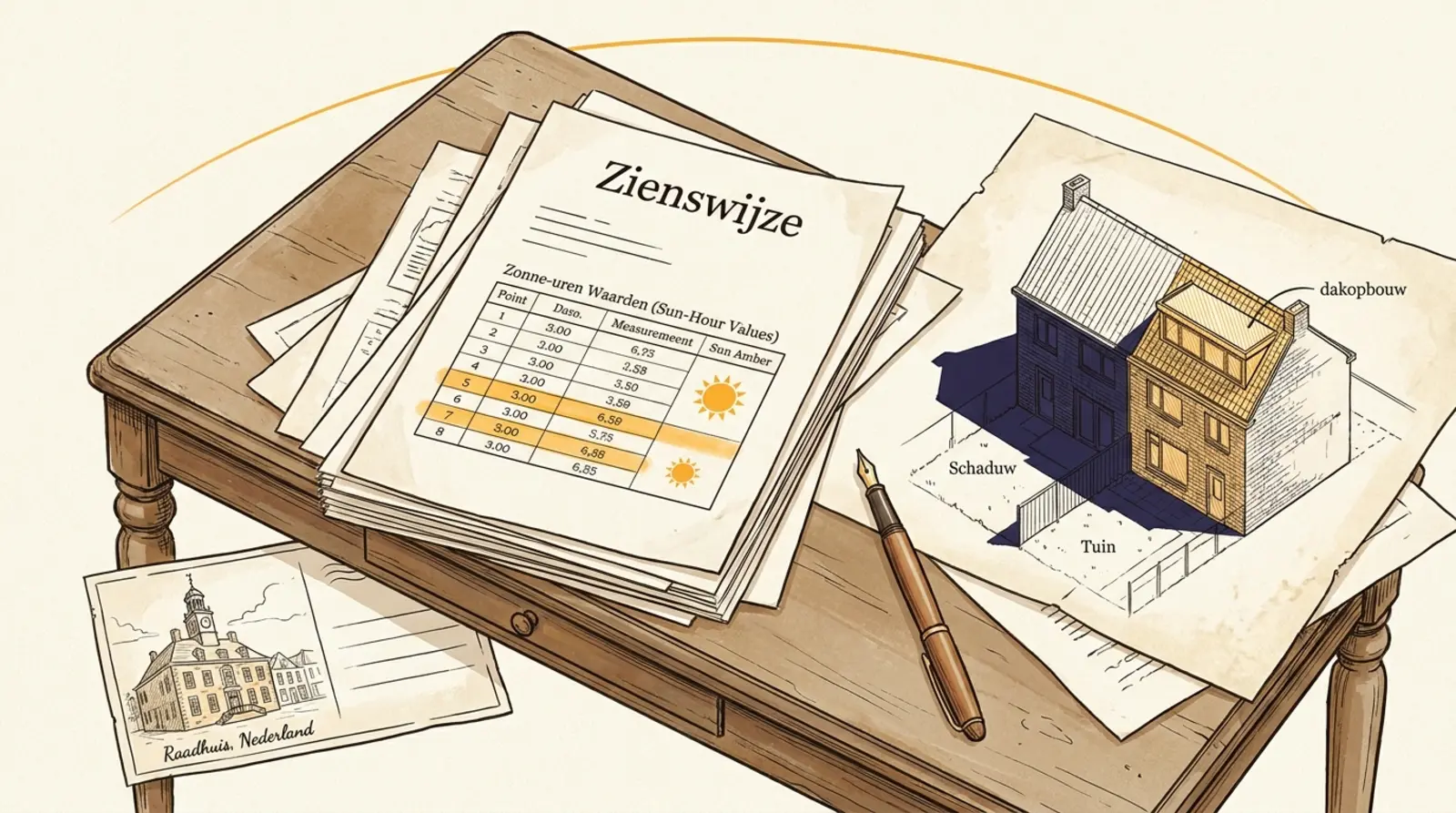
A zienswijze is your written response to a draft environmental permit during its six-week public-review window. This template combines the correct legal form under Article 3:16 of the General Administrative Law Act (Awb) with hard sunlight figures from 3DBAG and AHN4: three example paragraphs with placeholders for sun hours, measurement points and test dates from your report, plus guidance on when a zienswijze rather than a formal objection is the right route.
Objections & legal
Objecting to a neighbour's building permit: the steps
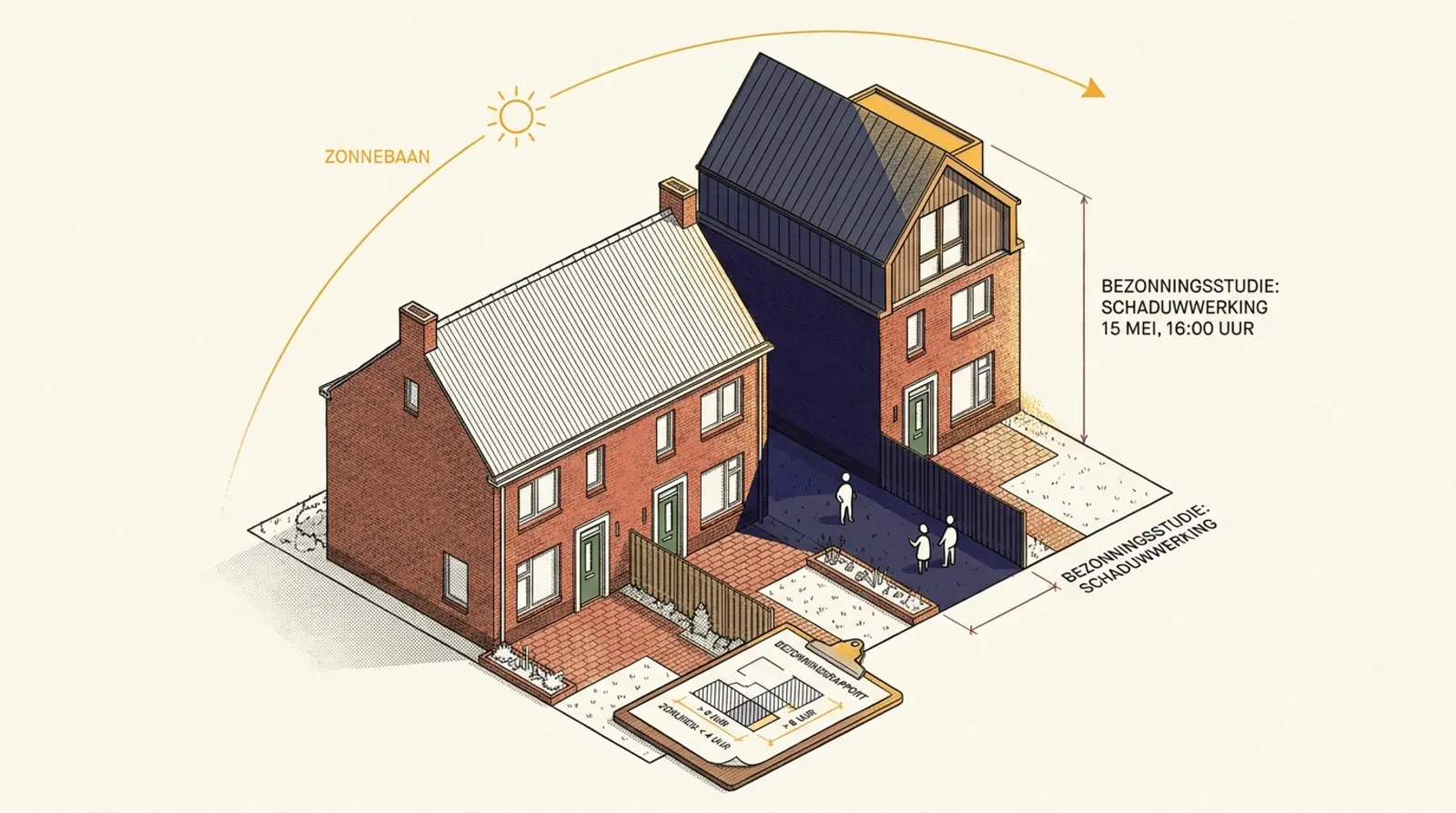
An objection based on gut feeling rarely succeeds. This step-by-step plan shows how, within six weeks, you use 3DBAG, BAG and AHN4 to quantify exactly how many sun hours you lose — the evidence on which the District Court of The Hague ordered a roof addition demolished at 75 to 80% sunlight loss on 17 January 2024.
Standards & municipalities
Sunlight and Dutch neighbour law: which rules apply
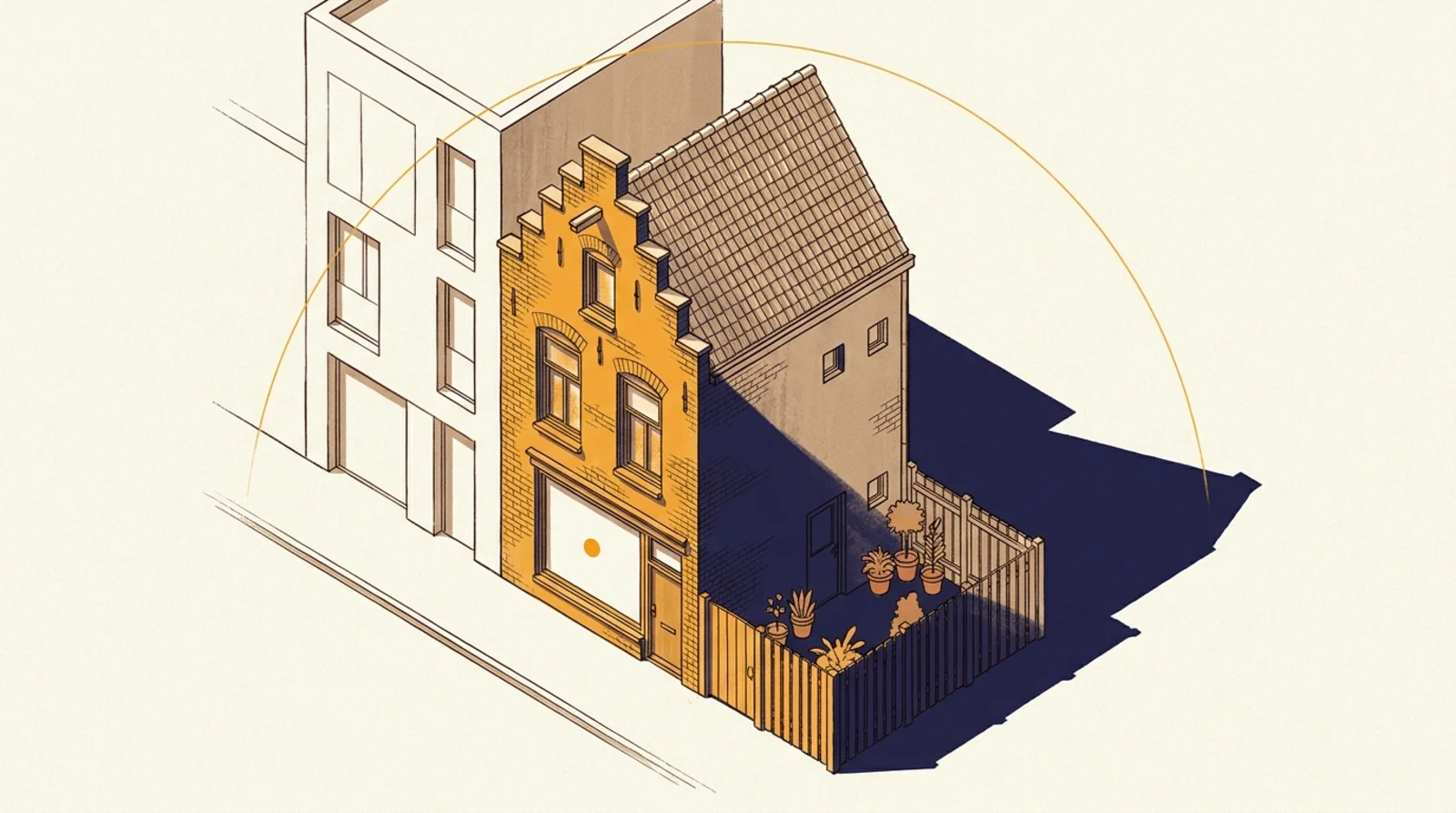
Three separate frameworks govern sunlight at a home. Sunlight access (the TNO standard) is a guideline, not a law. Daylight (Articles 4.146 and 4.147 of the Building Works Environment Decree) is the only one written into national law. Neighbour law (Article 5:37 of the Civil Code) governs unlawful nuisance. Window size counts for daylight, not for sunlight access.