Objections & legal
Example zienswijze on an environmental permit
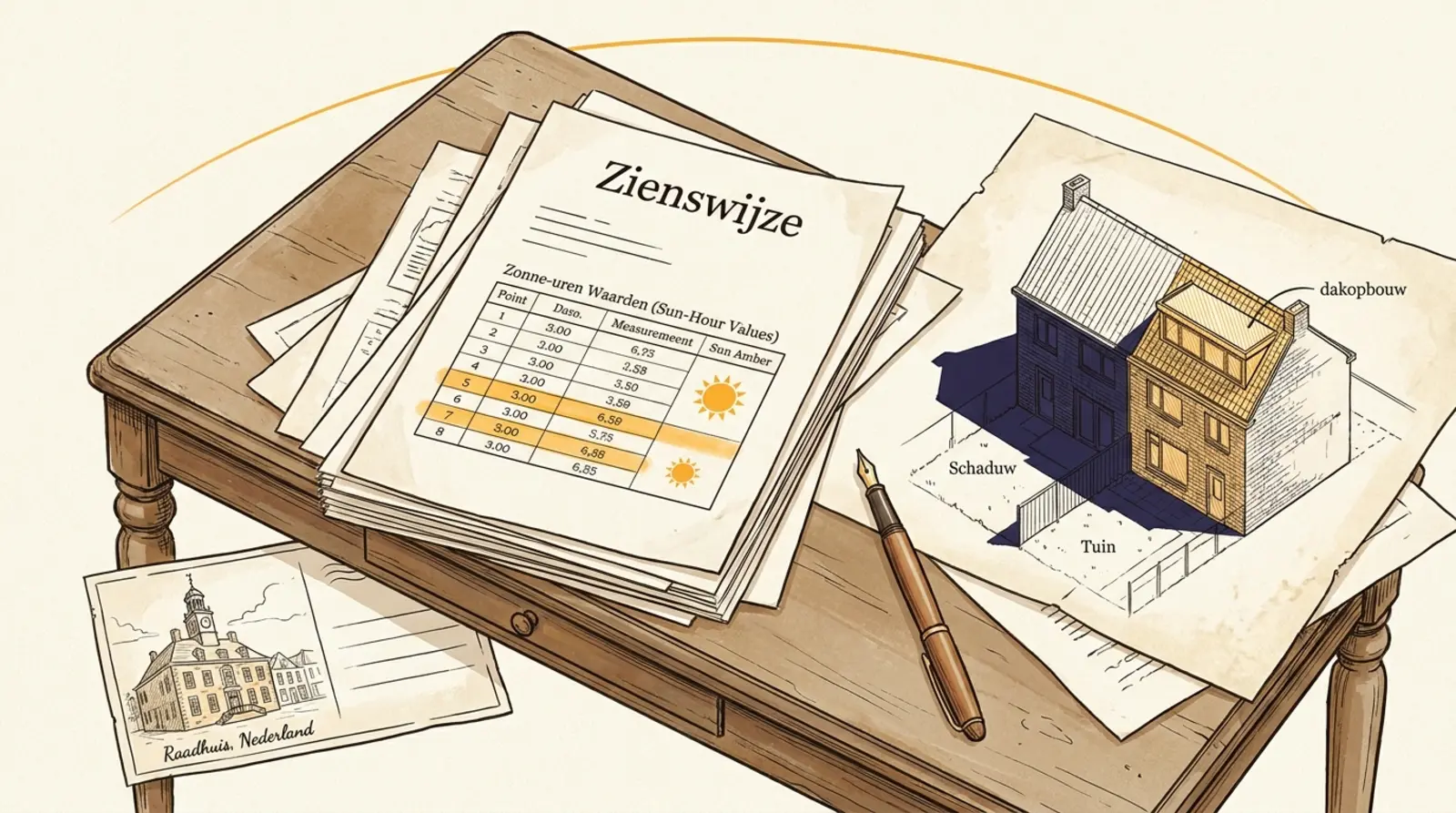
A zienswijze is your written response to a draft environmental permit during its six-week public-review window. This template combines the correct legal form under Article 3:16 of the General Administrative Law Act (Awb) with hard sunlight figures from 3DBAG and AHN4: three example paragraphs with placeholders for sun hours, measurement points and test dates from your report, plus guidance on when a zienswijze rather than a formal objection is the right route.
What is a formal view (zienswijze) against an environmental permit?
A formal view is a written response to a draft environmental permit that the municipality makes available for public inspection for six weeks. Under article 3:16 of the General Administrative Law Act (Awb), any citizen may, during that period, raise points that in their view were not weighed, are incorrect, or ought still to be taken into account. The municipality must respond to these with reasons in the final decision (article 3:17 Awb).
The formal view is the first formal step in procedures where a spatial plan affects the surroundings more drastically than a standard permit. Think of amendments to the environment plan, out-of-plan environment-plan activities (BOPA) with major deviations, or larger building plans for which the municipality applies the extended preparatory procedure (article 16.65 of the Environment and Planning Act, the Omgevingswet). For smaller works such as a regular extension or roof addition there is no draft decision and no formal-view phase; there, objection only comes into play after the permit has been granted.
Formal view or objection: which track fits your situation?
For the reader searching for “zienswijze omgevingsvergunning voorbeeld”, this is the first check that matters. The legal terms, deadlines and addresses differ. You do not want to accidentally submit a formal view against a decision that has already been taken, or a notice of objection against a draft decision that is still open for inspection. The table below sets the three most common tracks side by side.
| Track | When | Legal article | Term |
|---|---|---|---|
| Formal view against a draft decision | Extended procedure: large permit applications, conflict with the environment plan, environmentally sensitive activities | Art. 3:16 Awb, art. 16.65 Ow | 6 weeks of public inspection |
| Formal view against a draft environment plan | The municipality amends the environment plan itself | Section 3.4 Awb | 6 weeks of public inspection |
| Objection against a granted permit | Regular procedure: extension, roof addition, dormer, facade change without major deviation | Art. 7:1 Awb + art. 6:7 Awb | 6 weeks after publication |
According to the Administrative Jurisdiction Division of the Council of State (ECLI:NL:RVS:2021:786, the Varkens in Nood ruling), interested parties have, since April 2021, been able to appeal to the court even without a prior formal view. Even so, a formal view remains strongly recommended. You position your objections on the formal record, you compel the municipality to give a reasoned response, and you give it the chance to make changes without it having to come to an appeal. What is more, it strengthens your case file should the matter end up before the court after all.
When does the six-week term for a formal view start?
The six-week term starts on the day the municipality makes the draft environmental decision available for public inspection. Under article 3:11 Awb, the municipality must announce that public inspection in a daily, news or door-to-door paper, on officielebekendmakingen.nl, or via the digital municipal gazette. Since 2024 this almost always happens via the Omgevingsloket (omgevingswet.overheid.nl) combined with a publication in the municipal gazette.
Count back from the publication date. Publication on Tuesday 28 April means your formal view must arrive by Tuesday 9 June at the latest. By post, the postmark date counts in principle, but this is risky: if it is received after the deadline, the municipality can declare the formal view inadmissible. Choose digital where possible, because a formal view submitted digitally has a timestamp to the second and always arrives in time.
The draft decision itself is available for inspection at the municipality and online on the Omgevingsloket. There you will find the building drawings, the applicant’s sunlight study if any, the aesthetic-quality advice and the accompanying reasoning. Download all the documents in week one, so that you have weeks two and three for your own sunlight analysis, and weeks four and five for writing and reviewing the formal view itself. Plan buffer time for sending in week six.
Template: your formal view in three paragraphs
An effective formal view is short, factual and precisely focused on the points the municipality can actually do something with legally. Avoid abuse, emotional appeals and sprawling complaints. Three paragraphs are enough: an introduction that sets the framework, a core paragraph with the hard sunlight figures, and a closing with a conclusion and a request. Replace the [italic placeholders] with your own situation, your own sunlight report and the current case number.
Paragraph 1: opening and legal framework
Hereby I, [initials and surname], residing at [your own address and postcode], submit within the term of article 3:16 of the General Administrative Law Act a formal view against the draft environmental decision with case number [case number] / reference [reference], as available for public inspection since [public-inspection start date]. The draft decision concerns the application by [name of applicant] for [description of the building plan, for example a single-storey roof addition] on the parcel [applicant’s address]. I am an interested party within the meaning of article 1:2 Awb because my home directly borders the building parcel, so that the sunlight on my facade, living room and garden is immediately affected by the plan.
Paragraph 2: concrete breach of the sunlight standard
The building plan leads to an unacceptable reduction in my sunlight. On the basis of a sunlight study carried out with 3D models from 3DBAG, parcel data from the BAG and height data from AHN4 — the same sources that the Administrative Jurisdiction Division of the Council of State called not unusual in ECLI:NL:RVS:2023:172 (Almelo) — the following values were calculated. On test date [19 February] the sun duration at measurement point [R1, living-room south facade, 75 cm high] falls from [4 hours 20 minutes] to [1 hour 05 minutes], a decrease of [75%]. This remains below the lower limit of two sun hours that the light TNO standard prescribes. On test date [21 June] measurement point [T1, terrace, three metres from the rear facade] loses [3 hours 42 minutes] compared with the reference situation. The full report is attached as annex [A]; it sets out the other measurement points, the coordinates used in the Dutch national grid (EPSG:28992) and the methodology appendix.
Paragraph 3: conclusion and request
The decrease at measurement point [R1] on test date [19 February] does not meet the light TNO standard that the municipality has named as the assessment framework in the draft decision. The District Court of The Hague (ECLI:NL:RBDHA:2024:1206) ruled on 17 January 2024 that a sunlight loss of 75 to 80% constitutes unlawful nuisance under article 5:37 of the Civil Code, even where an environmental permit has been granted. I request the municipal executive not to adopt the draft decision in this form and, if the plan is pursued in an amended form, to adjust the building plan such that the sun duration at all assessed measurement points reaches at least the light TNO standard. I also request a reasoned written response to this formal view in the final decision, in accordance with article 3:17 Awb.
Sign with place, date, name and signature. Attach the sunlight report as annex A, a copy of the publication notice as annex B, and a site sketch with a cadastral map showing both your parcel and the building parcel as annex C. Send the whole to the address stated in the notice or upload it via the Omgevingsloket. Keep the acknowledgement of receipt.
How the municipality must assess your formal view
Article 3:17 Awb obliges the municipal executive to respond with reasons, in the final decision, to every formal view submitted. A standard sentence such as “the formal view does not lead to any change to the decision” is not sufficient. The reasoning must connect to the substantive points you have raised. If you submit a formal view with concrete measurement points and percentages, the municipality cannot make do with a general reference to “sound spatial planning”.
According to the Council of State in ECLI:NL:RVS:2023:172 (Almelo), the municipal executive’s assessment is reviewed only marginally by the administrative court. The municipality may depart from a sunlight standard if it gives reasons for doing so, for example on grounds of housing urgency or an urban-planning vision. What the administrative court reviews is whether the municipal executive could reasonably make the balancing of interests on the basis of the available data. That is exactly where your report helps: you make new facts available that the municipal executive must weigh. In ECLI:NL:RVS:2013:191 (Ootmarsum) the Division annulled a zoning plan precisely because no sunlight study had been carried out, while ECLI:NL:RVS:2023:1329 (Voorburg) shows that a missing structure in the municipality’s report is grounds for additional study.
How Schaduwplan supports this template
Schaduwplan delivers exactly the type of figures that paragraph 2 of the template calls for. You enter the address of the building parcel, after which the tool builds a 3D scene of the existing buildings based on 3DBAG, BAG and AHN4. You then draw the planned extension or roof addition according to the building drawing from the public-inspection file, place measurement points at the relevant windows (75 cm high, in line with the light TNO standard) and on outdoor spaces such as your terrace, and run the analysis on the TNO test dates of 19 February, 21 June and 21 October, plus your municipality’s local test dates if any.
The PDF report you download contains the fixed elements that a municipality and a judge expect in an annex: a cover with the address and reference date, assumptions with the chosen standard and coordinate system, side-by-side sunlight diagrams per test date, a table of sun duration before and after the planned construction per measurement point, and a methodology appendix with source attribution (“3DBAG by tudelft3d + 3DGI”). The report costs € 49 and is ready in about five minutes, against € 295 to € 535 at an independent firm with a turnaround of five to ten working days. Enough of a head start to write and review comfortably within the six-week term.
Sources (17)
We back every article with public sources. Click to see all the original documents, rulings and datasets.
Sources (17)
We back every article with public sources. Click to see all the original documents, rulings and datasets.
Legislation and regulations
- General Administrative Law Act (Awb), art. 3:11 (public inspection of the draft)— wetten.overheid.nl
- General Administrative Law Act (Awb), art. 3:15 (who may submit a formal view)— wetten.overheid.nl
- General Administrative Law Act (Awb), art. 3:16 (time limit for formal views)— wetten.overheid.nl
- General Administrative Law Act (Awb), art. 3:17 (reasoned response)— wetten.overheid.nl
- General Administrative Law Act (Awb), art. 6:13 (right of appeal and prior formal view)— wetten.overheid.nl
- Environment and Planning Act (Omgevingswet), art. 16.65 (extended preparatory procedure)— wetten.overheid.nl
Case law
- Council of State 14 April 2021 — Varkens in Nood: broadened right of appeal without a formal view— ECLI:NL:RVS:2021:786
- Council of State 18 January 2023 — Almelo: TNO standards not unusual— ECLI:NL:RVS:2023:172
- Council of State 3 July 2013 — Ootmarsum: zoning plan annulled, no sunlight study— ECLI:NL:RVS:2013:191
- Council of State 5 April 2023 — Voorburg: missing roof addition leads to additional study— ECLI:NL:RVS:2023:1329
- District Court of The Hague 17 January 2024 — roof addition demolished at 75 to 80% sunlight loss— ECLI:NL:RBDHA:2024:1206
Standards and guidelines
- TNO sunlight standard (light and strict variant)— TNO report 2005-BBE-R0036
- The Hague sunlight standard — RIS 180461— City of The Hague
- Sunlight: sun and shadow in the environment plan— IPLO (Informatiepunt Leefomgeving)
Data sources
- 3DBAG — 3D models of all Dutch buildings— TU Delft and 3DGI
- BAG — Key Register of Addresses and Buildings— Kadaster
- AHN4 — Actueel Hoogtebestand Nederland— Rijkswaterstaat and the water authorities
Frequently asked questions
- What is the difference between a formal view (zienswijze) and a notice of objection?
- You submit a formal view (zienswijze) before the municipality takes a decision, during the six weeks that the draft decision is open for public inspection (extended procedure, art. 3:16 Awb). You submit a notice of objection after the decision has been taken, within six weeks of publication (regular procedure, art. 7:1 Awb). Most extension and roof-addition permits follow the regular procedure, where objection is the route; for environment-plan amendments and larger building plans the municipality usually follows the extended procedure, in which a formal view fits.
- Do I have to be an interested party to submit a formal view?
- No. Article 3:15(1) Awb provides that in the extended preparatory procedure anyone may submit a formal view, including local residents who do not directly border the parcel, action groups and other organisations. Only for a later appeal before the court must you be an interested party within the meaning of article 1:2 Awb, which is almost always the case for immediate neighbours.
- Do I forfeit my right of appeal if I do not submit a formal view?
- Since the Council of State’s Varkens in Nood ruling of 14 April 2021 (ECLI:NL:RVS:2021:786), interested parties can still appeal to the administrative court without a prior formal view, on the basis of the Aarhus Convention. Even so, a formal view remains strongly recommended: you put your objections on the formal record, give the municipality the chance to make changes, and strengthen your case file if it comes to an appeal.
- Can a formal view with sunlight data protect me against legal-expenses costs?
- Indirectly, yes. Many legal-expenses insurers only cover the costs of a lawyer or expertise once the formal view has been submitted and a dispute is officially running. A well-substantiated formal view with a sunlight report costs € 49 at Schaduwplan and increases the chance that the municipality will make changes without your ever having to resort to more expensive appeal proceedings. With many policies it falls under the excess.
- How detailed does the sunlight substantiation in a formal view have to be?
- Specific enough to be quantifiable and verifiable. The municipality expects measurement points with an address, a location (for example window R2 on the south facade, 75 cm high), a test date (19 February, 21 June, 21 October), and sun duration before and after the planned construction in minutes. Refer explicitly to the sources used (3DBAG, BAG, AHN4) and the standard applied (light or strict TNO, or the The Hague variant). Abstract sentences such as "we will get less sun" have no place in a formal view.
- Can I submit a pro-forma formal view and supplement it later?
- In principle, no. The law has no pro-forma construct for formal views as is customary for objections. You must put your formal view forward in full within the six-week term, including its substantiation. In practice, municipalities take into account supplements received within the six weeks up until the final meeting, but that is a courtesy, not a right. So plan a sunlight report well in advance, preferably in week two or three of the public-inspection period.
Submit your formal view with hard sun hours, not gut feeling
Enter the address of the building plan, draw the planned extension or roof addition according to the design, and download a report with sun hours per measurement point on 19 February, 21 June and 21 October. The figures you fill into paragraph 2 of the template above. For € 49, in about five minutes.
Read more
Objections & legal
Neighbour's roof addition: when is the shadow unlawful?
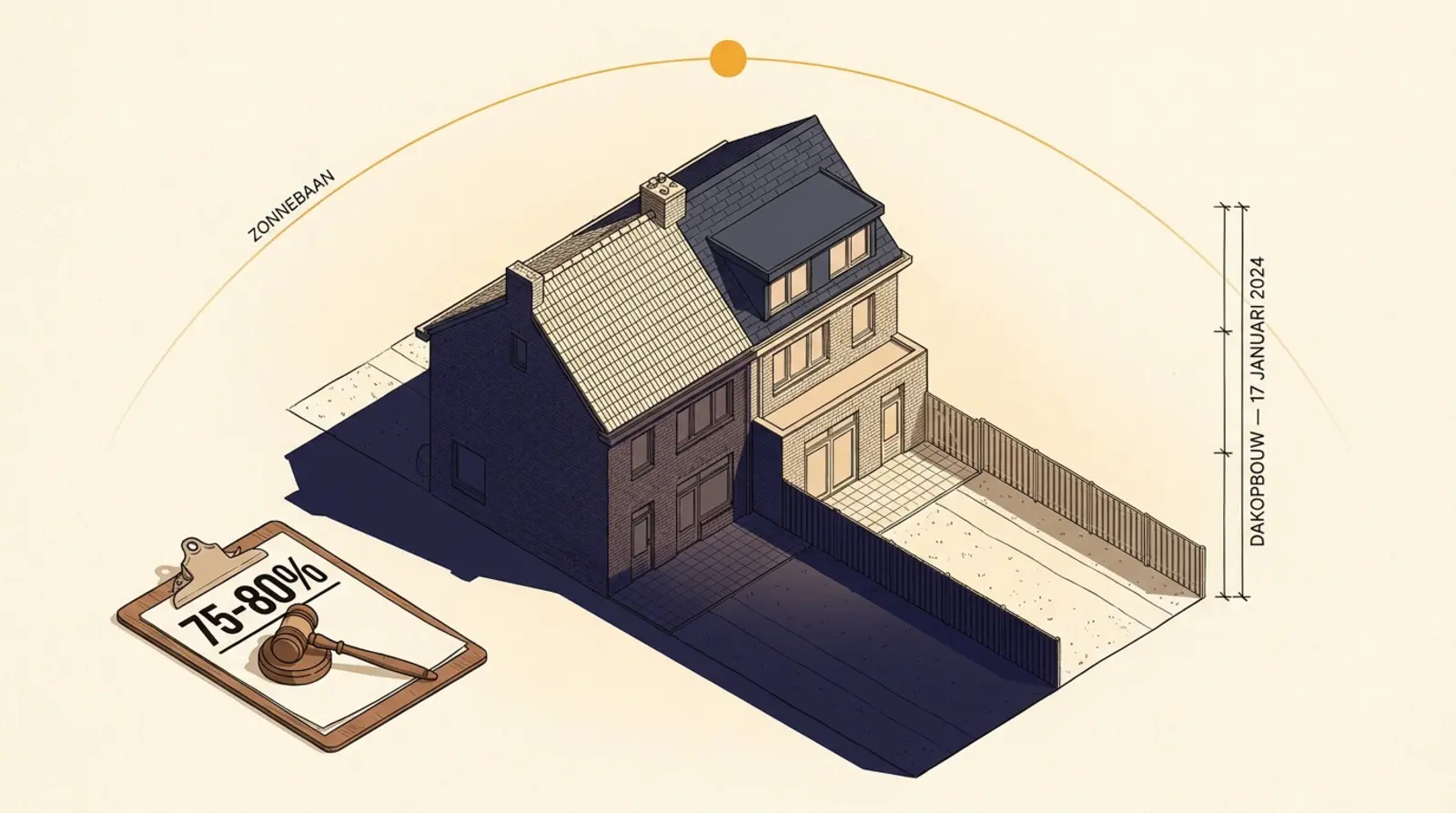
Shadow from a roof addition is legally unlawful when the loss of sunlight materially harms normal enjoyment of the home. On 17 January 2024 the District Court of The Hague ordered demolition at 75 to 80% sunlight loss — even with a valid permit, under Article 5:37 and Article 6:162 of the Civil Code.
Objections & legal
Objecting to a neighbour's building permit: the steps
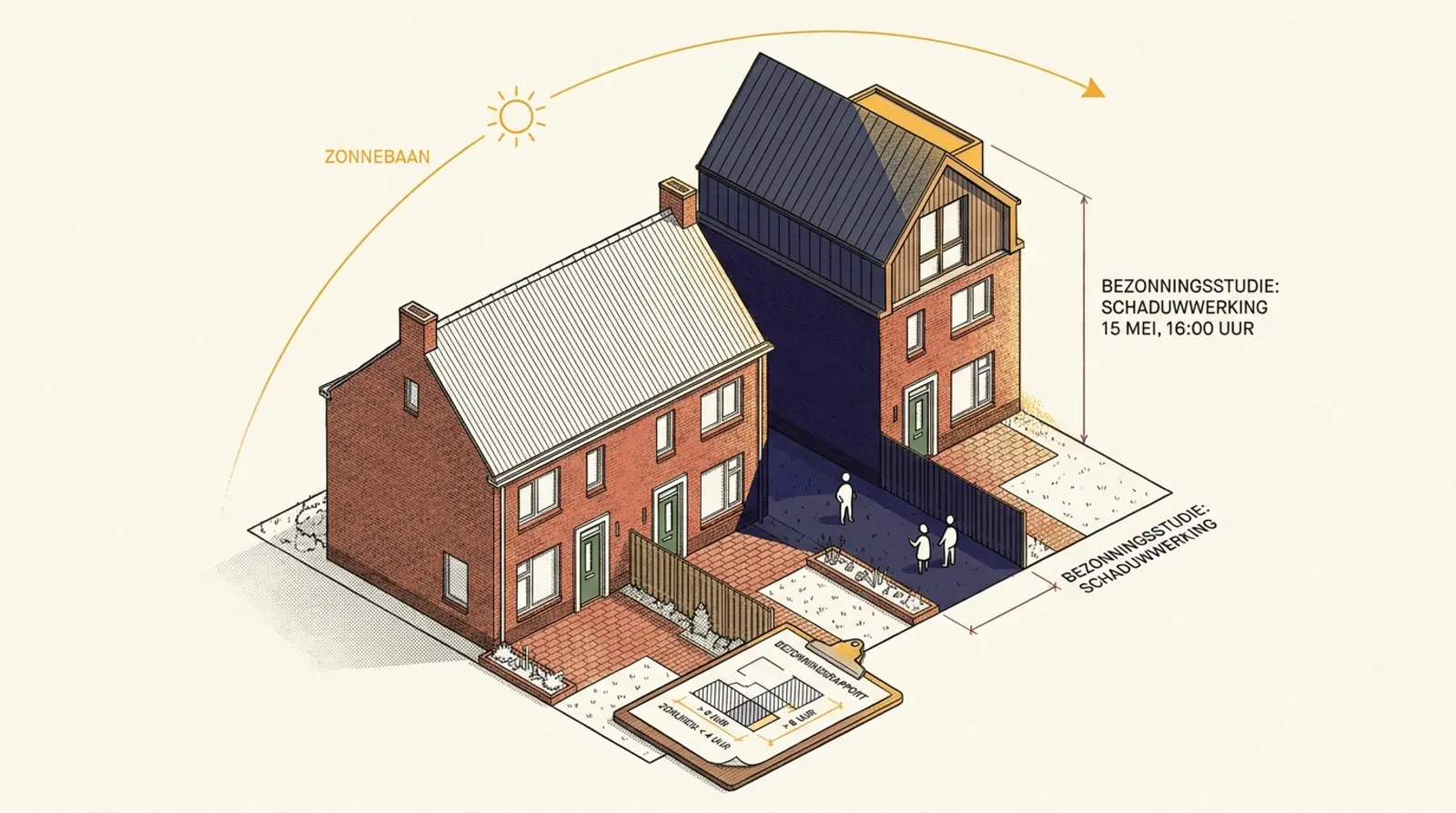
An objection based on gut feeling rarely succeeds. This step-by-step plan shows how, within six weeks, you use 3DBAG, BAG and AHN4 to quantify exactly how many sun hours you lose — the evidence on which the District Court of The Hague ordered a roof addition demolished at 75 to 80% sunlight loss on 17 January 2024.
Standards & municipalities
Sunlight and Dutch neighbour law: which rules apply
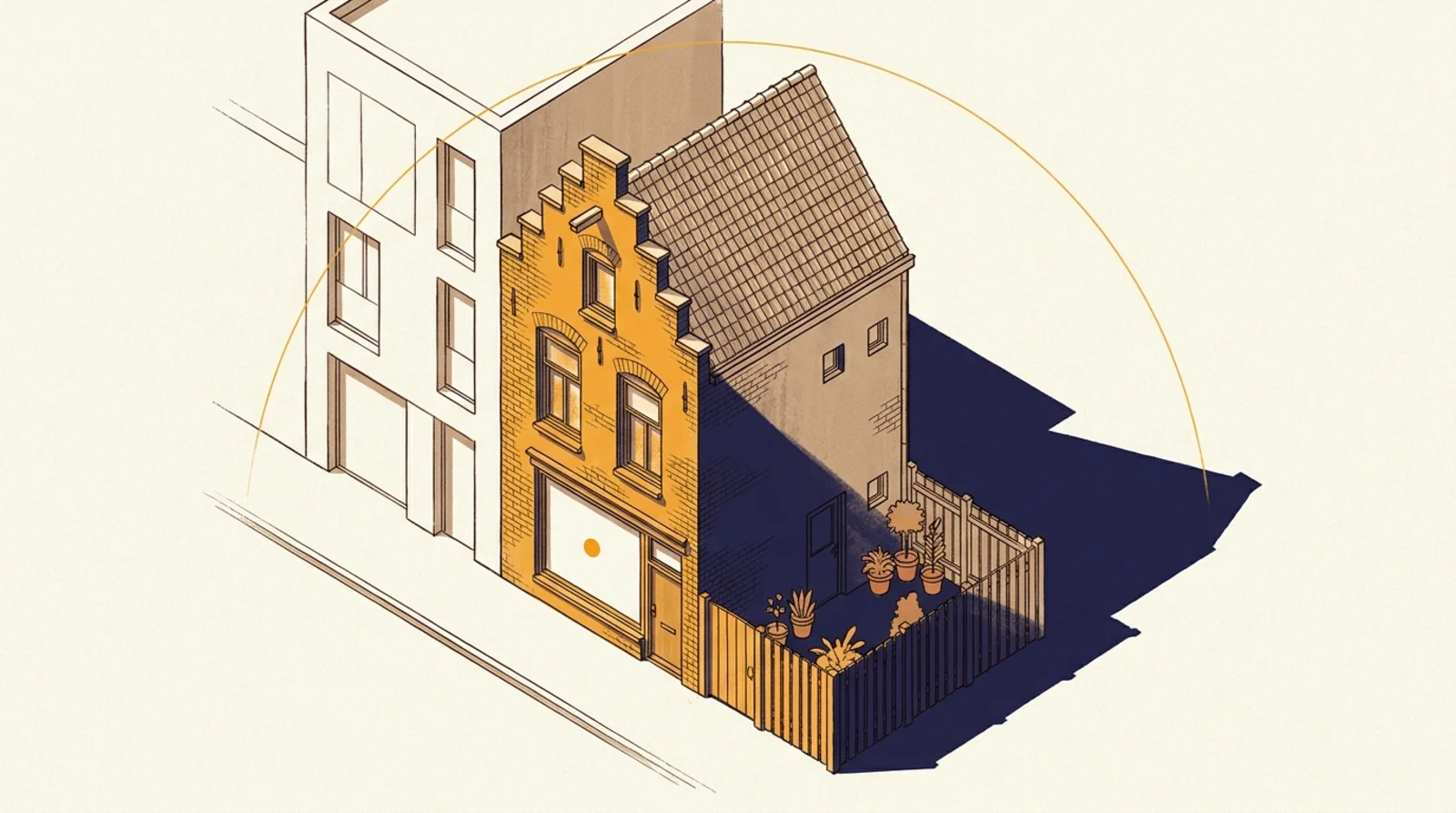
Three separate frameworks govern sunlight at a home. Sunlight access (the TNO standard) is a guideline, not a law. Daylight (Articles 4.146 and 4.147 of the Building Works Environment Decree) is the only one written into national law. Neighbour law (Article 5:37 of the Civil Code) governs unlawful nuisance. Window size counts for daylight, not for sunlight access.