Technology & data
How the sun moves across your garden, by season
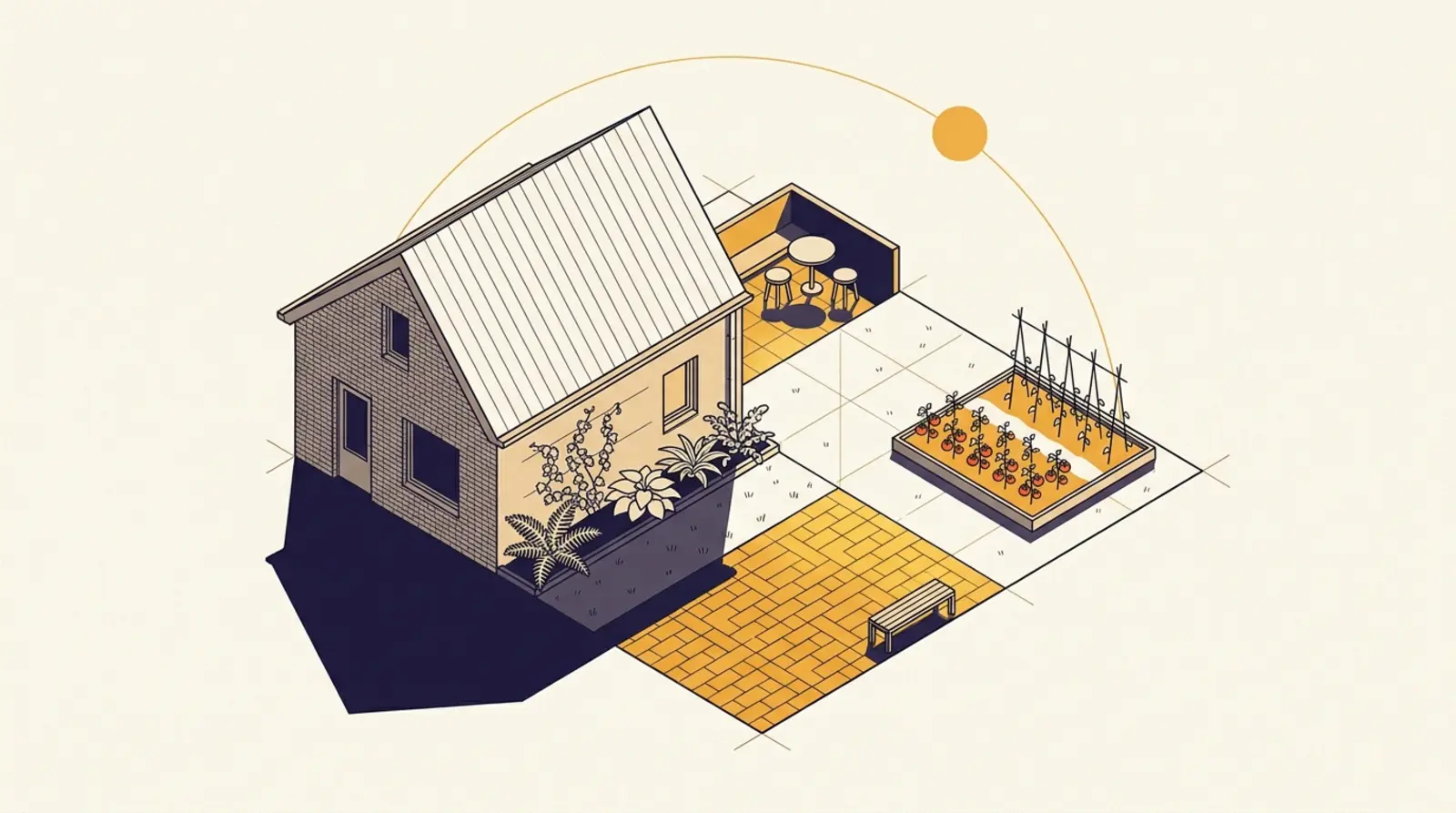
In the Netherlands the sun moves from east through south to west and stands due south around midday. Only its height changes: on 21 June it reaches 61 degrees in Amsterdam, on 21 December 14 degrees. This article gives the sun position per reference day and shows how much of that sun your garden actually keeps.
How does the sun move across your house and garden?
In the Netherlands the sun moves from east through south to west, and stands due south around midday every day of the year. Only its height changes with the season: on 21 June the sun in Amsterdam reaches 61 degrees above the horizon, on 21 December 14 degrees. Every sun position in this article is calculated with SunCalc, the sun-path library Schaduwplan itself uses.
Where the sun rises and sets shifts with it. On 21 June the sun in Amsterdam rises in the north-east (azimuth 48°) and sets in the north-west (312°): an arc of 264 degrees, a good part of which lies in the northern half of the sky. On 21 December it rises in the south-east (129°) and sets in the south-west (231°), an arc of just over 101 degrees. That difference is why a north-facing garden gets morning and evening sun in June and not a minute of it in December.
Latitude matters little within the Netherlands. On 21 June the sun reaches 62.6 degrees in Maastricht and 60.2 degrees in Groningen; on 21 December 15.7 against 13.3 degrees. Two degrees across the length of the country. What does matter is what stands around your house.
Sun position by season: how high does the sun get in the Netherlands?
The sun position in the Netherlands runs from 14 degrees around the winter solstice to 61 degrees around the summer solstice. That height determines how long shadows become. A house nine metres tall casts a midday shadow of 5.0 metres on 21 June and 35.6 metres on 21 December: more than seven times as long. The table below gives the four reference days for Amsterdam, in clock time (summer or winter time as it applies that day).
| Reference day | Sunrise (azimuth) | Highest position | Sunset (azimuth) | Day length | Midday shadow of a 9 m house |
|---|---|---|---|---|---|
| 21 March | 06:42 (89°, east) | 37.8° | 18:55 (272°, west) | 12 h 13 min | 11.6 m |
| 21 June | 05:19 (48°, north-east) | 61.1° | 22:07 (312°, north-west) | 16 h 48 min | 5.0 m |
| 22 September | 07:27 (88°, east) | 38.0° | 19:42 (272°, west) | 12 h 15 min | 11.5 m |
| 21 December | 08:49 (129°, south-east) | 14.2° | 16:29 (231°, south-west) | 7 h 41 min | 35.6 m |
For plant choice these are the four days you want to measure. They split the growing season into quarters and show the two extremes your garden design has to live with. The TNO sunlight standard that municipalities use for permits picks different reference days (19 February, 21 June and 21 October), because that standard looks at living rooms rather than vegetable beds.
How much sun does my garden get?
How much sun your garden gets depends on three things: the direction your garden faces, what stands directly around it, and how tall that is. A 50 m² south-facing garden in Maastricht with low buildings around it can receive 2,000 direct sun hours a year. The same garden facing north with the neighbours’ detached house alongside it stays below 400 sun hours a year. The national average in the Netherlands, according to KNMI data, is around 1,800 sun hours.
Those numbers say something different from what the sun does at a specific spot in your garden. You are asking not only “how much sun does my plot get”, but “does that corner at the back of the garden where I want to plant a grape vine get enough sun to produce fruit?”. That is a point question, not a plot question. For that point question general climate data does not work; you need a 3D model of your house and surroundings plus an hour-by-hour sun-path calculation for every day.
How to see the sun position at your own address
A national sun-position table tells you where the sun is, not what stands between the sun and your terrace. That second answer comes from a 3D model of your own neighbourhood. In the free Schaduwplan viewer you can watch the sun move through the day at your own address, with the neighbours’ buildings at their real heights. It takes three steps.
- Enter your address. The viewer loads the 3D model of your house and the surrounding buildings from 3DBAG, with heights from AHN.
- Pick a reference day from the table above and drag the time slider. The shadow travels across your garden on screen.
- Place measurement points where your questions are. Per point you get the sun duration on the chosen day.
If this is not about plant choice but about a building plan next door or a permit application, the sun duration on one reference day is the start and not yet the substantiation. For that you can commission a sunlight study, which puts the situation before and after the building plan side by side and tests it against the TNO standard.
Full sun, partial shade, shade: what those categories really mean
Every plant label from Intratuin to Praxis uses the same three or four categories. They are not arbitrary; they correspond to the number of hours of direct sun a plant needs to function healthily during the summer half of the year. The table below is the usual Dutch classification as Tuinieren.nl and Moestuinland apply it.
| Category | Direct sun per summer day | Example vegetables and herbs | Example ornamental plants |
|---|---|---|---|
| Full sun | More than 6 hours | Tomato, pepper, courgette, aubergine, basil | Roses, lavender, coneflower, sage, thyme |
| Partial shade | 3 to 6 hours | Lettuce, radish, spinach, rocket, chives, parsley | Hosta, bergenia, buttercup, hellebore |
| Light shade | 1 to 3 hours | Spinach, spurge, mint, lemon balm | Ferns, astilbe, lady’s mantle, sweet woodruff |
| Full shade | Less than 1 hour | Sorrel, watercress (where moist) | Moss, small ferns, ivy, foxglove |
Important: the number of hours is specific to the summer months. A tomato that has seven hours of sun in July may, in the same spot in May, still be three hours short of adequate light. Plants often do not mind this (they only start to fruit once it is warm enough), but for the flowering times of ornamental plants you do notice it. A classic mistake is to measure on a sunny September day and then say “anything grows here”, while in April the same spot is still in shade two thirds of the time.
How to choose spots for your terrace, vegetable garden and seating area
A garden design stands or falls on the right spot for three functions: the terrace for the evening sun, the vegetable garden for full-sun plants, and the seating area for the morning sun. The ideal spots usually do not clash, but you do want to think it through carefully before you lay paving or dig out an earth bed.
- Terrace. Choose the evening sun. On 21 June, measure between 17:00 and 21:00 how much of the terrace gets direct sun. The ideal terrace orientation in the Netherlands is south-west to west, where the evening sun shines on the terrace for hours. A terrace directly against the rear façade of an east-west-oriented house risks lying entirely in its own shadow from 18:00.
- Vegetable garden. Choose the midday sun. On 21 June, measure between 10:00 and 15:00. Full-sun plants such as tomatoes want continuous sun during those hours. A location that lies in the shadow of the neighbouring house at 10:00 and only gets sun from 11:30 is marginal for fruiting vegetables, excellent for leafy greens.
- Seating area or morning breakfast. Choose the morning sun. On 21 June, measure between 07:00 and 10:00. A spot in the east of your garden that gets sun early is perfect for a small table where you drink your coffee; that same spot is often in shade from 14:00, which gives a cool resting place for the rest of the afternoon.
- Shade border. The north or east side of a tall wall or fence provides constant coolness. Ideal for hostas, ferns, astilbes and other foliage plants that cannot tolerate fierce midday sun.
The north-garden myth: is a north-facing garden a lost cause?
“Nothing grows in a north-facing garden” is one of the most stubborn garden clichés in the Netherlands. Not true. A north-facing garden is lit differently, not without light. The summer half of the year often yields between 400 and 800 direct sun hours, which is ample for a flowering border and a productive leafy-greens vegetable garden. The winter half of the year is shady, but that is less relevant for plant growth because most species are dormant then.
What does work differently in a north-facing garden:
- Direct sun comes mainly early in the morning (from the east) and late in the evening (from the west), not between 10:00 and 16:00. That means cool-loving plants get their sun in the morning and evening and are less prone to stress on hot days.
- Hostas, ferns and shade-lovers thrive exuberantly. A north-facing garden can be a treasure trove for anyone who loves foliage textures.
- Fruiting vegetables (tomato, pepper, aubergine) are possible in pots on the sunniest part, usually near the east or west boundary. Or move them to a windowsill with southern light.
- Vegetable-garden plants that bolt (run to seed, throw up flower stalks) with too much heat actually do well here. A lettuce bed in a sunny south-facing garden bolts within two weeks in July; in a north-facing garden it does not.
The only scenario in which a north-facing garden becomes really difficult: when tall buildings on the south side of your house cast additional shadow over the summer half of the year on top of that. Then you get a garden that receives fewer than 200 sun hours even in June. For situations like that, a concrete 3D calculation per quadrant is the only way to decide whether to replant or simply enjoy the coolness.
How Schaduwplan supports this process
The sun positions in the table above apply to the whole country. What your garden keeps of that sun depends on the buildings around it. Schaduwplan combines the two: the sun path from the SunCalc algorithms, the buildings from 3DBAG, the heights from AHN4. That is the work a garden designer would otherwise spend hours on by hand.
You place measurement points exactly where you have a question: the south-west corner where you are considering a terrace, the middle of the bed where the tomatoes should go, the spot by the back door where the morning table will stand. In the free preview you get, per measurement point, the sunlight duration in minutes on your chosen test date. The full annual analysis (with a heatmap of sunlight across the whole year) is in the PDF report, which you need when you also want to formally record the outcomes, for example with a garden architect or a large-scale vegetable-garden project.
Sources (10)
We back every article with public sources. Click to see all the original documents, rulings and datasets.
Sources (10)
We back every article with public sources. Click to see all the original documents, rulings and datasets.
Data sources
- 3DBAG — 3D models of every Dutch building— TU Delft and 3DGI
- BAG — Key Register of Addresses and Buildings— Kadaster
- AHN4 — Actueel Hoogtebestand Nederland— Rijkswaterstaat and the water authorities
- KNMI climate data — annual sunshine hours per region— Koninklijk Nederlands Meteorologisch Instituut
Gardening and plant knowledge
- Plants and light: full sun, partial shade, shade— Tuinieren.nl compendium
- Vegetable garden in the shade: what can you grow?— Moestuinland.nl
- The north-facing garden: an underrated garden— Groei & Bloei
Sun position and calculation
- SunCalc — algorithm for sun position and azimuth— Vladimir Agafonkin
- Table of sunrise and sunset by date in the Netherlands— tijdzones.com
- Solar position algorithms — ephemeris tables, US Naval Observatory— NASA JPL
Frequently asked questions
- Where is the sun at 13:00?
- At 13:00 the sun in the Netherlands stands between due south and south-south-west. In Amsterdam the compass azimuth is 160 degrees on 21 June (summer time) and 185 degrees on 21 December (winter time). The height varies far more than the direction: 60 degrees above the horizon in June, 14 degrees in December. Calculated with SunCalc, the same sun-path library Schaduwplan uses.
- How can I see the position of the sun at my location?
- Enter your address on Schaduwplan. The tool loads the 3D model of your house and the neighbourhood from 3DBAG and places the sun at the date and time you choose. Drag the time slider and watch the shadow travel across your garden. That works without an account and without payment; you only pay for a report when you download it.
- What do full sun, partial shade and shade mean for plants?
- Full sun: more than six hours of direct sun a day in summer, ideal for tomatoes, peppers, lavender and roses. Partial shade: three to six hours of direct sun, suitable for lettuce, radish, spinach, hosta and ferns. Light shade: one to three hours of direct sun, workable for many leafy greens. Full shade: less than one hour of direct sun, where mosses, ferns and ground covers do best.
- How many hours of sunshine does the Netherlands get on average per year?
- According to KNMI climate data the Netherlands gets around 1,800 hours of sunshine a year on average, with regional differences between 1,650 hours in the south-east and 1,950 hours along the North Sea coast. That is the national average; besides that, how much sun your garden gets still depends heavily on which way your house faces, the surrounding buildings and the height of trees.
- Can I create a vegetable garden on the north side?
- Only to a limited extent. True full-sun plants such as tomatoes and peppers want at least six hours of direct sun and do not do well in a purely north-facing garden, even in June. Leafy greens such as lettuce, spinach and rocket manage on three to four hours of direct sun and do fine in a north-facing garden during the summer half of the year. On a north-facing terrace in the garden (where sun can reach it from the side) a narrow vegetable bed with herbs and leafy greens works excellently.
- Why does my garden get less sun in winter than I would expect?
- Two reasons. First, around 21 December the sun sits at most 14 degrees above the horizon (Amsterdam, 52.37 degrees north latitude), so even small obstacles cast long shadows: a house nine metres tall then casts a midday shadow of 36 metres. Second, the sun’s arc in December is much narrower. The sun rises in the south-east (azimuth 129 degrees), sets in the south-west (231 degrees) and is above the horizon for only 7 hours and 41 minutes. An extension at the neighbours’ that casts no shadow in June does so in December.
- How accurate is the sun-hour calculation on Schaduwplan?
- Sun hours are calculated at hourly intervals across 365 days per point. The sun path is modelled with the SunCalc algorithms, which match the ephemeris tables of the US Naval Observatory at the level of seconds. The buildings around your garden come from 3DBAG (10 million buildings) with AHN4 heights (vertically accurate to 5 cm). Time is computed internally in UTC and converted to CET or CEST for display, with a correct DST transition.
- Should I include trees and fences in the calculation?
- Not by default. Schaduwplan calculates with permanent buildings from 3DBAG. Trees grow, lose their leaves in winter and can be felled, so for a long-term estimate they do not belong in it. For the full-sun period in summer a large beech in the neighbouring garden is relevant; you can add it in a custom scenario. For plant choice it is useful to know both the “worst case” (with tree) and the “best case” (without).
See the sun position at your own address
Enter your address and see in 3D how the sun moves across your garden through the day and through the year. Free preview with the sun duration per measurement point on your chosen test date; the full annual analysis is in the report. No account needed.
Read more
Technology & data
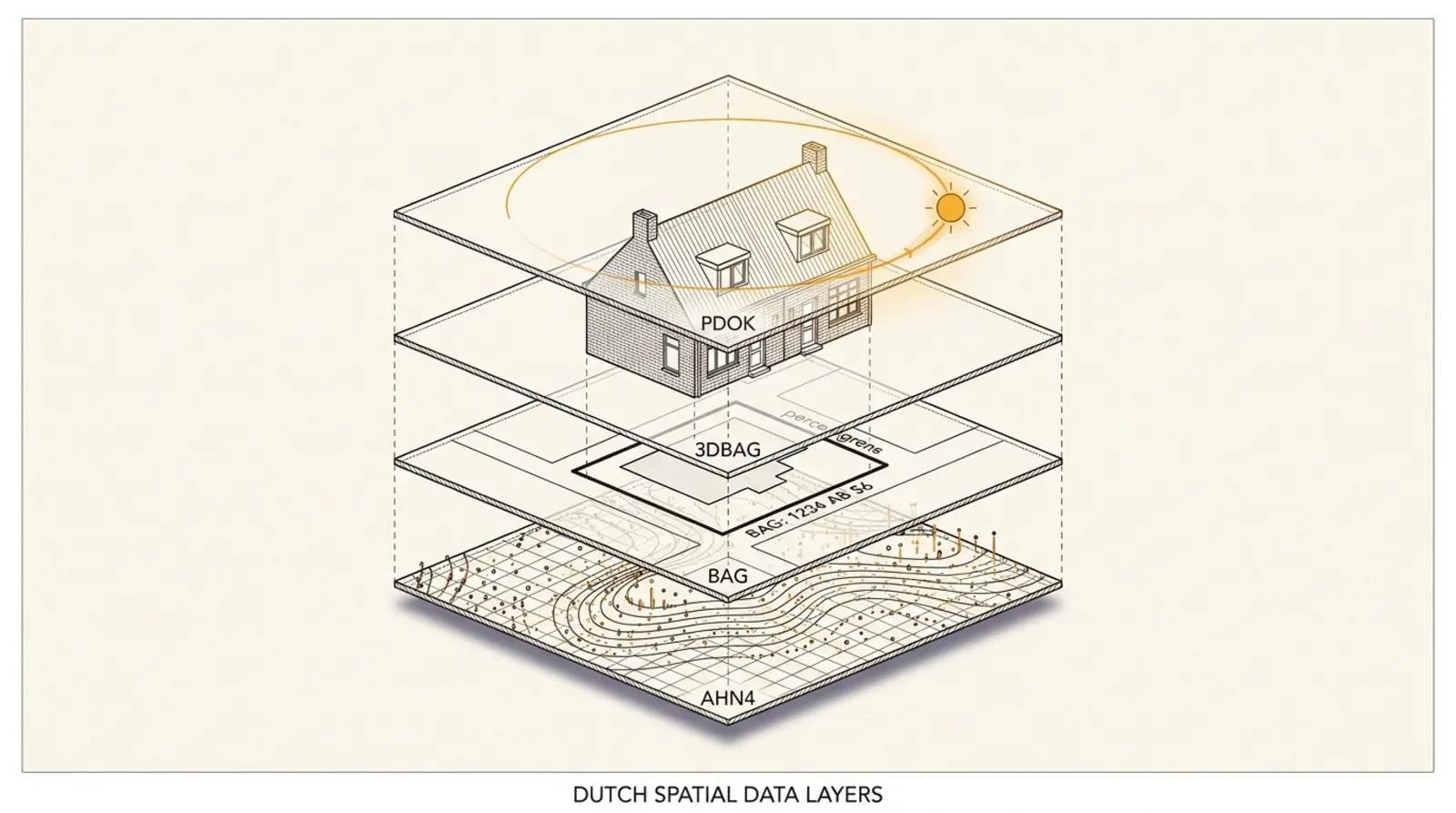
Which data does Schaduwplan use? 3DBAG, BAG, AHN4 and PDOK
Schaduwplan runs on four open government sources: 3DBAG for 3D building models, BAG for address and parcel data, AHN4 for ground and object heights, and PDOK for geocoding. The same data that professional firms and the Council of State accept, with quarterly updates and vertical accuracy down to 5 cm.
Standards & municipalities
Sunlight and Dutch neighbour law: which rules apply
Three separate frameworks govern sunlight at a home. Sunlight access (the TNO standard) is a guideline, not a law. Daylight (Articles 4.146 and 4.147 of the Building Works Environment Decree) is the only one written into national law. Neighbour law (Article 5:37 of the Civil Code) governs unlawful nuisance. Window size counts for daylight, not for sunlight access.
How Schaduwplan works
Verifying a sunlight report: how to check it is genuine
Every Schaduwplan PDF carries a unique SHA-256 hash that we publish at the moment of issue on schaduwplan.nl/verify. A judge, lawyer or neighbour can confirm in under thirty seconds that the file has not been altered since issue, without having to trust us. As far as we know, no other sunlight-study provider in the Netherlands does this.